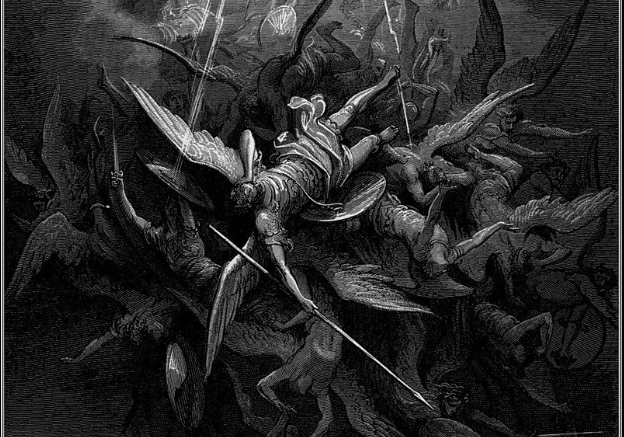
If the Bible were like the comic book industry, the book of Jude would be Moon Knight.
It’s super obscure. It references a lot of weird mythology. It feels pretty psychedelic in its language and imagery. And it often gets unfairly compared to a bigger, more popular franchise (in Moon Knight’s case, Batman; in Jude’s case, 2 Peter).
Okay. I probably just lost a lot of you with that SUPER nerdy comparison. If you happened to understand it, you’re my people. If not, don’t worry about it.
The point is, I love the book of Jude despite it being one of the shortest, weirdest, and most frequently overlooked parts of the Bible.
I love the evocative metaphors Jude uses (angels chained in the nether-gloom! Wild, foaming waves of the sea!). I also love how Jude writes with a pastor’s heart. According to verse 3, he interrupted his plans of writing a more formal theological treatise when he found out his friends were in danger from spiritual abusers. He recognized that the practical needs of his community were the first priority.
But at the same time, I also find myself frustrated by Jude. He’s long been a bit of a pebble in my shoe, constantly but almost imperceptibly bugging me.
You see, in making his argument, Jude relies heavily on extrabiblical, apocryphal material (the lost ending to The Testament of Moses in verse 9; the Jewish mythology of the fallen “Watchers” from 1 Enoch in verses 6 and 14-15).
And he doesn’t do this in the same way that, say, Paul quotes pagan philosophers in Acts 17:28 or Titus 1:12. No, Jude uses these apocryphal stories as illustrations of God judging evil in history. He appeals to them as “biblical” lessons right alongside his other Old Testament references.
And in doing so, he opens a pretty big can of worms for those of us trying to understand how Scripture works as being divinely inspired or as a closed canon.
Verses 14-15 really are the kicker for me. Jude quotes 1 Enoch 1:9 as if it were an actual, God-inspired prophecy from the ancient patriarch Enoch. The guy from Genesis 6, who lived all the way back before Noah’s Flood.
…Suuuure, Jude.
Scholars are pretty much agreed that 1 Enoch was written no earlier than around the 200s BC. It’s one of the most famous examples we have of Second-Temple Jewish writings where some anonymous writer (or writers) put an apocalyptic prophecy into the mouth of an ancient, long-dead patriarch.
And unless you’re Ethiopian Orthodox, it’s not considered canonical Scripture.
But to all appearances (and despite how often conservative readers quickly brush past it), Jude treats 1 Enoch 1:9 as a valid prophecy, on par with canonical Old Testament prophecies.
Does that mean 1 Enoch should be considered Scripture? The majority of the church throughout history has said no. It has largely been recognized as being an apocryphal, non-historical, non-“inspired” work.
But the story told in 1 Enoch is deeply embedded into the conceptual world that Jude and his audience took for granted. And Jude, at least, seems to have thought it was inspired in some way. That’s definitely the impression his words and argument give off, if we take his text at face value.
Some have tried to explain this by arguing that maybe this one specific part of 1 Enoch that Jude quotes actually does go all the way back to Enoch himself, passed down orally through hundreds of generations until it was written down. But this idea strains credulity far too hard. It strikes me as special pleading — a desperate attempt to avoid admitting Jude made a mistake when he claimed Enoch prophesied this text.
What if we just chalk it up to Jude quoting something he knew was legendary, but that his audience respected and valued? Is he just being cheeky here? Is this the same thing as if I quoted a line from Batman to a group of comic book fans?
I used to think for a long time that this was the best solution to this puzzle and tried to get on with my life. But the problem is, again, that the actual text on the page of Jude describes the words of 1 Enoch 1:9 as an authoritative prophecy. Not just a cool quote from an interesting book, but a word from the Lord.
So what do I do with that?
Well, in many ways it’s still a pebble in my shoe. Perhaps we’ll ruminate on it further in a later post.
See you down the path.


 Theology Pathfinder
Leave a reply to RT Cancel reply