Tag: Second Temple Judaism

  • Christians, Don’t Ignore How Weird the Book of Jude Is

    Christians, Don’t Ignore How Weird the Book of Jude Is

    If the Bible were like the comic book industry, the book of Jude would be Moon Knight

    It’s super obscure. It references a lot of weird mythology. It feels pretty psychedelic in its language and imagery. And it often gets unfairly compared to a bigger, more popular franchise (in Moon Knight’s case, Batman; in Jude’s case, 2 Peter).

    Okay. I probably just lost a lot of you with that SUPER nerdy comparison. If you happened to understand it, you’re my people. If not, don’t worry about it.

    The point is, I love the book of Jude despite it being one of the shortest, weirdest, and most frequently overlooked parts of the Bible. 

    I love the evocative metaphors Jude uses (angels chained in the nether-gloom! Wild, foaming waves of the sea!). I also love how Jude writes with a pastor’s heart. According to verse 3, he interrupted his plans of writing a more formal theological treatise when he found out his friends were in danger from spiritual abusers. He recognized that the practical needs of his community were the first priority.

    But at the same time, I also find myself frustrated by Jude. He’s long been a bit of a pebble in my shoe, constantly but almost imperceptibly bugging me. 

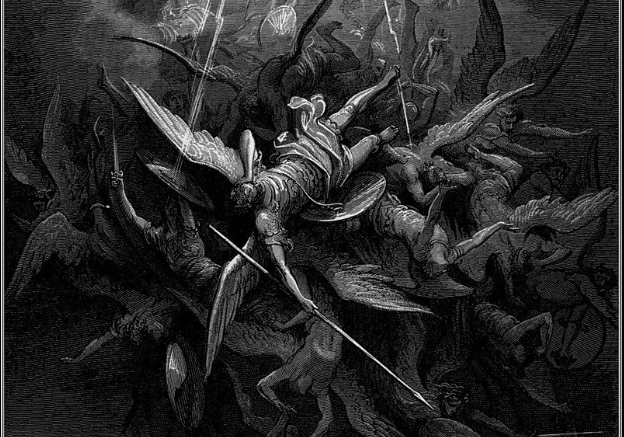
    You see, in making his argument, Jude relies heavily on extrabiblical, apocryphal material (the lost ending to The Testament of Moses in verse 9; the Jewish mythology of the fallen “Watchers” from 1 Enoch in verses 6 and 14-15). 

    And he doesn’t do this in the same way that, say, Paul quotes pagan philosophers in Acts 17:28 or Titus 1:12. No, Jude uses these apocryphal stories as illustrations of God judging evil in history. He appeals to them as “biblical” lessons right alongside his other Old Testament references. 

    And in doing so, he opens a pretty big can of worms for those of us trying to understand how Scripture works as being divinely inspired or as a closed canon.

    Verses 14-15 really are the kicker for me. Jude quotes 1 Enoch 1:9 as if it were an actual, God-inspired prophecy from the ancient patriarch Enoch. The guy from Genesis 6, who lived all the way back before Noah’s Flood. 

    Suuuure, Jude.

    Scholars are pretty much agreed that 1 Enoch was written no earlier than around the 200s BC. It’s one of the most famous examples we have of Second-Temple Jewish writings where some anonymous writer (or writers) put an apocalyptic prophecy into the mouth of an ancient, long-dead patriarch. 

    And unless you’re Ethiopian Orthodox, it’s not considered canonical Scripture. 

    But to all appearances (and despite how often conservative readers quickly brush past it), Jude treats 1 Enoch 1:9 as a valid prophecy, on par with canonical Old Testament prophecies.

    Does that mean 1 Enoch should be considered Scripture? The majority of the church throughout history has said no. It has largely been recognized as being an apocryphal, non-historical, non-“inspired” work.

    But the story told in 1 Enoch is deeply embedded into the conceptual world that Jude and his audience took for granted. And Jude, at least, seems to have thought it was inspired in some way. That’s definitely the impression his words and argument give off, if we take his text at face value.

    Some have tried to explain this by arguing that maybe this one specific part of 1 Enoch that Jude quotes actually does go all the way back to Enoch himself, passed down orally through hundreds of generations until it was written down. But this idea strains credulity far too hard. It strikes me as special pleading — a desperate attempt to avoid admitting Jude made a mistake when he claimed Enoch prophesied this text. 

    What if we just chalk it up to Jude quoting something he knew was legendary, but that his audience respected and valued? Is he just being cheeky here? Is this the same thing as if I quoted a line from Batman to a group of comic book fans?

    I used to think for a long time that this was the best solution to this puzzle and tried to get on with my life. But the problem is, again, that the actual text on the page of Jude describes the words of 1 Enoch 1:9 as an authoritative prophecy. Not just a cool quote from an interesting book, but a word from the Lord.

    So what do I do with that?

    Well, in many ways it’s still a pebble in my shoe. Perhaps we’ll ruminate on it further in a later post.

    See you down the path.

  • Views on Hell in Ancient Judaism

    Views on Hell in Ancient Judaism

    Beliefs about the nature of hell have always been diverse. This was the case even in ancient Judaism before and during the time of Jesus, as well as in early Christianity. For those who are curious, here’s a small sampling of some ancient Jewish writings on hell. These writings are from the time just before and during the ministry of Jesus and the writing of the NT (c. 200 BCE to 100 CE), so they can help give us a bit of a window into the cultural context and show us what prevailing opinions might lie behind what the NT authors wrote.

    This list is far from exhaustive, as I’m by no means an expert in this arena, but it should be enough to demonstrate that there wasn’t a unanimous tradition on the subject even in those early days other than that God would, in fact, judge unrepentant sinners with some kind of fiery punishment in the afterlife. Opinions differed on the nature of the punishments in hell, as well as their duration (eternal torment vs. eventual annihilation).


    Second-Temple Jewish literature on hell: [1]

    The popular Jewish book of 1 Enoch (compiled in parts from around 200 BCE until around 100 CE) speaks a lot about the bad fate coming to sinners on the day of God’s judgment. It is difficult to say with certainty whether the book as a whole envisions the wicked suffering torment forever after the final judgment, or merely suffering for a time and then being annihilated, but the balance seems to me to skew toward the latter.

    For instance, 1 Enoch 22:10-11 might suggest eternal torment: “in like manner, the sinners are set apart when they die and are buried in the earth and judgment has not been executed upon them in their lifetime, upon this great pain, until the great day of judgment–and to those who curse (there will be) plague and pain forever, and the retribution of their spirits. They will bind them there forever…”

    But other passages suggest annihilation, such as 1 Enoch 38:1, 5-6: “When the congregation of the righteous shall appear, sinners shall be judged for their sins, they shall be driven from the face of the earth…. At that moment, kings and rulers shall perish, they shall be delivered into the hands of the righteous and holy ones, and from thenceforth no one shall be able to induce the Lord of the Spirits to show them mercy, for their life is annihilated.” Similarly, 1 Enoch 91:14 speaks of the wicked being “written off for eternal destruction.”

    Still other passages in the middle of 1 Enoch speak of the wicked being led away from God’s presence and destroyed on the day of judgment, with language like the wicked “vanishing away from before [God’s] face,” being chained and imprisoned, and being “cast into the furnace of fire” (1 Enoch 53:2-3; 54:1-6; 62:11-13; 63:1-12).

    Then in 1 Enoch 108:3-4, the wicked are presented as spiritually perishing in fire, crying and lamenting as they burn away: “As for you, wait patiently until sin passes away, for the names of (the sinners) shall be blotted out from the Book of Life and the books of the Holy One; their seeds shall be destroyed forever and their spirits shall perish and die; they shall cry and lament in a place that is a chaotic wilderness and burn in the fire…” This final statement on hell in 1 Enoch sounds pretty annihilationist to me, but I suppose it could be debated.

    Later on, in a separate work by a different author called 2 Enoch (late 1st century CE), eternal torment is very clearly expected for the wicked. See 2 Enoch 10:2-3“every kind of torture and torment is in that place, and darkness and gloom. And there is no light there, but a black fire that blazes up perpetually, and a river of fire is coming out over the whole place, with cold ice; and places of detention and cruel angels and carriers of torture implements, tormenting without pity.”

    Going back to the first century before Christ, the apocryphal book of Judith also promotes eternal conscious torment: “Woe to the nations that rise up against my people! The Lord Almighty will take vengeance on them in the day of judgment; he will send fire and worms into their flesh; they shall weep in pain forever (Judith 16:17, NRSV).

    In the Dead Sea Scrolls, 1QS 4:11-14 (2nd century BCE?) puzzlingly describes the fate of the wicked as both eternal torment and extinction or annihilation: “And the visitation of all who walk in this spirit shall be a multitude of plagues by the hand of all the destroying angels, everlasting damnation by the avenging wrath of the fury of God, eternal torment and endless disgrace together with shameful extinction in the fire of the dark regions. The times of all their generations shall be spent in sorrowful mourning and in bitter misery and in calamities of darkness until they are destroyed without remnant or survivor” (source). Perhaps we should understand “eternal torment” here more along the lines of “torment in the future age,” culminating in annihilation? (If you happen to be a Qumran expert reading this, please weigh in.)

    Turning to the years in which the NT was being written, a Jewish writer called Pseudo-Philo (70-100 CE?) argues that the wicked dead will waste away in the underworld until the final judgment, where they will be annihilated forever: “And their dwelling place will be in darkness and the place of destruction; and they will not die but melt away until I remember the world and renew the earth. And then they will die and not live, and their life will be taken away from the number of all men” (L.A.B. 16:3).

    In a passage that’s dated to around the end of the first century CE, the Ascension of Isaiah 4:14-18 depicts unbelievers (followers of Beliar, aka Satan) as being blasted by fire from the Lord which “will consume all the impious, and they will become as if they had not been created.” Sounds pretty clearly like annihilation to me.

    But another first century work, 4 Maccabees, expects eternal conscious torment. A martyr declares to his murderers, “In return for this, justice will hold you in store for a fiercer and an everlasting fire and for torments which will never let you go for all time” (4 Macc 12:12).

    And in 100 CE, the book of 4 Ezra 7:32-38 describes “the furnace of Hell” into which the ungodly are cast into “fire and torment” that never end. 4 Ezra 7:80-87 details these torments, including their jealousy over the delight that righteous people experience in heaven, and their shame for rejecting God.

    So what’s the upshot of all this?

    Well, this look at early Jewish views on hell, while brief and incomplete, is at least enough to show that there were proponents of both annihilationist and eternal conscious torment views in the Second-Temple period (when Jesus and the apostles ministered). Thus, it doesn’t seem to be the case that we can say, authoritatively, that one or the other of these views was the dominant or prevailing view at the time — at least, not from what I can see.

    So when it comes time to do the work of interpreting what the New Testament teaches about hell, we can’t just appeal to “the prevailing understanding of hell at the time” to settle the issue. People of faith had varying perspectives even then. We have to carefully exegete each text on its own terms. But we can talk more about that later.

    See you down the path.


    [1] For nerds like me who are interested, I’m using the translations and approximate dates of Jewish works from James H. Charlesworth’s The Old Testament Pseudepigrapha, 2 vols.