Tag: church history

  • Early Christians Debated How to Interpret Genesis, Too

    Early Christians Debated How to Interpret Genesis, Too

    For many folks with a little exposure to church history, this is actually old news. Discussions of how to interpret the early chapters of Genesis are as old as Christianity.

    But since I’ve been reading through the major theologians of the early church lately, I thought I’d share some of their more interesting quotes on the subject to demonstrate that differences of opinion on how God created are not to be treated as a matter of essential importance for salvation.

    St. Augustine: “Don’t weigh in if you’re ignorant of science!”

    Let’s start with this favorite of mine from St. Augustine of Hippo, written around AD 398:

    “Whenever I hear a brother Christian talking in such a way as to show that he is ignorant of these scientific matters and confuses one thing with another, I listen with patience to his theories and think it no harm to him that he does not know the true facts about material things, provided that he holds no beliefs unworthy of you, O Lord, who are the Creator of them all. The danger lies in thinking that such knowledge is part and parcel of what he must believe to save his soul and in presuming to make obstinate declarations about things of which he knows nothing.” (Confessions, Book 5, Ch. 5).

    In other words, Christians shouldn’t be weighing in on scientific matters about which they really aren’t sufficiently qualified. Much less should they treat their theories as essential to salvation.

    Augustine’s advice feels all the more relevant today. In another chapter of his Confessions, he mentions that the early chapters of Genesis are so dense and rich with ideas that he can’t help but feel like readers shouldn’t limit themselves to just focusing on the one “original meaning” of the text:

    “…since I believe in these commandments, and confess them to be true with all my heart, how can it harm me that it should be possible to interpret these words in several ways, all of which may yet be true? How can it harm me if I understood the writer’s meaning in a different sense from that in which another understands it? All of us who read his words do our best to discover and understand what he had in mind, and since we believe that he wrote the truth, we are not so rash as to suppose that he wrote anything which we know or think to be false” (Conf. 12.18).

    Notice that Augustine is not so flippant as to suggest that we can read whatever we want out of the text; he does acknowledge that there was an intended meaning to it. But at the same time, he has no problem admitting that the “literal” or “original” meaning is not the only layer that matters, and that truth is multifaceted.

    As he goes on to say in the next chapter, “For the great truth, O Lord, is that you made heaven and earth” (Conf. 12.19). That is the essential doctrine; the bottom line we must all agree on.

    Here Augustine lines up well with the creeds of the church, which say we must believe in “God Almighty, Creator of heaven and earth,” but do not hold us to a specific view on how he created, or how long ago.

    Origen of Alexandria: “All of Scripture has a spiritual meaning, but not all of it has a bodily meaning.”

    Prior to Augustine, we find the influential theologian Origen of Alexandria (c. AD 230) vehemently denying that everything in Scripture is to be taken literally:

    “For who possessed of understanding will suppose that the first and the second and the third day, evening and morning, happened without a sun and moon and stars? And that the first day was as it were also without a sky? And who is so foolish as to suppose that God, after the manner of a human farmer, planted a paradise in Eden towards the east, and placed in it a visible and perceptible tree of life, so that one tasting of the fruit by bodily teeth would obtain life, and again that one could partake of good and evil by chewing what was received from the tree there? And if God is said to walk in the paradise in the afternoon, and Adam to hide himself behind the tree, I do not think that anyone doubts that these figuratively indicate, through apparent narratives and through things that did not happen bodily, certain mysteries.” (On First Principles, trans. by John Behr, 4.3.1).

    Origen makes clear that his intention is not to say that the Bible is never talking about actual history (Princ. 4.3.4). Rather, like any good biblical scholar, he says we must carefully search and investigate the Scriptures, as well as history and science, to discover whether a given passage is discussing literal history or is conveying spiritual truths through the use of myth or legend (4.3.5).

    Lest people cry foul, keep in mind that Origen’s principles here were not out of left field for ancient Christianity! He was regarded as the greatest teacher of biblical interpretation and theology by such crucial later theologians as St. Athanasius and St. Gregory of Nazianzus — men largely responsible for mainstream Christianity’s understanding of the doctrine of the Trinity.

    Though Origen was later accused of heresy after his death, it was not because of his biblical hermeneutics, but because certain groups of people grossly misinterpreted some of his other, more sophisticated ideas. His point about being sensitive to the different genres of biblical texts is timelessly important.

    St. Irenaeus of Lyons: “Day” Can Mean a Long Age

    Still earlier than Origen, writing around AD 180, St. Irenaeus of Lyons remarks that in his day, many Christians were of differing opinions as to whether the word “day” in Genesis 1 should be taken as referring to exactly 24 hours or as a symbol for a longer age of time, since verses like Psalm 90:4 and 2 Peter 3:8 affirm that to God “a thousand years are like one day” (Against Heresies, 5.23.2). 

    While Irenaeus himself preferred the more literal interpretation (5.28.3), he in no way implies that this was a matter of importance for one’s salvation, or that those who held to a “day = age” theory were somehow undermining the gospel.

    He is clear that it was a matter of opinion, about which people can disagree and discuss to their hearts’ content, but certainly shouldn’t divide the church over.

  • The Earliest Church Fathers on Election and Predestination (Part Two: Apostolic Fathers)

    The Earliest Church Fathers on Election and Predestination (Part Two: Apostolic Fathers)

    Christians have long wrestled with the subject of how God’s plans and actions in salvation interact with human responsibility and choice. And it is common for proponents of any theological system to appeal to the writings of theologians from the early church to support their views. After all, we should pay attention to how those who learned the gospel within a generation or two from Christ’s apostles talk about salvation, seeing as they are closer to the source.

    In the previous post, we looked at the writings associated with Clement of Rome, one of the earliest sources outside of the New Testament. Today we’ll turn our attention to the rest of those writings traditionally labelled the Apostolic Fathers.

    The Epistles of Ignatius of Antioch (around AD 110)

    Ignatius was bishop of the church in Antioch, and was famously martyred in Rome in the early years of the second century. On his way to martyrdom, he wrote seven letters to churches throughout the empire. These letters are primarily situational and practical, and as such they don’t delve too deeply into theological topics like election. But there are still numerous incidental references to it.

    In several of the letters’ openings, Ignatius refers to his audience as those who are elect of God. He writes that the church at Ephesus was “predestined before the ages for lasting and unchangeable glory forever, united and elect through genuine suffering by the will of the Father and of Jesus Christ our God” (Ephesians, Salutation). [1] Ignatius seems to take a very high view of God’s action in choosing his church, more so than what we saw in the Clementine writings.

    This does not mean, however, that Ignatius thinks God’s actions leave no room for human choice, or that God limits his grace only to a select few. He encourages prayer for all non-believers (“the rest of humankind”), “that they may find God, for there is in them hope for repentance” (Ephesians 10:1). In Ephesians 14:1-2 the bishop speaks of faith and love as necessary conditions for salvation: “faith is the beginning and love is the end. …For the work is a matter not of what one promises now, but of persevering to the end in the power of faith.” Elsewhere he writes that the life of Christ “is not in us unless we voluntarily choose to die into his suffering” (Magnesians 5:2).

    We also find again in Ignatius’s writings (as in Clement’s) several statements that seem to imply that individual believers must ratify their elect status through their lifestyle, and can only reach final salvation if they persevere in faith — and, as Ignatius in particular loves to emphasize, if they remain in union with the church under the authority of their bishop! He says in Ephesians 4:2 that church members must work toward unity and mutual submission “in order that [the Father] may both hear you and, on the basis of what you do well, acknowledge that you are members of his Son. It is, therefore, advantageous for you to be in perfect unity, in order that you may always have a share in God.”

    Nonetheless, Ignatius affirms that it is by God’s preparative grace that believers can, indeed, do the work of God: “because you are stones of a temple, prepared beforehand for the building of God the Father, hoisted up to the heights by the crane of Jesus Christ, which is the cross, using as a rope the Holy Spirit; your faith is what lifts you up, and love is the way that leads up to God” (Ephesians 9:1).

    Polycarp, Bishop of Smyrna, Letter to the Philippians (around AD 110)

    Polycarp was the bishop of the church in Smyrna, a personal friend of Ignatius, and a disciple of the apostle John — quite a strong pedigree for this church father! We have only one surviving document from him — a letter to the church in Philippi, written on the occasion of Ignatius’ death.

    Polycarp is very beholden to Paul’s epistles, especially the pastorals. He builds most of the core of his teaching off of Paul’s instructions about church order and leadership qualifications from 1 Timothy. Along with that, he uses Pauline phraseology to refer to salvation, as when he writes: “knowing that by grace you have been saved, not because of works, but by the will of God through Jesus Christ” (1:3).

    He also maintains the balance of NT soteriology (and aligns closely with all the other Fathers) by stressing that faith must persevere and bear fruit to be genuine and result in final salvation:

    “But the one who raised him from the dead will raise us also, if we do his will and follow his commandments and love the things he loved, while avoiding every kind of unrighteousness…” (2:2).

    “If we please him in this present world, we will receive the world to come as well, inasmuch as he promised that he will raise us from the dead and that if we prove to be citizens worthy of him, we will also reign with him — if, that is, we continue to believe” (5:2).

    For Polycarp, as it was for Paul, faith is not just mental assent but a continuing loyalty or faithfulness. Final salvation is, again, contingent on perseverance in the faith.

    Also I should mention one unique use of election terminology in Polycarp’s epistle. In 1:1, he speaks of Christians suffering persecution (likely with his recently-martyred friend, Ignatius, in mind) as those “confined by chains suitable for saints, which are the diadems of those who are truly chosen by God and our Lord.” In other words, those who are willing to suffer the ultimate test for their faith are seen by Polycarp as having undoubtedly proven their elect status.

    The Epistle of Barnabas (between AD 70 and 132)

    The document traditionally called the “Epistle of Barnabas” is actually an anonymous tract that appears to have been composed to demonstrate how Christians are distinct from mainstream Judaism and, in fact, the true beneficiaries of the Jewish scriptures and covenants. With that focus, the concept of election comes to the fore in a few places.

    A couple of passages in Barnabas connect election to God’s foreknowledge of those who would believe in Christ. The first is in chapter 3:

    “So for this reason, brothers and sisters, the one who is very patient, when he foresaw how the people whom he had prepared in his beloved would believe in all purity, revealed everything to us in advance, in order that we might not shipwreck ourselves as proselytes to their law” (3:6).

    The last phrase is significant, in that it brings up the danger of returning to traditional Judaism as a way in which the elect could potentially “shipwreck” their faith (compare Hebrews 6:1-6; 1 Timothy 1:19). But also note that God’s work of preparing people through Christ (“his beloved”) is involved in their coming to faith. The other passage that mentions God’s foreknowledge is 6:14, which speaks of God fulfilling the prophecy of Ezekiel 11:19 and giving new hearts of flesh to those “whom the Spirit of the Lord foresaw.”

    The phraseology here in Barnabas is quite pregnant, and leaves open to interpretation how much emphasis we should give to God’s work of preparing people vs. his foreknowing of people’s faith. However, other passages in Barnabas make quite clear that human volition is a major deciding factor.

    In keeping with the rest of the Apostolic Fathers, the author of Barnabas once again displays the idea that final salvation can be missed if Christians do not persevere in faith and good works, or if they fall into error. Indeed, Barnabas is even more extreme on this point.

    The author himself is merely “hoping to be saved” (1:3). Believers should “give very careful attention to our salvation, lest the evil one should cause some error to slip into our midst and thereby hurl us away from our life” (2:10). In 19:1 he says that “if any desire to make their way to the designated place, let them be diligent with respect to their works.” And in 21:6, he says we must be “seeking out what the Lord seeks from you and then doing it, in order that you may be found in the day of judgment.”

    To drive the point home, the failures of Israel in the OT are held up as the key example of the danger of apostasy — even for those who are called! — in chapter 4:

    “Let us never fall asleep in our sins, as if being ‘called’ were an excuse to rest, lest the evil ruler gain power over us and thrust us out of the kingdom of the Lord. Moreover consider this as well, my brothers and sisters: when you see that after such extraordinary signs and wonders were done in Israel, even then they were abandoned, let us be on guard lest we should be found to be, as it is written, ‘many called, but few chosen’” (4:13-14).

    Thus Barnabas, perhaps more than any other of the writings of the Apostolic Fathers, seeks to enforce the idea that the believer’s calling is conditional and must be maintained through much effort in order to ensure final inclusion among the elect (compare 2 Peter 1:10).

    The Shepherd of Hermas (between AD 90 and 154)

    The last text we’ll examine today is The Shepherd of Hermas, a complex writing that contains a mix of apocalyptic and allegorical visions intended to promote ethical living in the church. The Shepherd was one of the most popular Christian works in the first few centuries of the church, though we know little about its author other than that he appears to have been a Gentile freedman living in or near Rome and involved with the church there.

    Some of the earliest Church Fathers (including Irenaeus, Clement of Alexandria, and Origen) treated Hermas as authoritative Scripture, and even Athanasius (who was highly influential in shaping the canon as we know it) encouraged new believers to read it as discipleship material. (The analogy I’ve often heard is that The Shepherd of Hermas is a bit like an ancient equivalent to The Pilgrim’s Progress.)

    Seeing as it focuses more on Christian ethics and growth in virtue, Hermas does not discuss the topics of election or predestination in any great detail. But when the topic of salvation is discussed, the emphasis is almost entirely on the side of human volition. Indeed, one of the most striking teachings of the book is that if people “repent with all their heart, they will be enrolled with the saints in the books of life” (Vision 1.3:2). [2] According to Hermas, God gives repentance to those he foresees are “about to serve him with all their heart” (Similitude 8.6:2). Thus, there is no doubt that whoever wrote Hermas believed salvation was contingent on human choice.

    That doesn’t mean God’s grace is absent from the discussion. God is said to have, in his mercy, “instilled righteousness in you in order that you may be justified and sanctified from all evil and all perversity” (Vision 3.9:1; cf 4.3:5). However, and in keeping with every other writing thus far, perseverance in this sanctity is necessary in order to reach final salvation (Vision 1.3:4; 2.3:2; Mandate 7.1; 8.7-12; Similitude 6.1:3; 8.8:2; 8.11:1). Mandate 10.2:5 even warns that continued sin might cause the Holy Spirit to leave a believer! According to Similitude 8.6:3, God’s seal on believers can be broken. Hermas mentions apostasy and blasphemy against the Spirit as being the unforgivable sins (Similitude 6.2:3; 9.26:5; cf. Hebrews 6:1-6; 1 John 5:16).

    In Vision 3 chapter 8, Hermas sees a vision of different Christian virtues personified as women building a tower. The first and foundational virtue is Faith, and “through her God’s elect are saved” (Vision 3.8:3). However, the other virtues are described as also being necessary in order for one to be included in the church and final salvation. Faith must be supplemented with and expressed through a life of virtue (compare 2 Peter 1:3-11; see also Vision 4.2:4; Similitude 9.13:2).

    In a later passage, Hermas is told to go and preach “to all people, in order that they may repent and live to God, for the Lord in his compassion sent me to give repentance to all, though some, because of their deeds, do not deserve to be saved” (Similitude 8.11:1). In other words, the offer of salvation is universal. In that same verse, we’re told that God “wants those who were called through his Son to be saved,” implying in context that even those who are called could miss salvation if they don’t repent in time (much like in Barnabas).


    Thus, we may notice a trend in each of the writings from the century after the New Testament was written: all of these Christian thinkers viewed the believer’s calling and election as something that was contingent on their choices. One’s willingness to live a life of obedience to God in Christ and to persevere in the faith was the deciding factor, and even the most sincere believer could be at risk of failing to attain final salvation by committing apostasy.

    While none of the Apostolic Fathers writes in any kind of detailed, systematic fashion about how election works or whether God’s initial justification of a Christian is unconditional, they unanimously assert the contingency of final salvation. And their understanding of God’s offer of repentance is that it is genuinely universal, extended to all people and effective for those who believe (which is foreknown by God).

    When we turn in a future post to look at the early Christian Apologists from the second century, such as Justin Martyr and Irenaeus, we will see an even more explicit emphasis on this universal offer of salvation and the freedom of humanity to accept or reject it. Indeed, in the face of the prevailing Greek notions of Fate, the Christian Apologists’ constant refrain will be that every person is responsible for his or her own choices, “for there is no coercion with God.”


    [1] All quotations of the Fathers are from Michael W. Holmes, The Apostolic Fathers: Greek Texts and English Translations, 3rd ed. (Baker Academic, 2009).

    [2] The Shepherd of Hermas is divided into three sections — the Visions, the Mandates (or Commandments), and the Similitudes (or Parables). Citations of Hermas typically include references to these divisions, with chapters and verses in each Vision, Mandate, or Similitude (e.g., Vision 1, chapter 3, verse 2).

  • What Did Worship Look Like in the Early Church?

    What Did Worship Look Like in the Early Church?

    In my recent deep-dive back into church history, one of the things I’ve been most interested in is learning more about what early Christian worship looked like.

    There’s certainly a lot we can learn simply from reading the New Testament. By surveying the various depictions in the book of Acts, as well as the references to Christian practices in the epistles, we can piece together quite a rich picture.

    But we can also expand that picture when we learn more about the cultural background of first-century Judaism and the broader Greco-Roman society. After all, the New Testament assumes a lot of cultural background that most twenty-first century Christians know nothing about or don’t always appreciate enough — especially the Jewish background of the earliest Christ-followers.

    Without that context, we can easily glance right past important details in Scripture. That was definitely my experience. And as I’ve gone back and learned more about things like first-century synagogue practice and the writings of the earliest Church Fathers about ancient Christian worship, I find myself excited by the richness of what we can piece together about how the first Christians “did church,” so to speak.

    To get started, let’s look at one of the most detailed New Testament passages about early Christian worship: Acts 2:42-47.

    Devoted to the Prayers

    The passage starts by saying that the first Christians “devoted themselves to the apostles’ teaching and fellowship, to the breaking of bread and the prayers” (Acts 2:42, NRSV).

    Now right here we run into an issue because some popular translations (like the NIV, NLT, and NASB) say that they devoted themselves simply “to prayer.” But the Greek text reads “the prayers” (as the NRSV, ESV, and others rightly translate). This language suggests that the disciples were committed to some form of set prayers in a more liturgical context.

    And that would make perfect sense considering these Jewish disciples were used to ritual prayer in the synagogues every Sabbath. Jesus himself gave his disciples one example of such a set prayer (the “Lord’s Prayer,” in Matthew 6:9-13). Notice also that Acts 3:1 continues the story by reporting that the apostles Peter and John went to the Jerusalem Temple “at the hour of prayer.”

    Jewish customs from the Temple and synagogues form an important backdrop to our knowledge of early Christian worship, so it’s worthwhile to know a little about those customs.

    Jews worshiped every Sabbath (our Saturday), with fixed patterns including the reading of Torah (on a one-year or three-year lectionary cycle) and of the prophets, usually followed by a sermon on the day’s readings (see Luke 4:16-21). There were also formal prayers and blessings recited. As church historian Oskar Skarsaune points out,

    “In the days of Jesus the wording and sequence of the elements of the synagogue service had attained such stability that we are fully justified in speaking of a synagogal liturgy. The echoes of the synagogal prayers in the Lord’s Prayer and other early Christian prayers demonstrate that this liturgy was well known to Jesus and the early disciples. We should not think that the early Christians were antiliturgical in their worship gatherings.” — In the Shadow of the Temple: Jewish Influences on Early Christianity (InterVarsity Press, 2002), 125.

    So as we read the New Testament, it’s vital to keep in mind that the first Christ-followers did not immediately cease to be Jewish. They didn’t drop all of their traditions and customs in favor of a new and completely spontaneous faith.

    That said, with the arrival of the New Covenant brought about by Christ’s ministry, there were certainly some things that changed. Especially now that the Holy Spirit had been poured out upon all of Christ’s followers (see Acts 2:1-4, 38-39), we quickly begin to see movement away from the Levitical system of sacrifices in the Temple and a re-centering around the meal table in homes, where Christ’s ultimate sacrifice was remembered in the Lord’s Supper or Eucharist (more on that below).

    There was also an extremely early, if not immediate, shift from worshiping on the Jewish Sabbath (the seventh day of the week) to worshiping on “the Lord’s Day,” or Sunday (the first day of the week), in honor of Jesus’ resurrection on a Sunday. We see this evidenced in Acts 20:7, 1 Corinthians 16:2, and Revelation 1:10; see also Justin Martyr’s First Apology, in chapter 67: “But Sunday is the day on which we all hold our common assembly, because it is the first day on which God, having wrought a change in the darkness and matter, made the world; and Jesus Christ our Saviour on the same day rose from the dead.”

    Teaching, Fellowship, and Breaking Bread

    Since ancient Jews tended to mark sundown as the start of the day, it’s possible that the first Christians actually gathered in the evening to share a meal and participate in worship. This would mean that what we consider Saturday night was actually the start of their Sunday.

    Interestingly, we see in 1 Corinthians 11:21, 33-34 that the apostle Paul had to rebuke certain Christians for refusing to wait until the whole church was gathered before starting the common meal. Many Gentile Christians in the early church would not have had any kind of day off from their labor, and so the poorer members of the community would be coming in after work later than those who were well-to-do.

    The church’s fellowship meals may have been something like a potluck, where everyone was supposed to contribute what they could for the benefit of all. These were sometimes referred to as “love-feasts” (Jude 12). Acts 2:44-45 describes how ancient Christians who had an excess would give generously to support fellow believers who had need (see also 2 Corinthians 8-9). Deacons (the Greek word for “servants”) and deaconesses were appointed to help facilitate the meal and to ensure that food was distributed to those who were unable to be there in person (see Acts 6:1-7; Romans 16:1; Philippians 1:1; 1 Timothy 3:8-13).

    During these gatherings, there would be public reading of Scripture, followed by a lesson or sermon, much like in synagogue practice (see 1 Timothy 4:13), along with the singing of psalms and hymns (1 Corinthians 14:26; Ephesians 5:19; Colossians 3:16) and the sharing of prophetic words with interpretations (1 Corinthians 14:26). If a church community happened to receive a letter from an apostle (or later, a regional bishop like Clement or Ignatius, etc.), it would be read publicly for the congregation’s instruction (see Colossians 4:16; 1 Thessalonians 5:27).

    At the high point of the meal would be the celebration of the Lord’s Supper/Eucharist, in which Christ’s sacrificial death was memorialized. Whoever was presiding over that local church gathering (an elder/priest — Greek presbyteros — see Acts 14:23; Titus 1:5; 1 Peter 5:1) would pray a blessing over the bread and wine and presumably declare Jesus’s words of institution over the sacrament, as well as offer other set prayers of thanksgiving.

    We have an example of such Eucharistic prayers from the first century preserved in the early church handbook called The Didache (or “Teaching”), chapters 9-10:

    “Now concerning the Eucharist, give thanks as follows. First, concerning the cup: We give you thanks, our Father, for the holy vine of David Your servant, which You have made known to us through Jesus, Your Servant; to You be the glory forever. And concerning the broken bread: We give you thanks, our Father, for the life and knowledge that You have made known to us through Jesus, Your Servant; to You be the glory forever. Just as this broken bread was scattered upon the mountains, and then was gathered together and became one, so may Your Church be gathered together from the ends of the earth into Your kingdom; for Yours is the glory and the power through Jesus Christ forever. But let no one eat or drink of your Eucharist except those who have been baptized into the name of the Lord, for the Lord has also spoken concerning this: ‘Do not give what is holy to dogs.’ …But permit the prophets to give thanks however they wish.” — Didache 9; 10:7. Translated by Michael W. Holmes, in The Apostolic Fathers: Greek Texts and English Translations, Third Edition (Baker Academic, 2007), 360-61.

    Following the meal and any concluding prayers or instructions, as well as any additional planning for the financial offerings and food distribution, the congregation would depart. Though in the earliest days described in Acts such meetings took place daily (Acts 5:42; 6:1; 17:11), by the mid-second century they were typically done weekly on Sundays (again, see Justin Martyr, First Apology, 65-67).

    Some Takeaways for Modern Christians

    Obviously there’s a lot more we could talk about when it comes to worship in the early church. Whole books and dissertations have been written on the subject.

    I could mention the layout of Greco-Roman dining rooms and their meal customs. We could dive into the controversies in the early church about whether Christians could eat meat from Gentile markets. If I were really brave, I’d get into the details of Paul’s teaching on the Lord’s Supper in 1 Corinthians 10 and 11 and how he views it as a “participation in the blood… and body of Christ” (1 Cor 10:16) and what all that might or might not entail.

    …But I’ll save those for another day. For now, here are what I would suggest are some key takeaways for modern Christians in light of just this very brief and preliminary survey of worship in the primitive Christian church:

    1. As I mentioned above, we need to keep in mind that the earliest Christians primarily viewed themselves as the Jewish remnant centered around Jesus the Messiah, and as such they tended to carry a lot of continuity with Jewish tradition. They read the Hebrew Scriptures (our “Old Testament”), they prayed Jewish prayers, and they maintained a lot of the patterns and principles of Jewish synagogue worship.
    2. In keeping with that Jewish continuity, liturgical prayer and worship were ingrained in the earliest church. Even though they met primarily in homes (out of necessity more than anything else), the early Christians did not practice a purely spontaneous, purely “charismatic” (in the modern understanding) worship style. However, there certainly were charismatic or spontaneous elements, and prophets were a big deal in the early church. It’s best to view it as a diverse and lively movement. However
    3. The early church was VERY structured and centered when it came to the Lord’s Supper. As 1 Corinthians 10-11 and a great deal of content from the early Church Fathers indicates, the Eucharistic meal was held very highly as the most sacred part of weekly Christian worship, not to be treated lightly.
    4. Financial giving and taking care of the needs of the poor in the church was, from the start, a non-negotiable essential of Christian worship. Contemporary churches would do well to make sure this is kept in mind, and would also do well to evaluate what the model of the early church — where those who had much gave all their excess until no one had need — might have to teach us about wealthy Christian leaders today who flaunt material success.

    I hope this post is helpful to those interested in these kinds of things. If so, let me know in the comments! Lord willing, perhaps I’ll do more deep-dives into the early church’s teachings and practices — and maybe even get into those hotly-debated topics of Eucharist and baptism, if I can work up the courage!

    See you down the path.

  • The Earliest Church Handbook: The Didache

    The Earliest Church Handbook: The Didache

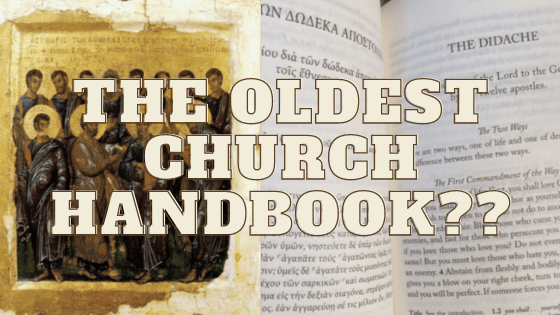
    In this new video post, I’m giving a quick introduction to what is likely the oldest church handbook in history, The Didache (aka the “Teaching” or “Instruction”). This short, ancient text gives us a fascinating window into the everyday practices of earliest Christianity.

    You can read a translation of The Didache online here: https://www.newadvent.org/fathers/0714.htm

  • Getting to Know the Earliest Church Fathers

    Getting to Know the Earliest Church Fathers

    The history of Christianity is long and complex, but as I’ve written previously, there are a ton of reasons why it’s worth getting to know a little more about. Learning how the earliest Christians understood and lived out their faith can help deepen ours.

    In particular, we should ask: How did those who lived closer to the time of the apostles interpret the Scriptures? How did the early church wrestle with doctrinal questions and answer challenges to their faith? Studying all of this will help us get a sense of what really is most essential for Christian belief and practice — what it is that makes up Christian orthodoxy (right belief / right worship) and orthopraxy (right living).

    To that end, I’m going to try to post every so often about some early Christian writings and some of the key insights we can glean from them. They won’t be exhaustive, but hopefully they’ll encourage you to go deeper in your own study of church history.

    Introducing The Apostolic Fathers (c. AD 70-150)

    To start, let’s look at the group of Christian writings that emerged immediately after the time in which the New Testament was written. This collection is commonly referred to as the Apostolic Fathers — so named because they were written by important Christian leaders in the early church (hence the honorific, “fathers”) who were alive early enough to have had a personal connection to Jesus’ apostles.

    This diverse group of writings was produced during the time immediately after the first generation of Christians, and they give us a glimpse into the kinds of issues that most concerned the early church. Most of them were written, in part, out of a concern for maintaining apostolic doctrine and church order now that the original generation of apostles was no longer around to consult on such matters.

    They come in different genres — most of them are epistles, or letter-sermons, in the same vein as Paul’s letters (1 & 2 Clement; The Epistles of St. Ignatius; The Epistle of Barnabas; The Epistle to Diognetus). There is also a handbook for church practice called The Didache. The Shepherd of Hermas is an apocalyptic-prophetic work similar to the book of Revelation. And there’s even a detailed account of an early Christian martyrdom (Martyrdom of Polycarp).

    We find in the Apostolic Fathers several major, repeated themes:

    • A concern for church order and what kinds of leadership should be maintained. With the original apostles gone, church unity hinged on curbing unnecessary divisions and urging individual Christians to unite under faithful leaders. Over time, this led to the formalizing of the office of bishops presiding over churches in different regions.
    • A focus on moral purity among congregations. The pressures of the pagan Roman culture around them presented a great deal of temptation for Christians to commit sinful behavior to blend in, so the Apostolic Fathers placed a great emphasis (some might say too great) on moral purity and virtuous living in the church.
    • Guidance on how believers should relate to outsiders — in particular, Jews (their estranged spiritual brothers) and Romans.
    • The reality of persecution and the possibility of martyrdom. This especially characterizes the epistles of Ignatius, bishop of Antioch, who writes zealously of his willingness and even eagerness to follow his Lord in martyrdom.

    Out of the whole bunch, my personal favorites are the Didache (the earliest surviving manual for church practice) and the Epistle to Diognetus (a stirring defense of the faith, beautifully presenting Christianity as an alternative way of life). The other writings in the collection all have their important perspectives to offer, too, giving us a valuable window into a time when Christians were navigating the very practical and urgent questions of how to keep this fledgling movement going in the midst of persecution from without, dissensions from within, and the ever-present temptation to compromise with the broader culture’s morals and values.

    In the letters of Ignatius of Antioch, who writes while on the way to his own imminent martyrdom, we get passionate pleas for unity under the leaders of the church. He promotes rule by single bishops in each local church, an important step on the way to later “catholic”/episcopal church structure.

    In 1 Clement, we see how a Roman Christian leader attempted to curb schisms in Corinth, where Paul had already been struggling to call the church to order barely a generation prior. 

    The Epistle of Barnabas, for all its strange allegorizing tendencies, represents an early attempt to define Christianity in light of its growing and undeniable distinction from the Judaism from which it grew. 

    The Shepherd of Hermas wrestles with issues of morality and community ethics in the second-century church, clothing its moral instruction in the popular garb of apocalyptic visions and allegories.

    And in The Martyrdom of Polycarp, we experience a gripping, firsthand account of an early Christian martyrdom under Roman persecution.

    It’s certainly true that the theological reflections of these writings are quite underdeveloped compared to the later church fathers and councils, but that’s mainly because they were writing at a time when Christian leaders were responding to urgent, practical needs in an off-the-cuff manner. As such, not everything the Fathers taught would be incorporated into later orthodoxy as it developed and was systematized over time; nor do they quite live up to the heights of the writings that we now recognize as canonical (though some early church theologians considered some of the Apostolic Fathers’ writings as equal to the New Testament!).

    Even so, these are vitally important historical works that I think every Christian ought to at least read once and be familiar with, considering they are the voice of those who passed the torch from the apostles to later generations. They thus serve as a crucial bridge between the New Testament and the later church fathers and theologians. As the great patristic scholar J. B. Lightfoot wrote,

    “There is a breadth of moral sympathy, an earnest sense of personal responsibility, a fervour of Christian devotion, which are the noblest testimony to the influence of the gospel on characters obviously very diverse, and will always command for their writings a respect wholly disproportionate to their literary merits” (The Apostolic Fathers, Part I, 2nd ed. [London: MacMillan, 1890, 1.1.7).

    We can learn a great deal about early Christianity from these courageous figures, and they’re definitely worth the time and effort to read.

    You can find the Apostolic Fathers for free online at the Christian Classics Ethereal Library (ccel.org), or check out the fantastic critical edition by Michael W. Holmes, which includes the original Greek text side-by-side with readable, modern English translations, as well as introductions to each writing. It’s a great resource, highly recommended for pastors, scholars, students, and anyone interested in experiencing firsthand the key documents of the early post-apostolic church.

    Next time we’ll dive in to some of these writings and their teachings more in depth. See you down the path.

  • Why Have Women Traditionally Been Excluded from Ministry? And Other Objections to Women in Ministry Answered (Pt. 4)

    Why Have Women Traditionally Been Excluded from Ministry? And Other Objections to Women in Ministry Answered (Pt. 4)

    So far in this series on women in ministry we’ve talked about my journey with the subject and why I interpret 1 Timothy 2:11-15 as not forbidding female pastors. In the last post I addressed some potential objections to women in ministry from other biblical passages. Now we’ll consider some broader theological questions about men and women, as well as what is the biggest stumbling block for some:


    Why has the church traditionally barred women from the pastorate/clergy for so many centuries?


    Let’s start with that. Because while I absolutely believe that Scripture takes priority over tradition, we should not ignore the importance of tradition for testing our interpretations. If we’re going to throw out a large chunk of historical precedence, we ought to have good reason. And to do so, we need to ask: Why did the tradition rise to prominence, and is it really reflecting biblical truth?

    In this case, we’ve already seen that women held prominent leadership positions during the first century, when the New Testament was written. Junia was an apostle (Rom 16:7), Phoebe was a deaconess (Rom 16:1-2), and Paul considered Priscilla one of his coworkers (Rom 16:3; Acts 18:24-26). This means that any universal bans on women in ministry would have been postbiblical developments.

    So did the earliest churches in the post-apostolic era include female ministers?

    Turns out, many of them did! There is archaeological evidence for female deacons/ministers throughout the first several centuries of the church, as well as written evidence attesting to women in leadership positions.

    In a letter to Emperor Trajan (111 C.E.), the Roman governor Pliny mentions that he obtained information by torturing two Christian women “called by them ‘deaconesses’ (Latin: ministrae).” In the 300s C.E., we find in a Christian letter a curious reference to a woman called “Madame Teacher.” In the fifth century, a woman named Olympias was lauded as a deaconess and founder of a monastery.[1]

    Also in the fifth century, Theodoret of Cyrus makes this interesting comment on Romans 16:7, where the female apostle Junia is mentioned: “…[Paul] says that they are of note, not among the disciples, but the teachers; nor among ordinary teachers, but the Apostles.” In other words, it seems this ancient church father took Paul’s words to be affirming a very authoritative female teacher.

    However, although women often ministered in the earliest churches, there is a noticeable movement toward male-only leadership by the third and fourth centuries that became overwhelmingly dominant throughout the Middle Ages. Why the change?

    According to church historian William Witt, there is one key reason, which he lays out in this excellent article:

    “Historically, there is a single argument that was used in the church against the ordaining of women. Women could not be ordained to the ministry (whether understood as Catholic priesthood or Protestant pastorate) because of an inherent ontological defect. Because of a lack of intelligence, or a tendency to irrationality or emotional instability, a greater susceptibility to temptation, or an inherent incapacity to lead, women were held to be inferior to men, and, thus, were not eligible for ordination. Moreover, this argument was used to exclude women not only from clerical ministry, but from all positions of leadership over men, and largely to confine women to the domestic sphere.”

    Witt goes on to cite a number of comments from prominent church fathers and theologians (including Origen, Tertullian, Chrysostom, Thomas Aquinas, and several Reformers) that clearly exhibit their misogynistic assumptions. These men were deeply enmeshed in the prejudices of their times, so it’s hard to blame them too much.

    But it’s also hard to follow them on this.

    Because the major problem with their line of reasoning is that it is simply not true — women are not inherently intellectually inferior to men. Science doesn’t back it up, experience doesn’t back it up, and Scripture nowhere legitimates such a view (unless we take a wrong view of 1 Tim 2:13-15, as I’ve belabored already).

    So the major flaw with the “argument from tradition” against women in ministry is that the reasoning behind the tradition is flawed. It relies on incorrect assumptions about women that, while common in the ancient and medieval periods, is not exactly in keeping with the truths we see in Scripture and in nature — that women and men are equally created in the image of God (Genesis 1:27), equally redeemed and united in Christ (Galatians 3:28), and equally capable of leading, teaching, and stewarding authority.

    But there were always outliers, in spite of the larger consensus on male priesthood that built up during the medieval period. It simply isn’t true to say that arguments in favor of female ministers only show up after the feminist movement of the modern era. As New Testament scholar Craig Blomberg points out,

    “Some of this history has, in fact, been suppressed during the last century by those who have wanted to pretend that it was only with the rise of modern, secular women’s liberation in the 1960s and 1970s that any churches have opened all leadership doors to both genders. . . . E.g., the facts that the Evangelical Free Church of America ordained women and Moody Bible Institute supported the ordination of women before the fundamentalist-modernist controversy of the 1910s and 1920s.” — Craig L. Blomberg, A New Testament Theology (Baylor University Press, 2018), pg. 286.

    And as Witt concludes in his article,

    “It is all to the good that Catholics and Protestants have embraced the inherent ontological equality of men and women and no longer argue against women’s ordination based on an inherent inferiority, irrationality, or sinfulness of women. However, in so doing, they can no longer argue that they are simply adhering to the church’s historic stance against the ordination of women.”

    In other words, if you don’t think that women are inherently inferior to men, but you still want to exclude women from ministry, then your position technically isn’t the “traditional” one; rather, it’s a quite recent innovation!

    Let’s turn now from the “tradition” issue to some other theological arguments commonly brought up against women in church leadership.


    Broader Theological Arguments Briefly Considered

    #1: God is identified in male terms throughout Scripture, so shouldn’t his representatives be male?

    This potential objection seems incredibly beside the point, since Genesis 1:27 tells us that God created all humanity, male and female, in his image:

    “So God created humankind in his image,
    in the likeness of God he created him,
    male and female he created them.” (LEB)

    Thus, it would seem appropriate that both men and women be able to serve as God’s ministers. I only mention this objection preemptively, as I’ve never found it to be a good support for an all-male pastorate.

    #2: The Old Testament priesthood was restricted to males, so shouldn’t the pastorate be, too?

    Perhaps this question is a little less beside the point, but at the same time, there is considerable discontinuity between the levitical priesthood and the “priesthood of all believers” we see in the New Testament. For example, 1 Peter 2:9 and Revelation 1:6; 5:10; 20:6 refer to all Christians (whether male or female) as priests now.

    Plus, when one considers the importance of ritual purity for priesthood in the ancient Near East, you can see a very practical reason why women were barred from the Israelite priesthood: they would be ritually unclean (and therefore unable to officiate) due to menstruation for an entire week out of every month!

    Under the New Covenant that Christ initiated, such concerns for ritual purity were replaced by an emphasis on moral purity — a purity of the heart. And with that change there is no reason to restrict priesthood in the new temple of God (=the church community; see 1 Corinthians 3:16; Ephesians 2:21-22) — on the basis of gender.

    #3: So then why did Christ only appoint men to be his twelve apostles?

    Jesus certainly took a big step forward from his Jewish contemporaries when he allowed women to follow him and learn as his disciples. That much is largely undisputed. But when it came time for him to choose his primary successors — the twelve apostles — he chose all men. Why not include a woman or two, if he wanted to truly show equality? Doesn’t it mean he wouldn’t support female church leaders?

    Why Jesus chose twelve men is a good question to ask, but as an objection to female pastors it’s actually a flawed argument. Consider how I could turn it on its head by saying, “Well, the twelve apostles were also all Jewish men, so therefore we should never have any non-Jewish church pastors, right??” It’s a non-sequitur.

    This kind of argumentation can also be dismissed when you keep in mind that there is a very important historical reason why Jesus chose men to comprise the Twelve: they were to be a symbolic reenactment of the original twelve patriarchs of Israel, who founded the twelve tribes. By choosing twelve Jewish men in particular to be his inner circle, Jesus was symbolically showing that he was founding the new people of God — the new Zion, the restored Israel — around himself. This action was a powerful messianic claim in and of itself.

    In light of this, it should be clear that the choosing of twelve male apostles was a very unique situation in history — one that shouldn’t factor in to the discussion of whether we can have female pastors today.


    We’re almost done with the topic of women in ministry for now. In my next post I’ll offer a few parting thoughts regarding my change in perspective on the matter, as well as some recommendations for further research in case you’re still wanting to do some more digging.

    Let me know if you’ve found these posts helpful! Have I answered your pressing questions, or do you have others I haven’t covered? Let me know in the comments.

    See you down the path.


    [1] References are from Ruth A. Tucker & Walter Liefeld, Daughters of the Church: Women and Ministry from New Testament Times to the Present (Zondervan: 2010), 91, 94, 120.

  • Women in Ministry, Pt. 3: Addressing Some Biblical Questions

    Women in Ministry, Pt. 3: Addressing Some Biblical Questions

    In my previous post I argued that 1 Timothy 2:11-15 (often viewed as the strongest biblical passage against female pastors) is not a universal, absolute prohibition against women having authority in the church. Rather, it was addressing a particular, local situation in Ephesus at the time it was written.

    But of course, having been brought up to assume that complementarianism was the only possible view, there were still a number of important theological questions I had to work through before I could go from saying, “1 Timothy 2 isn’t a universal prohibition,” to saying, “Women can be pastors, too.”

    My goal in these next two posts is to briefly address what I personally saw as the biggest objections to affirming women at all levels of ministry. In this one we’ll focus on problems arising from specific passages of Scripture; in the next we’ll move on to theological and historical questions.

    I’ll start by answering some common arguments against my proposed reading of 1 Timothy 2:11-15. Then we’ll look at some other key passages of Scripture that pertain to the issue, like 1 Corinthians 14, Ephesians 5, and others.


    Additional Questions About 1 Timothy and Women in Ministry


    Doesn’t Paul’s use of Adam and Eve in 1 Tim 2:13-15 constitute a timeless principle about how men and women were created in hierarchy?

    We touched on this last time, but it deserves a bit more attention. It’s commonly asserted that when Paul says “Adam was formed first, then Eve,” he is setting that up as a basis for a male-dominated hierarchy intended by God at creation. This relates to the ancient idea of “primogeniture,” which is basically the concept that the firstborn had more rights, authority, and inheritance than their younger siblings/peers. Adam was made first, therefore he had authority over Eve.

    But think about this: Even though Adam is given dominion over the animals in Genesis 2 and names them all to show his authority over them, he doesn’t give Eve a name until Genesis 3:20 — after they’ve sinned and God announces that now the man will “rule over” the woman (Gen 3:16). Prior to the Fall, Adam and Eve are entirely equal. She is taken from his side to be his “helper,” a term used elsewhere of military reinforcements and even of God himself (she is hardly man’s subordinate!). And at the very beginning, Genesis 1:27 stresses that “male and female” were both made equally in the image of God to co-rule over creation. It seems pretty apparent, then, that any idea of hierarchy between the sexes is foreign to the context of Genesis 1-2.

    Think about this, too: Throughout the book of Genesis, a common trend we see over and over is God’s choosing of the younger to inherit the covenant blessings instead of the firstborn (Isaac over Ishmael; Jacob over Esau; Judah and Joseph over their older brothers)! In other words, the concept of “primogeniture” is constantly turned on its head throughout the Old Testament, to highlight the fact that God’s ways are different than the ways of worldly society. All the more reason not to read it into Genesis 1-2 or 1 Timothy 2:13-15.

    If Paul is trying to counter the beliefs of the Artemis cult in Ephesus, why doesn’t he come out and say so explicitly?

    Perhaps a lot of confusion could have been avoided if Paul had simply mentioned Artemis outright. Then again, though, it’s precarious for us to cast judgment on what we today think an ancient author could or should have said. We’re talking about letters — and in the case of 1 Timothy, a very personal letter!

    We have only one side of a conversation that took place between two people who were already intimately acquainted with the pressing issues going on at the time of writing. It’s like we’re listening to just one half of a telephone conversation — of course there are going to be bits and pieces of the context that we have to piece together ourselves. This is how good interpretation works, with any ancient text — even Scripture.

    It would have been nice if Paul had spelled out in more detail the kind of false teaching he was arguing against in Colossians, too, for example. Or if the epistle of Hebrews mentioned who wrote it. Or if John told us exactly what the “sin that leads to death” was (1 John 5:16). It would save us a lot of guesswork. But as it is, we have to do the work of piecing together the context as best we can, using the text before us and the insights we can glean from archaeology and historiography.

    How was I supposed to understand 1 Timothy correctly if I didn’t have access to any of this cultural-background information?

    Don’t get me wrong — I believe anyone who is a believer in Christ and has the Holy Spirit guiding them can understand the basic truths of Scripture without having to be an expert in the ancient culture of Ephesus. At the same time, though, remember that it was me looking at how Scripture holds up women in leadership in other passages that made me reexamine whether I was understanding 1 Timothy 2 correctly.

    Not only does Scripture help us interpret Scripture, but part of how Christ builds his church up to maturity is by gifting certain Christians to be teachers, to learn how to interpret the Bible and study the ancient context so they can help other Christians understand it. You don’t have to be an expert, but you can and should avail yourself of resources that go more in-depth for you. That’s what us teachers are for, we who invest our lives in studying Scripture with a view to enriching the life of the church.

    Why does 1 Timothy 3 go on to say that overseers should be “the husband of one wife”? Doesn’t that rule out female overseers?

    It’s true that 1 Timothy 3:2 (CSB) says “An overseer, therefore, must be above reproach, the husband of one wife, self-controlled, sensible, respectable, hospitable, able to teach…” etc. But again, I see 1 Timothy as primarily addressing some serious cultural problems that were arising in the church at Ephesus at the time Paul was writing — problems like the Artemis cult, or false teachers arguing that marriage was forbidden (see 1 Tim 4:3).

    We’ve already seen how Paul’s words in 1 Tim 2 suggest that the women in Timothy’s church in particular were in no shape to be overseers just yet, since they first needed to be taught. Also, we should ask why Paul lists “husband of one wife” before other qualifications you’d think would be even more important — like being self-controlled and able to teach. Obviously there were some serious issues going on concerning marriage in Ephesus.

    Some interpreters even see in Paul’s statement here a suggestion that some of the men in Ephesus were beginning to practice polygamy. But most take Paul’s words to be a generic way of saying that overseers (pastors or elders today) should be faithful to the spouse they have (which is how I interpret it).


    Other Bible Passages Concerning the Roles of Men and Women


    Doesn’t Paul also command women to be silent in church in 1 Corinthians 14:33-36?

    Here’s the passage:

    As in all the churches of the saints, 34 the women should be silent in the churches, for they are not permitted to speak, but are to submit themselves, as the law also says. 35 If they want to learn something, let them ask their own husbands at home, since it is disgraceful for a woman to speak in the church. 36 Or did the word of God originate from you, or did it come to you only?”

    This is another passage that, like 1 Tim 2:11-15, seems pretty straightforward (and pretty harsh!) at first glance. But believe it or not, this is a passage where even more interpreters are convinced Paul was addressing a cultural issue limited to his time period!

    That’s because shortly before this, in 1 Corinthians 11:1-16, Paul gives instructions about how women are to pray and prophesy in the church. His instructions in chapter 14, therefore, have to do with something besides the ordinary exercise of ministry. I should point out that the Greek word for “woman” is also the word used for “wife” (gyne), and the mention of asking “their own husbands” in verse 35 points to seeing only the married women in Paul’s congregations being addressed here.

    The focus, then, is on wives not disrupting the service to ask their husbands questions (or perhaps to challenge their husbands when they prophesy, bringing dishonor on them in public). The fact that women of the time were typically less educated is probably at play again here. Paul’s overarching, universal point is that church services are to be orderly and not clamorous. He was correcting a specific problem that was common at the time, rather than stifling all female speakers forever (otherwise, how could he commend female church leaders like Phoebe, Priscilla, and Junia elsewhere in his writings?).

    What about the passages that command for wives to be submissive to their husbands (Ephesians 5:22-24; Colossians 3:18; 1 Peter 3:1-7)?

    This concept doesn’t necessarily rule out women from serving as pastors, since a woman can be a pastor and still be submissive to her husband. As an analogy, consider that a male pastor could have governing officials in his congregation. The pastor gets to preach the word of God authoritatively to them and shepherd them, but he must still submit to their governing authority in a societal sense. I would imagine a female pastor’s relationship to her husband could function quite well just the same.[1]

    But consider, too, that while Paul does command “submission” in the home, he qualifies it (in Ephesians 5, at least) in a context of “mutual submission” (Eph 5:21). All the commands after verse 21 are grammatically connected to the initial commands to “be filled with the Spirit” (5:18) and to submit to fellow believers. The wives are to respect their husbands as part of their obedience to Christ (“as to the Lord,” v. 22), and the husbands are to “submit” (in a sense) to their wives by loving them sacrificially and nurturing them as they would their own body (5:25-33). This is a remarkably egalitarian family model for the time Paul was writing.

    Even in Colossians 3:18-19 and 1 Peter 3:1-7, where the language of mutual submission is absent, the fact that Paul and Peter give commands to husbands to love their wives was counter-cultural for the time. There is more that could be said on this, but again, the role of husbands and wives in the home doesn’t really have the kind of direct bearing on the topic of women in ministry that some complementarians claim it does.


    For my more egalitarian brothers and sisters in Christ, these may be questions you’ve already considered. But for me, coming from the church background that I did, reading these kinds of verses stirred up so much confusion when I first began this journey. Thankfully, I now see far more continuity with the whole of scripture.

    I’ve landed in quite a different spot than where I began, and hopefully these posts help you to understand why.

    But we’re not done yet! After all, if Scripture doesn’t forbid women ministers, then why is it that women have traditionally been excluded from the pastorate/clergy for the majority of church history?

    We’ll look at that next time!

    See you down the path.


    [1] I didn’t come up with this analogy myself, but I was unable to track down where I first came across it.

  • What Are Scholars Saying About the Holy Spirit? (Reading Reflections on Thiselton)

    What Are Scholars Saying About the Holy Spirit? (Reading Reflections on Thiselton)

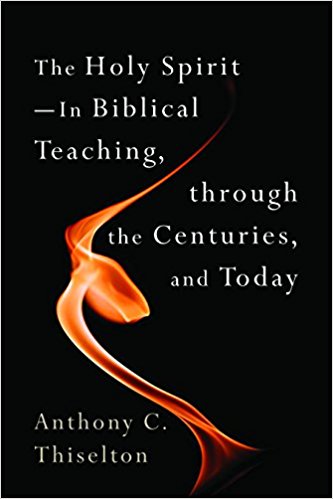
    Thiselton Holy Spirit Cover

    I recently finished reading Anthony Thiselton’s book, The Holy Spirit – In Biblical Teaching, through the Centuries, and Today. It was a fun coincidence that I stumbled across this book when I did. My church had just concluded a sermon series on the Holy Spirit and spiritual gifts, and my wife and I were desiring to dig a little deeper into what scholars are saying about the subject. So of course when I saw this tome sitting on the sale table at my seminary’s bookstore I snatched it up. And I was not disappointed!

    Thiselton is a prominent British theologian famous for his commentary on 1 Corinthians and his books on biblical interpretation, so I already knew this book on the Holy Spirit would reflect a lifetime of serious scholarship. Throughout church history, theologians and ministers have often wrestled with how to understand the person and work of the Holy Spirit, as well as the nature and role of spiritual gifts. Thiselton helps lay a foundation by examining what the Bible says about the Spirit of God before surveying in detail the scholarly conversations about the Spirit from the early church to today. Anyone who wants to become familiar with academic discussions on the Holy Spirit would do well to start here.

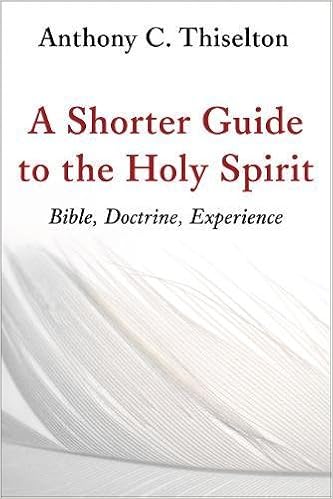
    Now, I have to give one important disclaimer! Clocking in at 500 pages and jam-packed with advanced scholarly interaction, Thiselton’s book is not for the faint of heart! Thankfully, though, he has also produced a condensed, reader-friendly version (link below)!

    Definitely check out the abridged version if you’re interested in learning more about the Holy Spirit, spiritual gifts, or views on the Spirit in church history, and especially if you’re going to be teaching on these topics. It’s a great resource. (I’d only recommend the original version if you’ve already had some exposure to seminary-level research.)


    A Call for Dialogue

    The thing I appreciated most about Thiselton’s book was his commitment to fostering open and respectful dialogue on this controversial topic. Considering how heated the conversations can get when people discuss the nature and role of the Spirit, I loved seeing such a gifted scholar as Thiselton calling for balance and dialogue.

    Among the other things I appreciated in Thiselton’s book:

    • He constantly called for a focus on what Scripture teaches as being of central importance.
    • He was willing to critique the weak points of both cessationists (those who think that the more “showy” gifts like miracles and tongues ceased, either after the first generation of apostles died or after the canon of Scripture was closed), as well as of continuationists/charismatics (like myself) with a gracious attitude. Thiselton shows us all where we need to clarify our thinking, but without vilifying either side.
    • He referenced and quoted from a broad range of voices from all across the theological spectrum and from every era of church history. You get the usual greats – Athanasius, Augustine, Basil, Luther, Calvin, etc., but you also get to hear from lesser-known figures like Hilary of Poitiers, Philoxenus of Syria, and Bonaventure, to name a few. Thiselton also interacts heavily with modern writers like Karl Barth, James D. G. Dunn, Gordon Fee, and many others. This allowed for multiple perspectives to be heard.

    Key Insights I Gleaned

    Here are some of Thiselton’s main points that I think are worth pondering deeply:

    1) The Spirit’s goal is to glorify Christ.

    So, if you want to be more Spirit-led, focus more on Christ (see pp. 70-71).

    2) Your spiritual gifts are not about you.

    Spiritual gifts are not primarily for us as individuals or for our self-fulfillment. They are for the purpose of building up the community of God. “It is not so much a matter of having a gift as of being a gift” (Jean-Jacques Suurmond, quoted on p. 85).

    3) The biblical concept of prophecy can include both “on-the-spot” words from God AND prepared proclamations of the gospel message.

    In Thiselton’s words, “The ‘where and when’ of prophecy, I believe, should not exclude either charismatic spontaneity or prepared, reflective preaching” (p. 176). This means we shouldn’t limit our concept of “prophecy” only to spontaneous utterances, and we should never undervalue the importance of preparation and study in ministry. Dependence upon the Holy Spirit should never be an excuse for such unspiritual qualities as laziness or neglect of learning. At the same time, though, Thiselton rightly affirms that the Lord indeed still speaks fresh words to his people through his Spirit – it’s not an “either/or” situation.

    4) The “gift of healing” is not just miraculous, but also includes giftedness at treating others medically.

    When Paul talks about the gift of healing in 1 Corinthians 12, he specifically mentions (in the Greek) “gifts of healings” (plural!). Thiselton points out that for the majority of church history this has been understood to mean both spontaneous, miraculous recoveries and/or God gifting people with medical skill to treat others (pp. 102-03, 114-20). We shouldn’t make a big divide between God working through more mundane natural processes and God working dramatically or “supernaturally.” Again, it’s not “either/or.”

    5) Being Spirit-led should not be confused with doing what’s new.

    It’s true enough that many churches are unhealthy because they’re tied to dry, religious formalism and rejecting fresh moves of the Spirit. But there’s an equal and opposite danger of being too obsessed with “new” and “fresh,” to the neglect of our past heritage (pp. 484-85). A healthy church learns from the past while being attuned to God’s will for the present. Perhaps you could say we need solid roots in the past along with fresh winds from the Spirit.

    6) A biblical understanding of the Kingdom of God helps us understand why prayers for healing are not always answered the way we might hope.

    This is a complex but important point. Let me try to explain briefly: Through the Spirit’s presence in believers, the Kingdom of God is already present to a degree, and this is why miraculous healings can and should be sought. To deny that God ever miraculously heals in response to prayer is to deny the current inbreaking of God’s Kingdom. But on the other hand, the Kingdom is not yet here in its fullest form – that will only be when Christ returns. It is only then that we will be delivered from all sickness and all death forever. It is not on this side of Christ’s return that we will experience complete and total healing in all cases.

    As Thiselton writes, this concept of the “already/not-yet” of the Kingdom “explains the ambiguity of expectancy and prayer in relation to healings.”

    “Sometimes God allows, as it were, the opening of Christmas presents before Christmas, and heals as if the End were already here. But clearly the end is not yet. . . . It seems a distraction from this important eschatological question to browbeat us with the question: Is it the will of God to heal? Of course it is; but when and where?” (p. 487).

    This last point is a powerful one, and cuts through a lot of the false expectancy taught in so many Pentecostal circles. Again Thiselton hits the nail on the head:

    “If expectancy is raised to a high pitch, there must be a degree of depression and misplaced self-recrimination from those for whom it is claimed that their Christian faith and trust was somehow deficient. If healing were a uniform and universal phenomenon, in cases of disappointment this would make the problem of suffering and evil much more acute” (p. 487).

    In other words, for those who sincerely expected a healing that did not occur, the feeling that their faith was insufficient can cause horrible disillusionment and self-doubt. Yes, God desires to heal – but in some cases that healing only comes on the other side of eternity.

    Those are a few of the many thought-provoking nuggets of wisdom Thiselton offers. What do you think of his observations? Do you disagree with any of them?

    What are your favorite books on the Holy Spirit?

    Let me know in the comments!