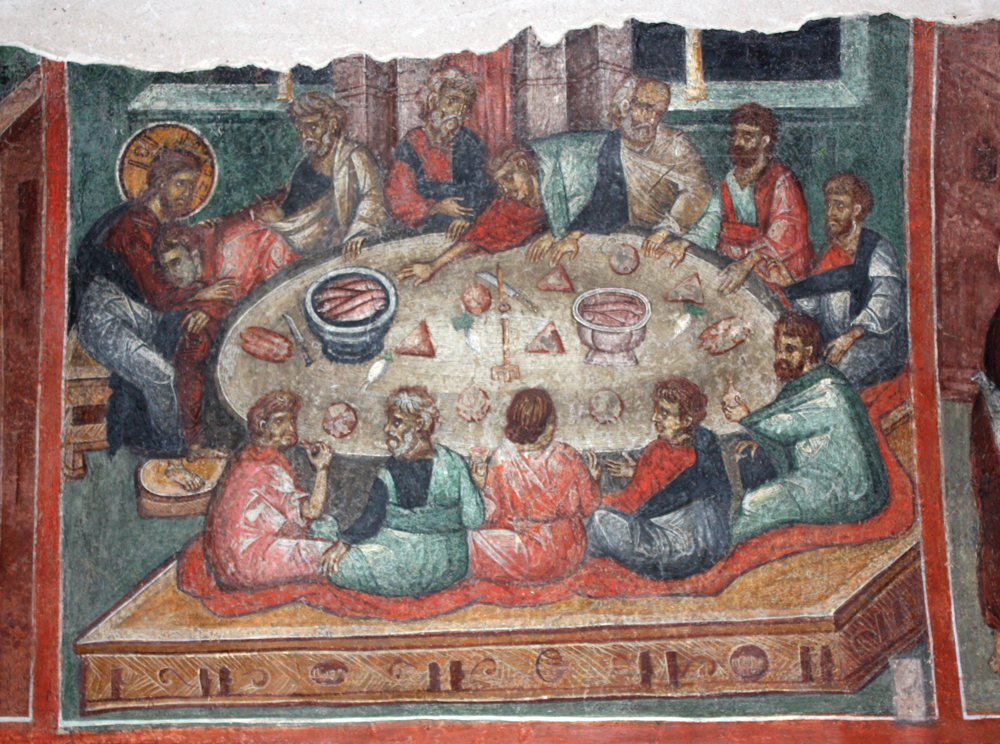
In my recent deep-dive back into church history, one of the things I’ve been most interested in is learning more about what early Christian worship looked like.
There’s certainly a lot we can learn simply from reading the New Testament. By surveying the various depictions in the book of Acts, as well as the references to Christian practices in the epistles, we can piece together quite a rich picture.
But we can also expand that picture when we learn more about the cultural background of first-century Judaism and the broader Greco-Roman society. After all, the New Testament assumes a lot of cultural background that most twenty-first century Christians know nothing about or don’t always appreciate enough — especially the Jewish background of the earliest Christ-followers.
Without that context, we can easily glance right past important details in Scripture. That was definitely my experience. And as I’ve gone back and learned more about things like first-century synagogue practice and the writings of the earliest Church Fathers about ancient Christian worship, I find myself excited by the richness of what we can piece together about how the first Christians “did church,” so to speak.
To get started, let’s look at one of the most detailed New Testament passages about early Christian worship: Acts 2:42-47.
Devoted to the Prayers
The passage starts by saying that the first Christians “devoted themselves to the apostles’ teaching and fellowship, to the breaking of bread and the prayers” (Acts 2:42, NRSV).
Now right here we run into an issue because some popular translations (like the NIV, NLT, and NASB) say that they devoted themselves simply “to prayer.” But the Greek text reads “the prayers” (as the NRSV, ESV, and others rightly translate). This language suggests that the disciples were committed to some form of set prayers in a more liturgical context.
And that would make perfect sense considering these Jewish disciples were used to ritual prayer in the synagogues every Sabbath. Jesus himself gave his disciples one example of such a set prayer (the “Lord’s Prayer,” in Matthew 6:9-13). Notice also that Acts 3:1 continues the story by reporting that the apostles Peter and John went to the Jerusalem Temple “at the hour of prayer.”
Jewish customs from the Temple and synagogues form an important backdrop to our knowledge of early Christian worship, so it’s worthwhile to know a little about those customs.
Jews worshiped every Sabbath (our Saturday), with fixed patterns including the reading of Torah (on a one-year or three-year lectionary cycle) and of the prophets, usually followed by a sermon on the day’s readings (see Luke 4:16-21). There were also formal prayers and blessings recited. As church historian Oskar Skarsaune points out,
“In the days of Jesus the wording and sequence of the elements of the synagogue service had attained such stability that we are fully justified in speaking of a synagogal liturgy. The echoes of the synagogal prayers in the Lord’s Prayer and other early Christian prayers demonstrate that this liturgy was well known to Jesus and the early disciples. We should not think that the early Christians were antiliturgical in their worship gatherings.” — In the Shadow of the Temple: Jewish Influences on Early Christianity (InterVarsity Press, 2002), 125.
So as we read the New Testament, it’s vital to keep in mind that the first Christ-followers did not immediately cease to be Jewish. They didn’t drop all of their traditions and customs in favor of a new and completely spontaneous faith.
That said, with the arrival of the New Covenant brought about by Christ’s ministry, there were certainly some things that changed. Especially now that the Holy Spirit had been poured out upon all of Christ’s followers (see Acts 2:1-4, 38-39), we quickly begin to see movement away from the Levitical system of sacrifices in the Temple and a re-centering around the meal table in homes, where Christ’s ultimate sacrifice was remembered in the Lord’s Supper or Eucharist (more on that below).
There was also an extremely early, if not immediate, shift from worshiping on the Jewish Sabbath (the seventh day of the week) to worshiping on “the Lord’s Day,” or Sunday (the first day of the week), in honor of Jesus’ resurrection on a Sunday. We see this evidenced in Acts 20:7, 1 Corinthians 16:2, and Revelation 1:10; see also Justin Martyr’s First Apology, in chapter 67: “But Sunday is the day on which we all hold our common assembly, because it is the first day on which God, having wrought a change in the darkness and matter, made the world; and Jesus Christ our Saviour on the same day rose from the dead.”
Teaching, Fellowship, and Breaking Bread
Since ancient Jews tended to mark sundown as the start of the day, it’s possible that the first Christians actually gathered in the evening to share a meal and participate in worship. This would mean that what we consider Saturday night was actually the start of their Sunday.
Interestingly, we see in 1 Corinthians 11:21, 33-34 that the apostle Paul had to rebuke certain Christians for refusing to wait until the whole church was gathered before starting the common meal. Many Gentile Christians in the early church would not have had any kind of day off from their labor, and so the poorer members of the community would be coming in after work later than those who were well-to-do.
The church’s fellowship meals may have been something like a potluck, where everyone was supposed to contribute what they could for the benefit of all. These were sometimes referred to as “love-feasts” (Jude 12). Acts 2:44-45 describes how ancient Christians who had an excess would give generously to support fellow believers who had need (see also 2 Corinthians 8-9). Deacons (the Greek word for “servants”) and deaconesses were appointed to help facilitate the meal and to ensure that food was distributed to those who were unable to be there in person (see Acts 6:1-7; Romans 16:1; Philippians 1:1; 1 Timothy 3:8-13).
During these gatherings, there would be public reading of Scripture, followed by a lesson or sermon, much like in synagogue practice (see 1 Timothy 4:13), along with the singing of psalms and hymns (1 Corinthians 14:26; Ephesians 5:19; Colossians 3:16) and the sharing of prophetic words with interpretations (1 Corinthians 14:26). If a church community happened to receive a letter from an apostle (or later, a regional bishop like Clement or Ignatius, etc.), it would be read publicly for the congregation’s instruction (see Colossians 4:16; 1 Thessalonians 5:27).
At the high point of the meal would be the celebration of the Lord’s Supper/Eucharist, in which Christ’s sacrificial death was memorialized. Whoever was presiding over that local church gathering (an elder/priest — Greek presbyteros — see Acts 14:23; Titus 1:5; 1 Peter 5:1) would pray a blessing over the bread and wine and presumably declare Jesus’s words of institution over the sacrament, as well as offer other set prayers of thanksgiving.
We have an example of such Eucharistic prayers from the first century preserved in the early church handbook called The Didache (or “Teaching”), chapters 9-10:
“Now concerning the Eucharist, give thanks as follows. First, concerning the cup: We give you thanks, our Father, for the holy vine of David Your servant, which You have made known to us through Jesus, Your Servant; to You be the glory forever. And concerning the broken bread: We give you thanks, our Father, for the life and knowledge that You have made known to us through Jesus, Your Servant; to You be the glory forever. Just as this broken bread was scattered upon the mountains, and then was gathered together and became one, so may Your Church be gathered together from the ends of the earth into Your kingdom; for Yours is the glory and the power through Jesus Christ forever. But let no one eat or drink of your Eucharist except those who have been baptized into the name of the Lord, for the Lord has also spoken concerning this: ‘Do not give what is holy to dogs.’ …But permit the prophets to give thanks however they wish.” — Didache 9; 10:7. Translated by Michael W. Holmes, in The Apostolic Fathers: Greek Texts and English Translations, Third Edition (Baker Academic, 2007), 360-61.
Following the meal and any concluding prayers or instructions, as well as any additional planning for the financial offerings and food distribution, the congregation would depart. Though in the earliest days described in Acts such meetings took place daily (Acts 5:42; 6:1; 17:11), by the mid-second century they were typically done weekly on Sundays (again, see Justin Martyr, First Apology, 65-67).
Some Takeaways for Modern Christians
Obviously there’s a lot more we could talk about when it comes to worship in the early church. Whole books and dissertations have been written on the subject.
I could mention the layout of Greco-Roman dining rooms and their meal customs. We could dive into the controversies in the early church about whether Christians could eat meat from Gentile markets. If I were really brave, I’d get into the details of Paul’s teaching on the Lord’s Supper in 1 Corinthians 10 and 11 and how he views it as a “participation in the blood… and body of Christ” (1 Cor 10:16) and what all that might or might not entail.
…But I’ll save those for another day. For now, here are what I would suggest are some key takeaways for modern Christians in light of just this very brief and preliminary survey of worship in the primitive Christian church:
- As I mentioned above, we need to keep in mind that the earliest Christians primarily viewed themselves as the Jewish remnant centered around Jesus the Messiah, and as such they tended to carry a lot of continuity with Jewish tradition. They read the Hebrew Scriptures (our “Old Testament”), they prayed Jewish prayers, and they maintained a lot of the patterns and principles of Jewish synagogue worship.
- In keeping with that Jewish continuity, liturgical prayer and worship were ingrained in the earliest church. Even though they met primarily in homes (out of necessity more than anything else), the early Christians did not practice a purely spontaneous, purely “charismatic” (in the modern understanding) worship style. However, there certainly were charismatic or spontaneous elements, and prophets were a big deal in the early church. It’s best to view it as a diverse and lively movement. However…
- The early church was VERY structured and centered when it came to the Lord’s Supper. As 1 Corinthians 10-11 and a great deal of content from the early Church Fathers indicates, the Eucharistic meal was held very highly as the most sacred part of weekly Christian worship, not to be treated lightly.
- Financial giving and taking care of the needs of the poor in the church was, from the start, a non-negotiable essential of Christian worship. Contemporary churches would do well to make sure this is kept in mind, and would also do well to evaluate what the model of the early church — where those who had much gave all their excess until no one had need — might have to teach us about wealthy Christian leaders today who flaunt material success.
I hope this post is helpful to those interested in these kinds of things. If so, let me know in the comments! Lord willing, perhaps I’ll do more deep-dives into the early church’s teachings and practices — and maybe even get into those hotly-debated topics of Eucharist and baptism, if I can work up the courage!
See you down the path.
 Theology Pathfinder