Category: General

  • Biblical Studies Carnival #166: November 2019

    Biblical Studies Carnival #166: November 2019

    In a first for this site, I’ve had the privilege of being invited to host this month’s Biblical Studies Carnival! These carnivals are a long-running tradition in the world of academic biblical studies blogging, and I greatly enjoyed putting this together. A “carnival” is basically a roundup of new posts and publications from the previous month. It helps give exposure to some good scholarship or thought-provoking writing that people might otherwise have missed.

    Without further ado, here’s what I found to be well worth reading in November:


    Hebrew Bible / Old Testament Studies

    The folks behind Logos Bible Software put out this great reflection on the theme of exile in the Pentateuch on their blog.

    Brandon D. Smith weighs in on the historical Adam debate. I’m sure he and I would quibble on some of the details, but I largely agree with his conclusion about how we should preach and teach Genesis 1-3.

    At the Conciliar Post, Wesley Walker offers a beautiful reflection on two Old Testament passages where we see the self-emptying tendency of God that eventually finds full display on the cross: “Revelatory Crucicentricity: 1 Samuel 16 and 1 Kings 19 as Kenotic Patterns.”

    James Bradford Pate offers some reflections from reading John Walton’s The Lost World of the Torah.

    J. R. Miller also engaged with Walton’s work, with this paper presented at ETS: “Jesus in the Torah: A Response to John Walton’s Lost World Ethics.”

    The Bible Project’s blog begins a series on divine violence in Scripture with a post on the Noahic Flood: “Why Did God Flood the World?”

    Claude Mariottini ponders how Miriam’s role in leading Israel is portrayed and even downplayed in some passages: “The Leadership of Miriam.”

    Doug Chaplin at Liturgica has been busy this month posting summaries of the books of the Old Testament, focusing particularly on their use in the lectionary’s readings. Some of my favorites were this post musing on Abraham’s sacrifice of Isaac, this one on the book of Leviticus, and his summary of Job.

    And Alex at Scribes of the Kingdom reflects on the fall of Satan/Babylon in Isaiah 14.


    New Testament Studies

    November was a bittersweet month in the world of New Testament scholarship. On the one hand, we saw some incredible new publications. On the other, we lost a fine scholar: Dr. Larry Hurtado concluded his long battle with cancer on November 25, 2019. One of his protégés, Michael J. Kruger, posted a heartfelt tribute to Dr. Hurtado here, and Christianity Today posted an obituary here.

    If you haven’t had the chance to read him, you should definitely start by checking out his books Lord Jesus Christ: Devotion to Jesus in Earliest Christianity and Destroyer of the gods: Early Christian Distinctiveness in the Roman World.

    With the final few posts on his blog this month, Dr. Hurtado highlighted some important but neglected studies on the apostle Paul that deserve more attention (“Paul and His Predecessors” and “Chronology Matters.”), and promoted a forthcoming article on Latin and Aramaic loanwords in the Gospel of Mark (“Linguistics and Loanwords in the Gospel of Mark”).

    Elsewhere in the blogosphere, Michael Bird has been busy reflecting on New Testament theology, with a series of posts including “Does the New Testament Really Have a Unifying Centre? Maybe, Maybe Not!” and “New Testament Theology OR History of Early Christianity?”

    Teaching on Jesus’ apocalyptic sermons, Ian Paul explains why being “left behind” is the better option — at least if we’re talking about what Jesus says in Matt 24:36-44!

    Scot McKnight draws attention to a new study on the meaning of pistis Christou in Paul’s writings, arguing that the “faithfulness of Christ” is demonstrated not just in his suffering and crucifixion but in the ongoing faithfulness of the risen and ascended Jesus toward believers: “The Faithfulness of Jesus Christ.”

    McKnight also wrote about why we should read Romans backwards, recommends Craig Keener’s new book on the genre and reliability of the Gospels, and lists some takeaways from Michael Gorman’s recent work on Pauline theology.

    Jay Smith offers a very helpful summary of the practice of “mirror-reading” and why it is necessary in studying New Testament epistles: “Mirror, Mirror on the Wall: Mirror-Reading Occasional Letters.”

    A former Dallas Seminary classmate of mine, Mikel Del Rosario (aka the Apologetics Guy), has a post on “Was Jesus Married?”

    You can see a survey of new research on the Pastoral Epistles from the SBL 2019 conference here, and from ETS 2019 here.

    Speaking of the Pastorals, Susan Hylen’s recent article on female deacons in 1 Tim 3:11 is worth checking out: “Hylen, ‘Women διάκονοι and Gendered Norms of Leadership’.”

    Phil Long over at Reading Acts has also been doing a series on the Pastorals this month — here’s one of my favorite posts, on the creedal formula in 1 Tim 3:14-16.

    Richard Beck ponders what 1 Peter 4:10 has to teach us about grace as a gift exchange.

    Over at Zondervan Academic, Loren Stuckenbruck tells us why we ought to read Revelation within the context of Second-Temple Jewish literature: “Reading Revelation in Context.”

    James Bradford Pate gave a fair-minded review of Bart Ehrman’s Jesus Before the Gospels.


    Theology & Ethics

    In light of the Thanksgiving holiday, it’s only appropriate to share Stephen Jordan’s reflection on how the experience of gratitude itself points us to God: “Gratitude, Thankfulness, and the Existence of God.”

    Ian Paul at Psephizo wrote an amazing piece about the nature of resurrection bodies and how that pertains to our understanding of sexuality, marriage, and procreation: “What does it mean to ‘be like the angels’ in Luke 20?”

    Marg Mowczko shares her insights from the past ten years of blogging on biblical equality between men and women — definitely worth a read! “What I’ve Learned from 10 Years of Blogging on Mutuality.”

    Some worthwhile pieces on political theology: David Justice at the Conciliar Post reflects on “Why We Still Need the Theology of Martin Luther King, Jr. Today,” and Michael Bird gives an outsider’s perspective on America’s political climate: “Jesus Isn’t Interested in America’s Two-Party Division.”

    Jackson Wu has more good thoughts on how we talk about atonement theories in “Is Penal Substitution a Western Doctrine?”

    Over at the Jesus Creed blog, this post suggests that most who struggle with the doctrine of hell are really struggling with the question of who will be saved. 

    Ben Witherington spends a ten-post series going through N. T. Wright’s History and Eschatology: Jesus and the Promise of Natural Theology (Part One here).

    Phil Long has a good review of David Instone-Brewer’s recent book on Moral Questions of the Bible.

    Apologist Haden Clark conducts a sober thought experiment in “What if I’m wrong?”

    Martin Davie sums up a recent collection of essays put forth by the Doctrine Commission of the Anglican Church of Australia on the subject of same-sex marriage.

    Dwight Gingrich also concludes a series on the topic of “Was Jesus Okay with Homosexuality?”

    Roger Olson reflects on the relationship between God and time (“Can God Change the Past? And What does that Have to Do with Open Theism?”), and articulates his understanding of God’s sovereignty and interaction with creation (“A Relational View of God’s Sovereignty”).

    And Kevin RK Davis does a great job clearing away some unfortunate misconceptions about Arminianism here.


    Newly Released Books

    Pride of place has to go to the recent juggernaut of a textbook from N. T. Wright and Michael Bird, The New Testament in Its World: An Introduction to the History, Literature, and Theology of the First Christians. Time will tell if this truly ends up being the “New Testament introduction of all New Testament introductions,” as Craig Keener lauds it, but it certainly does look impressive. And considering it’s a distillation of N. T. Wright’s voluminous and influential scholarship into a single user-friendly volume, it’ll no doubt be a useful resource.

    Scot McKnight and Nijay Gupta have compiled a handy-dandy survey of current New Testament scholarship in their The State of New Testament Studies: A Survey of Recent Research

    Also pertinent for New Testament studies is Myths and Mistakes in New Testament Textual Criticism, edited by Elijah Hixson and Peter J. Gurry. You can find a very helpful summary of key takeaways from the book here. Those interested in apologetics need to take note of the conclusions of this book when it comes to how we defend the reliability of the NT.

    Eugene Boring gives a practical work on Johannine theology in Hearing John’s Voice: Insights for Teaching and Preaching.

    Andrei Orlov’s new work examines the potential ramifications of some important Second-Temple Jewish beliefs on early Christology: The Glory of the Invisible God.

    J. Scott Duvall and J. Daniel Hays offer what looks like a worthwhile contribution to biblical theology in God’s Relational Presence: The Cohesive Center of Biblical Theology.

    Those interested in a comprehensive study on spiritual warfare should check out Spiritual Warfare in the Storyline of Scripture: A Biblical, Theological, and Practical Approach by William Cook and Chuck Lawless.

    Anyone active in Christian education will benefit from the reflections in Theology as a Way of Life: On Teaching and Learning the Christian Faith by Adam Neder.

    And history/sociology buffs will appreciate Evangelicals: Who They Have Been, Are Now, and Could Be by Mark A. Noll, David W. Bebbington, & George M. Marsden.

    Quite a few new commentaries released in November:


    Podcasts

    The fine folks at OnScript have some great interviews on tap this month, including:
    — Chris Tilling discusses the importance of Karl Barth’s reading of Romans (Part 1 | Part 2)
    — Josh McNall offers a mosaic approach to atonement theories (here).

    On Seminary Dropout, Shane Blackshear interviews N. T. Wright about his aforementioned new release, The New Testament in its World (here).

    On Help Me Teach the Bible, Nancy Guthrie and David Helm discuss how to teach the tragically much-neglected epistle of Jude (here).


    Text Criticism & Archaeology

    Brent Nongbri reports on the SBL panel conducting a “postmortem” on the fraudulent “First-Century Mark” manuscript here.

    Elijah Hixson suspects that there is another page to 093 that has gone unrecognized: “A Previously Unidentified Folio of 093?”

    Peter Head reports on a research project covering Codex Zacynthius: “Codex Zacynthius Study Day.”

    The Jerusalem Post covers the unveiling of a 1,000-year-old copy of the Pentateuch: “1,000-year-old Hebrew Bible revealed in Washington, D.C.”

    Leen Ritmeyer has a fascinating write-up on the site of ancient Shiloh — The Place Where the Tabernacle Stood.

    In this ASOR article, Collin Cornell examines evidence of goddess worship among Judeans living in Egypt. This cultural background might illumine texts like Jeremiah 44, which mention Jewish people worshiping a figure called the “Queen of Heaven.”

    The Biblical Archaeology Report sums up the results of archaeological research on Sergius Paulus, the proconsul mentioned in Acts 13 (here), and on Tiglath-Pileser III, the king of Assyria mentioned in 2 Kings 15 (here).


    Curiosities

    Take a walk on the weirder side of cultural background studies: Jim Davila reviews Michael Stone’s book, Secret Groups in Ancient Judaism (here). Stone argues that the Qumran community (which produced the Dead Sea Scrolls) is best understood within the sociological category of a “secret society.” His work also covers various other sectarian groups, keepers of esoteric knowledge, and magical practitioners active during the time the New Testament was written. Be sure to wear your hooded robes before entering.

    David Douherty reviews what looks like a fascinating book chronicling the history of the tumultuous relationship between Christians and rock music in America: “Review of The Devil’s Music by Randall J. Stephens.”

    And lastly, if you haven’t yet, I agree with Ben Witherington: You should go see the new film Knives Out


    And that concludes this month’s carnival! I hope you enjoyed your stroll through the biblical & theological studies midway. Don’t forget to swing by the gift shop, and please leave a like or a comment on your way out!

    Next month’s carnival will be at Alex’s Scribes of the Kingdom blog in January 2020. If you have a biblical studies blog and are interested in potentially hosting a future carnival, reach out to Phil Long (email: plong42@gmail.com or @plong42 on Twitter).

    And If I missed anything from last month that you think deserves mention, please put a link in the comments below!

    See you down the path.

  • A Handy-Dandy Breakdown of Different Christian Denominations

    A Handy-Dandy Breakdown of Different Christian Denominations

    (*Updated June 24, 2023*).

    One topic that can be confusing for newer Christians is the seemingly endless variety of church denominations. Especially in the part of America where I live, you could find anywhere from three to thirty different types of churches in the same town!

    But what’s the difference between a “First Baptist” church and a “First United Methodist” church? How do you know whether you should attend an Assemblies of God church or a Presbyterian one?

    To help, here’s a quick overview of the different denominations of Christianity and what makes them distinct from each other.

    What Is a “Denomination”?

    A denomination is a branch or sub-group within Christianity that has a distinct name, organizational structure, and set of core doctrines. Denominations may differ in their interpretation of minor issues or on how churches should be run, but for the most part they agree on essential matters of doctrine about Christ and salvation.

    That said, there can be a great degree of variety even among churches within the same denomination. The best approach to choosing a denomination to join is to read the doctrinal statement of the particular church you’re considering (you can typically find them online). Examine whether that church takes an approach that you believe is biblical and that you can adhere to in good conscience.

    The “Big Three”: Main Branches of Christianity

    There are three major, overarching branches of Christianity: Roman Catholic, Protestant, and Eastern Orthodox.

    Roman Catholic: Catholics consider church tradition as equal in authority to the Bible, and also look to the Pope (the bishop of Rome) as the key human authority over the church. They also believe that Jesus’ sacrifice secured grace for all people, but individuals receive that grace through the sacraments offered in the Catholic Church (like Eucharist, baptism, confirmation, penance, etc.). It is common for Catholics to venerate Mary, the mother of Jesus, along with other saints.

    Eastern Orthodox: The Eastern Orthodox Church (or just “Orthodox Church,” or “Orthodox Catholic Church”) split from the Western (Roman Catholic) Church during the Middle Ages over issues of church leadership and theology. The Orthodox Church maintained that teams of bishops called synods should lead the church, rather than a single Pope. Theologically, the Orthodox Church places a high emphasis on mysticism, and considers salvation to involve achieving greater union with God (theosis). Like Roman Catholics, they consider church tradition to be just as authoritative as Scripture, and also practice veneration of Mary, the saints, and icons.

    Protestant: Protestant Christians split from the Catholic Church during the period now referred to as the Protestant Reformation. They denounced the extrabiblical traditions and corrupt practices of the medieval Roman Church and sought a return to Scripture alone for doctrine. While viewing tradition as helpful, Protestants today emphasize the need to respect Scripture as the highest authority for Christian belief and practice. Protestants also emphasize that salvation is by God’s grace through faith, not through works or rituals (even though those things are important).

    Major Denominations Within Protestantism

    Anglican and Episcopalian
    The Anglican Church is the national church of England. In America, the official presence of the English Church is in the form of the Episcopal Church (after the Greek word for “overseer”: episkopos), although there is also a more conservative branch known as the Anglican Church in North America (ACNA).
    Its main distinctive is its organizational structure, which is similar to Catholicism: one archbishop presides over a number of other bishops who in turn preside over local congregations. Anglican/Episcopal churches also tend to be very formal/liturgical in their worship services, place great value on historic traditions, and have a high view of the sacraments. They are also widely known for the Book of Common Prayer, which serves as a guide for Anglican worship services and daily prayer.
    In a nutshell: Catholic-flavored Protestantism.
    Famous members: C. S. Lewis, Theodore Roosevelt, J. I. Packer, John Stott, N. T. Wright, Bono.

    Presbyterian
    Gets its name from the Greek word for “elder” (presbuteros). Presbyterianism is noteworthy for its unique organizational structure, in which local congregations are governed by teams of elders who, in turn, are part of an overarching assembly of elders. In America, the largest of these assemblies are the PC-USA (which is more liberal in its leanings) and the PCA (which is more conservative). The Presbyterian denomination is also distinctive for holding to a fully Calvinist system of doctrine.
    In a nutshell: Elders and Calvinism.
    Famous members: B. B. Warfield, J. Vernon McGee, Jimmy Stewart, Ronald Reagan, Fred Rogers (of Mr. Rogers’ Neighborhood), R. C. Sproul, Tim Keller.

    Lutheran
    As the name implies, Lutheran churches are affiliated with the theology of Martin Luther, the German friar/professor who kick-started the Protestant Reformation.
    Lutherans have a high sacramental theology, perform infant baptisms, and hold to specific understandings of justification and amillennial eschatology. Like many other Protestant denominations, Lutherans have largely divided into liberal (ELCA) and conservative (LCMS) branches.
    In a nutshell: “This is the word of Martin Luther.” “Thanks be to God.”
    Famous members: Dietrich Bonhoeffer, Paul Tillich, Rudolph Bultmann, Dr. Seuss (purportedly).

    Baptist
    The Baptist denomination is one of the more well-known in the United States. Two things in particular make them unique. The first is their insistence that baptism must be reserved only for individuals mature enough to make a personal profession of faith (and done by full immersion, not sprinkling!). The second is their emphasis on the independence and self-governance of local church congregations (although many local Baptist churches choose to be affiliated with larger Baptist conventions, like the Southern Baptist Convention). Some Baptists also teach that certain spiritual gifts like healing, tongues, and prophecy died out once the New Testament was completed (this view is called cessationism).
    In a nutshell: Baptism for adults only; local church autonomy.
    Famous members: John Bunyan, Andrew Fuller, Charles Spurgeon, Martin Luther King, Jr., Billy Graham, Russell Moore, John Piper.

    Methodist 
    This denomination stems from the ministry of John Wesley in the 1700s. Wesley was an Anglican priest who pioneered new ministries on the American frontier. His followers, known as Methodists, subsequently split off into a new denomination. Methodist theology is traditionally Arminian. Some Methodists believe that Christians can achieve perfect sanctification in this life (Wesleyan Holiness Movement). Many also teach that one can lose their salvation through willful/persistent sin. Many Methodist churches also place a heavy emphasis on social activism. Methodist worship services are often more formal/liturgical, but some are contemporary. The largest Methodist body in the U.S. is the United Methodist Church, but they are currently undergoing a split, with the Global Methodist Church forming as the more conservative group.
    In a nutshell: Arminian theology and activism.
    Famous members: Francis Asbury, William Booth (founder of The Salvation Army), George W. Bush, I. Howard Marshall, Thomas Oden.

    Pentecostal and Charismatic 
    Pentecostalism is the largest Protestant denomination worldwide. It has grown especially in Asia and Africa thanks to missions endeavors. Its main distinctive is its emphasis on the continuance of the miraculous gifts of the Spirit (healing, tongues, and prophecy).
    Traditional Pentecostal distinctives also include: 1) the belief that the “baptism in the Holy Spirit” is an event subsequent to conversion, and 2) the belief that Spirit-baptism is always evidenced by speaking in tongues. Some branches of Pentecostalism also place an emphasis on trying to return to the conditions and practices of the first-century church (as described in the book of Acts). Pentecostalism also has many sub-denominations, including: Classical Pentecostalism, the Assemblies of God, the Foursquare Church, Holiness Pentecostals, and the Apostolic Church.
    [Important Note!: While Pentecostalism is a specific denomination, the term “charismatic” is a category description that says a church believes in the continuance of all spiritual gifts. In other words, a church can be charismatic without being Pentecostal. Non-Pentecostal charismatics believe that Spirit-baptism happens simultaneously with conversion and don’t teach that everyone must speak in tongues.]
    In a nutshell: “We really like the Holy Spirit here!”
    Famous members: Elvis Presley, Smith Wigglesworth, Joyce Meyer, John Wimber, Sam Storms, Gordon Fee, Craig Keener.

    Church of Christ and Disciples of Christ
    The Church of Christ denomination, while not as large as those mentioned above, is unique in its emphasis on simplicity and “Bible-only” teaching. They generally reject the use of creeds and historical theology when forming their doctrine. Some Churches of Christ are also known for forbidding the use of musical instruments in worship services.
    A closely-related denomination is the Disciples of Christ. This group also denies creeds, and teaches by way of having members read the Bible and and follow whatever it says to them. All that’s required to become a member is that you undergo believer’s baptism.
    In a nutshell: “No creed but the Bible (according to my own interpretation).”
    Famous members: Max Lucado, “Weird Al” Yankovic, Lyndon B. Johnson.

    Anabaptists 
    Anabaptist groups emerged out of the radical wing of the Protestant Reformation — those who distanced themselves from participating in society. Today, Anabaptist offshoots include the Mennonites, the Amish, and the Hutterites. They are well-known for their emphasis on pacifism, non-participation in military or political matters, and (in some cases) living in secluded, alternative communities.
    In a nutshell: Non-conformists.
    Famous members: Menno Simons, William Penn (founder of Pennsylvania), John Howard Yoder, Greg Boyd.

    And there you have it! Obviously much more detail could be given on any of these denominations and their own subgroups, but hopefully now you can at least tell your Lutherans from your Episcopalians.

  • A Little Dose of Bible Humor

    Since so many of my small-group members are trudging through final exams this week, and since my workload has been quite hectic lately, I thought I’d post something on the more jovial side. To give you a little cheer, here are a few Bible verses that never fail to bring a smile to my face. Happy Friday!


    Here’s a verse I really, really need printed on a coffee mug:

    “If someone blesses his neighbor with a loud voice early in the morning, it will be counted as a curse to him.” – Proverbs 27:14 (NET)

    Sounds like King Solomon wasn’t a morning person! Neither am I, so this is totally my life verse right here.


    Here’s one verse you probably won’t find on one of those fancy “verse of the day” photos on social media:

    “Listen to the Lord’s word, you prostitute.” – Ezekiel 16:35 (GW)

    . . . Man, now that I think about it, I really want to see this in pretty, white letters over a blurry stock photo of a mountain range. Send it to all your backsliding neighbors! #inspiring


    It’s refreshing to me to know that even the writers of Scripture got a little sassy sometimes. Tucked away in 2 Chronicles is this great hidden gem, where God’s Word throws some major shade at King Jehoram:

    “Jehoram was thirty-two years old when he became king, and he reigned in Jerusalem eight years. He passed away, to no one’s regret, and was buried in the City of David, but not in the tombs of the kings” – 2 Chronicles 21:20 (NIV) 

    “Jehoram? Yeah, no one misses that dude.” – The Bible.


    Don’t ever doubt that God has a sense of humor. He knows all your quirks and shortcomings, and he still loves you even when you’re just desperately trying to hold your sanity together until the weekend.

    See you down the path.

  • Love Cannot Be Hidden: A Challenge from John Wesley

    Love Cannot Be Hidden: A Challenge from John Wesley


    I’ve been chewing on this quote from John Wesley this week:


    “Love cannot be hid any more than light; and least of all when it shines forth in action, when ye exercise yourselves in the labour of love, in beneficence of every kind. As well may men think to hide a city as to hide a Christian.”[1]


    Wesley was commenting on a familiar passage – Matthew 5:14-16, part of Jesus’ most famous sermon. Right off the bat, what stands out most to me in Wesley’s comment is the notion that real love cannot be hidden. It naturally shows itself in attitudes and actions.

    If you flip the idea around, it implies that if you aren’t reaching out to others with loving actions, then there isn’t really any love there. Or, at the very least, it calls into question the level of love that’s there. People who have the love of Jesus don’t withdraw and fixate on themselves and their feelings and comforts – unless their only love is for themselves!

    Because as Wesley points out, love doesn’t stay still. It flows. It radiates like light. It manifests itself in beneficence toward others. That’s probably why the apostle Paul describes God’s love in fluid terms – God wants to pour it into our hearts and channel it through us to those around us (see Romans 5:5).

    Such love is visible. It isn’t hidden, and it doesn’t stay still.

    Of course, I think Wesley would agree with me that this doesn’t mean love will always be recognized by others or received well by them. You can certainly try to share God’s love with someone and it not be acknowledged by that person. But just because a person may close their eyes doesn’t mean light isn’t shining.

    I say all this to say that Wesley’s quote is really giving me pause. I have to look at my life and ask if any love is visible. I can tell myself I love others all day long, but the real question is, would they say they’ve received love from me?

    I think I’d probably give myself a pretty low grade on this lately. I tend to stay wrapped-up in my own thoughts and studies (occupational hazard!). And I worry that sometimes I come across as being a bit aloof. By God’s grace I’m trying to be better about reaching out in kindness to others and really communicating to them that I love them – and, far more, that God loves them.

    We should also take this beyond the level of individuals. How are our local churches doing? Is your church shining forth in action, exercising yourselves “in the labour of love, in beneficence of every kind”?

    Wesley says that it ought to be easier for people to try to hide a whole city than to hide a Christian. It’s an exaggeration for emphasis, of course, but it hammers home an important truth: God’s love should be visible in us. It’s true of individual believers and it’s true of the church.

    I’d put it this way – if your church community were to somehow disappear overnight, would your town/city miss it?

    Love shines forth in action. The community of Jesus’ followers – the church – should be radiating such labors of love that the broader community would feel its absence tremendously were it not there.

    More than having a nice building or glitzy production values on Sunday mornings, our loving and active engagement with the community around us should be of stellar quality and beauty and appeal. I think (and I’m pretty confident Wesley would agree) that we should give just as much thought to the church’s activities Monday-through-Saturday as we do to those on Sunday. We should make ourselves indispensable by providing loving services that truly impact others in our community.

    Real love – God’s love – cannot be hid. It does not stand still. It shines forth. It gets to work.

    How are you doing at this? Will your love shine forth today?

    See you down the path.


    [1] John Wesley, “Sermon on the Mount, IV,” in The Works of John Wesley, 1:539; quoted in Stephen W. Rankin, Aiming at Maturity: The Goal of the Christian Life (Cascade Books, 2011): 125.


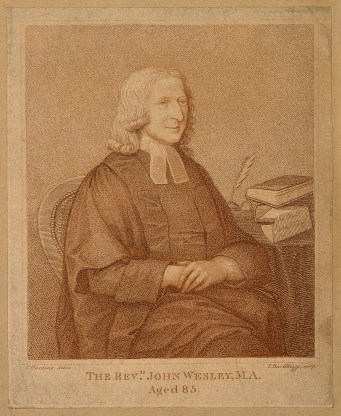
    Photo Credit: Wellcome Library, London. Wellcome Images images@wellcome.ac.uk http://wellcomeimages.org John Wesley. Stipple engraving by F. Bartolozzi after J. Zoffany, 1760.