Category: New Testament

  • Christians, Don’t Ignore How Weird the Book of Jude Is

    Christians, Don’t Ignore How Weird the Book of Jude Is

    If the Bible were like the comic book industry, the book of Jude would be Moon Knight

    It’s super obscure. It references a lot of weird mythology. It feels pretty psychedelic in its language and imagery. And it often gets unfairly compared to a bigger, more popular franchise (in Moon Knight’s case, Batman; in Jude’s case, 2 Peter).

    Okay. I probably just lost a lot of you with that SUPER nerdy comparison. If you happened to understand it, you’re my people. If not, don’t worry about it.

    The point is, I love the book of Jude despite it being one of the shortest, weirdest, and most frequently overlooked parts of the Bible. 

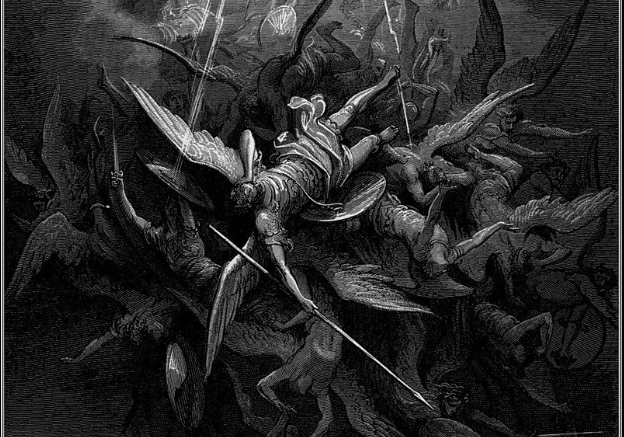
    I love the evocative metaphors Jude uses (angels chained in the nether-gloom! Wild, foaming waves of the sea!). I also love how Jude writes with a pastor’s heart. According to verse 3, he interrupted his plans of writing a more formal theological treatise when he found out his friends were in danger from spiritual abusers. He recognized that the practical needs of his community were the first priority.

    But at the same time, I also find myself frustrated by Jude. He’s long been a bit of a pebble in my shoe, constantly but almost imperceptibly bugging me. 

    You see, in making his argument, Jude relies heavily on extrabiblical, apocryphal material (the lost ending to The Testament of Moses in verse 9; the Jewish mythology of the fallen “Watchers” from 1 Enoch in verses 6 and 14-15). 

    And he doesn’t do this in the same way that, say, Paul quotes pagan philosophers in Acts 17:28 or Titus 1:12. No, Jude uses these apocryphal stories as illustrations of God judging evil in history. He appeals to them as “biblical” lessons right alongside his other Old Testament references. 

    And in doing so, he opens a pretty big can of worms for those of us trying to understand how Scripture works as being divinely inspired or as a closed canon.

    Verses 14-15 really are the kicker for me. Jude quotes 1 Enoch 1:9 as if it were an actual, God-inspired prophecy from the ancient patriarch Enoch. The guy from Genesis 6, who lived all the way back before Noah’s Flood. 

    Suuuure, Jude.

    Scholars are pretty much agreed that 1 Enoch was written no earlier than around the 200s BC. It’s one of the most famous examples we have of Second-Temple Jewish writings where some anonymous writer (or writers) put an apocalyptic prophecy into the mouth of an ancient, long-dead patriarch. 

    And unless you’re Ethiopian Orthodox, it’s not considered canonical Scripture. 

    But to all appearances (and despite how often conservative readers quickly brush past it), Jude treats 1 Enoch 1:9 as a valid prophecy, on par with canonical Old Testament prophecies.

    Does that mean 1 Enoch should be considered Scripture? The majority of the church throughout history has said no. It has largely been recognized as being an apocryphal, non-historical, non-“inspired” work.

    But the story told in 1 Enoch is deeply embedded into the conceptual world that Jude and his audience took for granted. And Jude, at least, seems to have thought it was inspired in some way. That’s definitely the impression his words and argument give off, if we take his text at face value.

    Some have tried to explain this by arguing that maybe this one specific part of 1 Enoch that Jude quotes actually does go all the way back to Enoch himself, passed down orally through hundreds of generations until it was written down. But this idea strains credulity far too hard. It strikes me as special pleading — a desperate attempt to avoid admitting Jude made a mistake when he claimed Enoch prophesied this text. 

    What if we just chalk it up to Jude quoting something he knew was legendary, but that his audience respected and valued? Is he just being cheeky here? Is this the same thing as if I quoted a line from Batman to a group of comic book fans?

    I used to think for a long time that this was the best solution to this puzzle and tried to get on with my life. But the problem is, again, that the actual text on the page of Jude describes the words of 1 Enoch 1:9 as an authoritative prophecy. Not just a cool quote from an interesting book, but a word from the Lord.

    So what do I do with that?

    Well, in many ways it’s still a pebble in my shoe. Perhaps we’ll ruminate on it further in a later post.

    See you down the path.

  • Revelation 3:10 and the Timing of the Rapture

    Revelation 3:10 and the Timing of the Rapture

    What is Jesus promising when he says he’ll keep the faithful Philadelphian Christians from the “hour of testing” (3:10)? Is this talking about a pre-tribulation rapture?


    This is one of the few places in Revelation where some interpreters see a reference to a rapture of Christians before a seven-year great tribulation. Three main lines of evidence are used to support this:

    1) Jesus’ language about an “hour of testing that is going to come on the whole world to test those who live on the earth” is widely agreed to be a reference to the terrifying judgment of God at the end of history. [1]

    2) The specific Greek wording of being “kept from” that “hour” of testing seems to imply total, physical separation from that time period, and not merely spiritual protection through it. [2]

    3) The letters to the seven churches have implications for all Christians everywhere (as I belabored in my previous post), so something of this promise should be relevant to all those “with ears to hear” in any generation. [3]

    On all of these details, I am actually inclined to agree with pre-trib interpreters. But, there’s one interesting little fact that most supporters of a pre-tribulation rapture often miss that really hurts their position, and it’s that the “hour” is not the whole tribulation!

    When Jesus refers to “the hour of testing,” he’s not referring to a seven-year period of tribulation, but to a very limited time at the tail end of the tribulation!

    The tribulation is consistently referred to throughout Revelation with the time-reference “1,260 days,” or three and a half years (Rev 11:3; 12:6, 14; derived from the “half-week” prophecy of Daniel 9:27). Nowhere is it described as an “hour.” In fact, Allen Kerkeslager points out that instances of an “hour” of time in Revelation always refer to the very final day, at the end of the tribulation, when Christ returns and the evil empire of “Babylon” is finally overthrown (Rev 11:11-13; 14:7, 15; 18:10, 17, 19). [4]

    We also see this kind of time reference in the Gospels, where Jesus consistently refers to the time of his actual Second Coming as “that day or that hour” (Matt 24:44, 50; 25:13; Luke 12:39-40, 46; John 5:25). [5] This will be the time when God’s full wrath is vented on unbelievers on the earth, when he overthrows “Babylon” in “a single hour.”

    Believers will be delivered from that horrible day by the post-tribulation rapture, which will happen concurrently with Christ’s descent from heaven at the Second Coming (see Mark 13:24-27; 1 Thes 4:16-17; 1 Cor 15:52).

    Since Christians living in the first century believed that the events leading up to Christ’s return could begin taking place any day, this promise that they would not experience the day of final wrath on the earth was applicable to them just as it is to us should we happen to be alive at the end. The Philadelphian Christians just happened to experience this protection through their physical deaths, which technically is still a form of physical separation from an earthly trial!

    These Christians  — and us, as well — would still have to be faithful through all other trials (including the possibility of imprisonment or martyrdom for their faith, as well as the attacks of the coming Beast and his empire). But these will pale in comparison to the outpouring of God’s full and final wrath on non-believers on the last day of history. That hour of trial we are exempt from, by the grace of God through our faith in Christ.

    All of this information lines up with the fact that elsewhere in Scripture and in Revelation believers are told to endure to the very end, when Christ will appear to the whole world (Matt 24:13; Mark 13:13; 2 Thes 2:1-10; 1 Pet 4:12-13; Rev 7:14; 13:10).

    To sum up: The “hour of testing” is not referring to the whole time of tribulation, but only to the events connected with the very final day of history and the Second Coming, when Christ descends from heaven and God pours out his final wrath on “Babylon” and those who worship the Beast. When Christ promises believers in Rev 3:10 that he will “keep” them from this hour of trial, it is indeed via the rapture, but I’m convinced this will be a post-tribulation rapture!


    [1] See Grant R. Osborne, Revelation, BECNT (Baker, 2002), 193. He calls this the consensus view, and summarizes the usual two pieces of support: the global scope of the trial and the fact that “those who dwell on the earth” is a stock phrase throughout the book for unbelievers who follow the Beast. Osborne takes a post-tribulational view, though.

    [2] See Buist M. Fanning, Revelation, ZECNT (Zondervan, 2020), 177 for some pretty convincing arguments why we shouldn’t see Rev 3:10 as merely referring to spiritual preservation through the tribulation, and why supposed parallels with John 17:15 won’t work.

    [3] Though see Sam Storms’ blog post, “Kept From the Hour of Trial (Revelation 3:10-11),” for an example of the view that Rev 3:10 is in fact a promise only for the first-century Philadelphian church. This used to be my own approach.

    [4] Allen R. Kerkeslager, “The Day of the Lord, the ‘Hour’ in the Book of Revelation, and Rev 3:10,” unpublished paper delivered at the annual 1991 Annual Meeting of the Society of Biblical Literature; cited in G. K. Beale, Revelation, NIGTC (Eerdmans, 1999), 292.

    [5] John Murray, “The Interadventual Period and the Advent: Matthew 24-25,” reprinted in his Collected Writings, Vol. 2 (Banner of Truth Trust, 1996), 394-95; cited in Jonathan Menn, Biblical Eschatology: Second Edition (Resource Publications, 2018), 142-43.

  • The Book of Revelation is a Musical?!

    The Book of Revelation is a Musical?!

    When you’re reading a book of the Bible, one of the easiest mistakes to make is to breeze past the parts that were originally sung. The book of Revelation is a case-in-point. It’s positively teeming with songs — more so than any other book of the New Testament. But what’s the point of all the music?

    Why is John’s Apocalypse, the last book in the Christian canon, a musical?

    Well, okay. I suppose I should admit that technically the term “musical” only refers to modern media forms. According to most sources, a musical is a play or film that uses song to advance the plot or develop the characters. So, since Revelation is a book, it doesn’t fully count.

    But still! The point I want to make today is that the book of Revelation uses songs to advance its plot, just like modern musicals do. The hymnic portions scattered throughout Revelation aren’t there just for show; they develop and enforce the key themes and ideas of the book.

    I’ll explain how below. But first, how do we know which parts were sung?

    Revelation’s Musical Numbers

    Most modern translations will indicate when the original text was meant to be read as poetry or music by indenting the text a little bit and setting it in poetic lines. The CSB translation, for example, has 28 of these poetic sections in Revelation.

    Of these poetic passages, only two are explicitly referred to as songs: the “new song” in 5:9-10, and the “song of Moses and of the Lamb” in 15:3-4. But several others are very clearly songs, too, even if they aren’t labeled as such.

    Other sections that many scholars agree should be seen as hymnic or musical include:

    • The “Holy, Holy, Holy” hymn of the living creatures (4:8).
    • The song of the elders (4:11).
    • The praises of the angelic hosts and every living creature (5:11-13).
    • The song of the elders, redux (11:17-18).
    • “The Accuser of our brothers has been thrown down” (12:10-12).
    • “Just are you, O Holy One” (15:5-7).
    • The final Hallelujahs of heaven (19:1-8).

    These songs are all interspersed throughout the main narrative portion of Revelation (chapters 4-21), and they show up at key turning points throughout the story that unfolds in John’s visions.

    The Message of the Music

    The first songs in Revelation 4:8-11 are hymns of worship to God from the celestial beings around his throne. They focus on God’s holy character and on why he is worthy of worship. We could see these musical numbers as an intro or overture of sorts, setting the musical (and spiritual) tone for what’s to come. They introduce one of the main themes of the book: Only God truly deserves our worship and devotion.

    And as we read the rest of Revelation, we will discover that the book centers around a conflict between those who are competing for this worship! There are enemies — the dragon in the heavens and his minions, the beasts, on the earth — who are trying to lay claim to this worship and this authority. They will be introducing discord into the melody of the book as they accuse God’s people day and night (12:10).

    No wonder, then, that we’re told the angels worship God with hymns day and night (4:8) — they’re trying to drown out the unholy voices of the enemy! This is a musical battle! The heavenly worship is a weapon in a cosmic struggle.[1]

    Revelation’s second musical number (5:9-14) reflects on the first great plot-twist in the book: No one in heaven is worthy to open the scroll in God’s hand, except for the “Lion of the Tribe of Judah” — but this “lion” appears as a sacrificed lamb! The one who is worthy is the one who was slain, and the song explains this further: the Lamb won his victory over evil by laying down his life for God’s people and God’s purposes.

    And so heaven breaks out in praise and cheer for the Lamb (aka Jesus) and, in the surprising conclusion to the song, their worship is shared between the One on the throne and the Lamb! Jesus is shown to be worthy of the same worship as his Father. This musical number expands our vision of the One who is worthy of our worship, and fills out an even bigger picture of why he deserves praise: because of the love and sacrifice he’s shown to redeem his creatures.

    The next three musical numbers all revolve around the highest point of drama and conflict in Revelation — the struggle of God’s kingdom against the earthly kingdoms under the rule of the Dragon/Satan (11:17-18; 12:10-12; 15:1-7). These songs highlight God’s justice and certain victory over evil, even before that victory has been fully realized. It’s as good as done, because the good and holy God is the one who is acting. He is just in bringing destruction back upon those who have been destroying his creation (11:18), and he is faithful to vindicate those who have stayed loyal to him.

    The grand finale comes as the conflict concludes (19:1-8), and it is grand indeed! A string of “Hallelujahs” rings out from a massive crowd in heaven as God overthrows the armies of the Beast and brings about his kingdom on earth at last. Evil is defeated, heaven and earth meet, and Jesus and his people are now able to enjoy the consummation of all their hopes and longings to finally be together forever. Hence, the final lyrics paint the picture of a great wedding banquet — the greatest party in history.

    This musical has a happy ending.

    The Power of Song

    Whether you love musicals or hate them, one thing that can make a good musical so powerful is the emotional effect music has on its listeners.

    When a story is not just told but sung, it stirs up strong feelings and engages an entirely different part of our brains (and souls). It also becomes more memorable (just ask anyone who’s had a song stuck in their head!).  

    Because of these qualities, music also has great power to shape our affections and values. So when the book of Revelation repeatedly highlights its main themes in song form, it’s driving home the values that God wants to cultivate in the book’s readers/hearers.

    (Keep in mind that the books of the New Testament would originally have been read out loud/performed to a listening congregation — which is why Revelation pronounces a blessing on those who “hear” it in 1:3; 22:17-18.)

    As Craig Koester summarizes it,

    “Worship expresses fundamental loyalties and commitments. As the hymns define the character of God, they shape the identities of those who worship him. The divine actions affirmed in the hymns include creation, redemption through sacrifice, and the exercise of justice and truth. By praising these acts of God and the Lamb, the hymns shape the way worshipers see their place in a world where they live with competing claims upon their loyalties, while fostering their hope in God’s kingdom. As the hymns provide a means of expressing faith, they also shape the faith of readers who identify with the worshipers in the narrative.”[2]

    Now, obviously we no longer have the melodies to which these songs were originally sung, nor do we still speak the Koine Greek in which they were originally written.

    But there have been many, many songs inspired by the lyrics in Revelation down through the years (some of them better than others; this one is my personal favorite, though it’s a bit dated now). The sheer volume of contemporary worship lyrics and classic English hymns that have taken wording from Revelation illustrates the power that this book’s poetry has had upon its readers throughout the centuries.

    But besides listening to music inspired by Revelation, another way we can appreciate the book’s musical nature is by taking more time than usual to ponder its song lyrics.

    Read them more meditatively, recognizing that they are very intentional and important to the overall message of the book. Don’t just breeze by them. Sit with them a while. Try to imagine the wonder of hearing these words as a song.

    And consider that there is more focus on beauty than on terror in this last book of the canon.

    See you down the path.


    [1] Sigve K. Tonstad, Revelation, Paideia Commentaries on the New Testament (Grand Rapids: Baker Academic, 2019), 108-09.

    [2] Craig R. Koester, Revelation: A New Translation with Introduction and Commentary, Anchor Yale Bible Commentary, vol. 38A (Yale University, 2014), 130, emphasis added.

  • Was 1 Peter Written to Jews or Gentiles? Why the Answer Matters More Than You Might Think

    Was 1 Peter Written to Jews or Gentiles? Why the Answer Matters More Than You Might Think

    The opening line of 1 Peter identifies it as a letter from “Peter, an apostle of Jesus Christ: To those chosen, living as exiles dispersed abroad in Pontus, Galatia, Cappadocia, Asia, and Bithynia…” (1:1, CSB).

    At first blush, the wording suggests that Peter is addressing ethnically Jewish followers of Jesus. He calls them the “chosen” — Israel was God’s chosen nation in the Old Testament. He refers to them as “exiles” — the Jewish people had been exiled from their homeland by the Babylonians in 586 B.C.E. And when he says they are “dispersed abroad,” the Greek term he uses is “diasporas,” a term used to refer to the scattering of the Jewish people (from which we get the phrase “Diaspora Jews”). 

    And yet, there are some other verses in 1 Peter that seem to suggest the letter was intended for Gentile (non-Jewish) Christians — leading to much debate among commentators.

    In 1:18 Peter writes of how his readers have been redeemed from “your empty way of life inherited from your fathers.” Would Peter really have referred to the Jewish faith he grew up with as an “empty way of life”? And in 4:3, he implies that his readers used to practice “unrestrained behavior, evil desires, drunkenness, orgies, carousing, and lawless idolatry”– hardly the kind of behavior that should characterize good, Torah-observing Jews.

    Scholars have long been divided over the question of 1 Peter’s intended audience, but it seems the majority of classical interpreters took the phrase “exiles dispersed abroad” at face-value, seeing a Jewish audience to be in view. John Calvin is a good representative when he writes in his commentary on 1 Peter:

    “They who think that all the godly are thus called, because they are strangers in the world, and are advancing towards the celestial country, are much mistaken, and this mistake is evident from the word dispersion which immediately follows; for this can apply only to the Jews.” [1]

    In modern times, though, the consensus has shifted. Today most scholars understand 1 Peter to have been written to Gentile Christians. They do so primarily because of verses like 1:18 and 4:3, but also because the regions Peter addresses were largely Gentile territory.


    Does It Make a Difference?

    Why does it matter whether 1 Peter was written primarily to Jewish or Gentile followers of Christ? What difference does it make for interpretation?

    It turns out that if we take 1 Peter as addressing a Gentile audience, then the epistle becomes one of the strongest supports for the theological idea that the church has replaced Israel as the people of God. This concept is also referred to as “replacement theology” or “supersessionism” (i.e. the church supersedes Israel).

    In 1 Peter 2:9, the readers are said to be “a chosen race, a royal priesthood, a holy nation, a people for his possession” — phrases pulled right out of the Hebrew Scriptures as descriptors of the nation of Israel. If Peter is applying this imagery to Gentiles, then as Scot McKnight claims, “There is no passage in the New Testament that more explicitly associates the Old Testament terms for Israel with the New Testament church than this one.” [2]

    But if the original readers of 1 Peter were themselves ethnically Jewish, then Peter’s language is not surprising at all, and it would undercut the use of 1 Peter as a proof-text in support of supersessionism. That’s not to say you couldn’t potentially arrive at a supersessionist theology from other passages, but 1 Peter 2:4-10 is often one of the most important passages in the debate, so it’s worth considering.

    That said, here are four reasons why I believe, against the current consensus, that 1 Peter was originally written to Jewish followers of Jesus.


    Four Lines of Evidence That Point to a Jewish Audience:

    #1: A straightforward reading of 1:1 supports a Jewish audience. 

    As I mentioned above, this is the simplest and best way to make sense of why Peter refers to his readers as the chosen exiles of the Diaspora. This phrasing was enough to convince most pre-modern interpreters of 1 Peter that it was written to ethnic Jews. It’s also the strongest argument for a Jewish readership.

    The term diasporas is only ever applied to ethnic Jews in biblical texts (John 7:35; James 1:1; in the Apocrypha, 2 Maccabees 1:27; Judith 5:19), so if it were taken to mean Gentiles in 1 Peter 1:1, it would have to be a remarkable exception. It certainly wouldn’t be a natural reading of the verse.

    #2: Peter’s critique of their former way of life actually applies quite well to Hellenistic Jews in the Roman Empire.

    Commentators often stress that it’s hard to see the Jewish apostle Peter referring to his Jewish heritage as “former ignorance” (1:14) and an “empty way of life inherited from [the] fathers” (1:18). Funny enough, however, it apparently wasn’t difficult for the apostle Paul (himself also Jewish) to describe Judaism apart from faith in Christ as a life of ignorance (Romans 10:2-3; 1 Timothy 1:13) and a life dominated by sinful desires (Ephesians 2:3). In Philippians 3:2-9, Paul similarly describes all of his Jewish merits as worthless compared to knowing Christ (Philippians 3:2-9).

    What’s more, as Jim R. Sibley points out in his article on this issue, Peter’s critique of the “traditions of the fathers” makes perfect sense if referring to such traditions as those of the Pharisees, which Jesus himself vehemently criticized (Matthew 15:1-9) and which Paul also distanced himself from (Galatians 1:14). [3]

    We know from archaeology that not only was there a substantial Jewish population living in the regions Peter addresses, but they were very much prone to emulate the pagan lifestyle of their Greco-Roman neighbors when it was socially advantageous for them. [4]

    All of this to say that Peter’s language isn’t all that unexpected if referring to a Jewish audience; indeed, it’s all the more powerful for highlighting the need that even the Jewish people have for the redemption available in the Messiah Jesus.

    #3: Peter’s use of Old Testament prophetic imagery points to a Jewish audience.

    Peter alludes to prophecies from Hosea 1-2 to describe his readers in 2:10, and that Old Testament text clearly refers to the Israelites. Hosea speaks of Israel’s abandonment of God and subsequent restoration. If Peter is addressing Jews, then he is not throwing away the original context of Hosea, but is actually demonstrating its fulfillment in the way Jesus of Nazareth is bringing about the promised restoration of his people.

    In 2:25, Peter says that his readers are returning to the Shepherd and Overseer of their souls. If Gentiles were in view, we might expect him to say they were turning to God for the first time, or were returning to their Creator. But the “God as Shepherd” imagery makes better sense if referring to the covenant relationship of God to the Jewish people, since the Hebrew prophets frequently use that metaphor (Psa 80:1; Ezek 34:13-16; Hos 4:16; Zech 11:7).

    #4: Peter explicitly distinguishes his readers from “the Gentiles” (2:12; 4:3-4).

    At various points in the letter, Peter’s readers are exhorted to live holy lives in the sight of the “Gentiles” they live among. As Sibley writes,

    “Those outside of the circle to whom Peter is writing are referred to as ‘Gentiles’ (ἐθνῶν). The pronouns are most significant: ‘You’ are not a part of ‘them’ and ‘they’ are surprised that ‘you’ do not run with ‘them,’ and therefore, ‘they’ malign ‘you.’ It would hardly be possible to draw a sharper contrast between the Gentiles and Peter’s audience. The clear implication is that his audience is comprised of Jewish believers. Since, however, it has been concluded that the audience, though Gentile, is being addressed as the ‘true Israel,’ then the word ‘Gentiles’ is reinterpreted as ‘unbelievers,’ or non-Christians.” [5]

    I put this argument last, however, because there are instances where the apostle Paul felt free to refer to all non-believers as “Gentiles” (1 Corinthians 5:1; Ephesians 4:17; 1 Thessalonians 4:5), so it’s not beyond possibility that Peter did, too. This is part of the reason why commentators have so long debated whether 1 Peter was written to Jews or Gentiles.

    But based on the other three lines of evidence above, it’s more natural to take Peter’s reference to Gentiles as an ethnic distinction first, and a religious distinction only by extension.


    Reading This Jewish Letter as a Gentile Christian Today

    So what’s the upshot of all this? If 1 Peter was written to ethnically Jewish followers of Jesus living in Asia Minor as part of the Diaspora, then what does it have to say as Scripture for Gentile Christians like me?

    The way I look at it, 1 Peter stands as a reminder that what we now know as “Christianity” began as a sect within Judaism. It didn’t start out as a Gentile religion that was totally separate from God’s dealings with the Jewish people. Rather, it was a movement of Jews who had recognized that their Messiah had come, and that the Messianic Age promised in the Hebrew Scriptures was finally dawning.

    Along with the arrival of the Messianic Age came the inclusion of the Gentiles into God’s people as part of the New Covenant. People from all nations were now being grafted into God’s covenant people (see Romans 11). This doesn’t necessarily mean the same thing as saying that an entirely new entity (the church) replaced Israel; it could just as well mean that the availability of becoming members of Israel had broadened. Jewish priority is maintained (as Paul seems to stress in Romans 1:16; 2:9-10).

    Bottom Line: Since 1 Peter was most likely written to an ethnically Jewish audience, it shouldn’t be pressed into service as a linchpin in arguments to support supersessionism. The conversation is much more complex than that. If one wants to read 1 Peter from a supersessionist perspective, the rationale needs to be stronger than just saying, “He’s applying OT terms for Israel to a Gentile audience.”

    Of course, there are all sorts of other issues and passages to consider when constructing one’s theology of Israel and the church. But whatever theological system we adopt, we need to make sure we’re reading 1 Peter with the grain of its Jewish context rather than against it.

    See you down the path.


    Notes:

    [1] John Calvin, Commentary on the Catholic Epistles, accessed from https://www.ccel.org/ccel/calvin/calcom45.iv.ii.i.html.

    [2] Scot McKnight, 1 Peter, NIVAC (Grand Rapids: Zondervan, 1993), 109-10.

    [3] Jim R. Sibley, “You Talkin’ to Me? 1 Peter 2:4-10 and a Theology of Israel,” Southwestern Journal of Theology 59:1 (Fall 2016), 65. Accessed from https://swbts.edu/sites/default/files/images/content/docs/journal/59_1/SWJT%2059.1_Sibley.pdf.

    [4] See the discussion in Ben Witherington III, Letters and Homilies for Hellenized Christians: A Socio-Rhetorical Commentary on 1–2 Peter, vol. 2 (Downers Grove, IL; IVP Academic, 2007), 25–27.

    [5] Sibley, “You Talkin’ to Me?” 66.

  • No One Can Come to Jesus Unless the Father Draws Them: Two Views on Election in John 6

    No One Can Come to Jesus Unless the Father Draws Them: Two Views on Election in John 6

    (Unless otherwise noted, all Scripture quotations are from the CSB).

    In John 6, Jesus makes a number of startling claims. He’s in the middle of a dialogue with a crowd of Jewish people who were denying the claims he was making about himself. Specifically, they struggled to accept that he truly had “come down from heaven” (6:41-42). In response to their unbelief, Jesus says, among other things:

    “Everyone the Father gives me will come to me, and the one who comes to me I will never cast out” (6:37).

    No one can come to me unless the Father who sent me draws him, and I will raise him up on the last day” (6:44).

    “He said, ‘This is why I told you that no one can come to me unless it is granted to him by the Father’” (6:65).

    Why does Jesus tell these people that only those who are drawn by the Father can come to him? Here I’ll do my best to briefly summarize two possible views on this topic.


    Option 1: Unconditional, Individual Election

    Here’s one way we could interpret Christ’s statements: We could see John 6 as teaching that God already decided (unconditionally) that certain people would believe and be saved — and only those people will come to Jesus. Calvinist interpreters, in particular, look to John 6 as a foundational passage for this doctrine of unconditional election. On this reading, people only choose to believe in Jesus because God the Father, before time began, predestined them to do so. And then, at some point during their earthly life, he draws them irresistibly to Jesus.

    Among the details in the passage that might support such a reading are: 1) the intense emphasis on the inability of many in Jesus’ audience to accept his teaching, 2) the fact that Jesus’ words focus on individuals, and 3) the Greek term for “draw” (helkō), which in many contexts refers to a strong action like drawing in a net of fish (John 21:11) or actually dragging someone (Acts 16:19).

    On the other hand, reading John 6 as a timeless affirmation of unconditional election does involve a few difficulties. One is the fact that elsewhere in John’s Gospel, Jesus teaches that every person’s eternal destiny will be based on whether or not they choose to put their faith in him (John 3:18; 5:24). Another is the question of how the “drawing” in John 6 relates to Jesus’ “drawing” (same Greek word) of all people in John 12:32.

    We’re also told in John 3:16 that God loves the whole world (specifically referring, in John’s writings especially, to the world of unbelieving humanity). Holding to a doctrine of unconditional election raises the difficult question of how exactly God’s love extends to the unbelievers he chooses not to draw.

    There have, of course, been numerous thoughtful answers to these questions by Calvinist scholars. Many of them point out that no one would choose salvation unless God first overpowered their rebellious wills, and that his decision to leave some in their sins is to display his just wrath against sin. This is all so that salvation is completely by God’s grace.


    Option 2: The Drawing of Faithful Jews to Jesus as Their Messiah

    Another way we could interpret John 6 is to see it as describing a unique situation in history — namely, the transfer of faithful Israelites under the Mosaic Covenant to their newly-arrived Messiah, Jesus. On this view, the people whom the Father was drawing to Jesus on that particular occasion were those Jewish people who were already faithfully responding to God’s revelation through the Torah and the Prophets.

    Right after Jesus says that no one can come to him unless the Father draws them (6:44), he immediately gives an explanation of what he means: “It is written in the Prophets: And they will all be taught by God. Everyone who has listened to and learned from the Father comes to me ” (6:45, emphasis added).

    Notice the parallel: the Father’s action of drawing people to Jesus is tied to the people’s action of heeding the words of the prophets. So the way Jesus himself explains it, God had already been preparing his people for their Messiah through the proclamation of his word. Those who were being drawn were those who were heeding what the Spirit of God was saying through the Hebrew Scriptures and the teachings of Jesus.

    The problem is, not everyone in Israel was responsive; the majority were not receptive at all. But there was a faithful remnant — we see this exemplified in the disciples (well, except for Judas!) who remained with Jesus because they understood he had “the words of eternal life” and believed (6:68).

    This minority of faithful Jews were the ones the Father drew to their Messiah. He ensured that no one who was responsive to his word missed out on its fulfillment in Jesus. Thus, when we read John 6, we shouldn’t see Jesus as offering philosophical speculations about eternity past; rather, he was addressing the issue of how only those who were receptive to the Father under the Old Covenant would be receptive to their promised Messiah, Jesus, now that he was finally on the scene.

    John’s Gospel in particular is concerned with the question, “Now that the Messiah has come, why did so many Jewish people reject him?” This is a very important topic for John, as he makes clear in his prologue: “he [Jesus] came to his own, and his own people did not receive him” (John 1:11). On the other hand, “But to all who did receive him, who believed in his name, he gave the right to become children of God” (1:12).

    With the arrival of Messiah, a massive shift in history was taking place. God was drawing the faithful remnant of Jews to their Messiah. Related to the salvation of the believing remnant of Israel was the full inclusion of Gentiles, too,  into God’s community. This is why Jesus later stresses that he has “other sheep that are not of this fold,” and he “must bring them also” (10:16). This refers to God-fearing Gentiles — those who, like the remnant of Israel, were already being taught by the Father and learning from him through the Jewish Scriptures.

    Later on in John’s Gospel, Jesus says that he will draw “all people” to himself when he is “lifted up” (12:32). In other words, through Jesus’ atoning work on the cross, the drawing activity of God through his Word/Messiah would be radically extended to include the entire Gentile world (see also the “mystery” Paul refers to in Ephesians 3:1-13). [1]

    In my opinion, this view does a better job of situating Jesus’ teaching firmly within its first-century Jewish context, and better accounts for how John’s Gospel describes the seismic salvation-historical shift that took place in Jesus’ ministry. That’s not to say it’s unquestionably the right view — one could still debate whether God decreed that the remnant would be receptive to the word, and of course other passages that touch on election/predestination have to be considered. But it does mean that John 6 can be faithfully interpreted in a way that coheres with a conditional view of election, without doing injustice to the text.


    Conclusion

    No matter which of these two views you end up taking, they both affirm that God is the one who has made salvation possible — a salvation found only by his grace through Jesus Christ. Faithful Christians can (and should) continue to test their interpretations against Scripture, and hold those interpretations with a gracious and humble attitude.

    Obviously, discussion about the interpretation of John 6 will continue. But I know that some people in my particular circles (within American evangelicalism) have only ever been exposed to Calvinist readings of John 6, so at the very least I hope this post will present a viable alternative they may not have considered.

    What do you think? Which reading do you prefer, and why? Are there some aspects of the alternative view that you hadn’t considered? Let me know in the comments.

    I close with this nice quote from Gerald Borchert’s commentary on John:

    “Salvation is never achieved apart from the drawing power of God, and it is never consummated apart from the willingness of humans to hear and learn from God. To choose one or the other will ultimately end in unbalanced, unbiblical theology. . . . Rather than resolving the tension, the best resolution is learning to live with the tension and accepting those whose theological commitments differ from ours.” [2]

    For more on the topic of election/predestination, check out my previous posts:
    Calvinism & Arminianism: What I Wish Everyone Knew About the Debate
    – Recommended Resources on Calvinism & Arminianism

    See you down the path.


    [1] This statement in John 12 cautions against seeing the “drawing” activity of God as something that leads irresistibly to salvation, since not everyone among the Gentiles will inevitably be saved.

    [2] Gerald L. Borchert, John 1-11, NAC vol 25A (Nashville: Broadman & Holman, 1996), 268-69.

  • First Timothy 2:11-15 and the Question of Women in Ministry

    First Timothy 2:11-15 and the Question of Women in Ministry

    In my last post I shared two reasons why I began reexamining my initial complementarian position on women in ministry — first, the ways female Bible teachers helped me grow spiritually, and second, the challenging points raised by my seminary classmates who were egalitarian.

    In this post, I’ll be sharing two even bigger reasons why I’ve dug into this subject more — the first being the examples the Bible itself gives of women in positive leadership positions, and the second being a greater awareness of the cultural context of 1 Timothy 2:11-15, which has traditionally been considered the strongest passage against women pastors.

    [Disclaimer: This will be a lengthier post than I normally write, but there are a lot of important details to cover, and I thought it best to keep it together rather than dividing it into multiple posts, so please bear with me!]

    First, the text under consideration:

    11 A woman is to learn quietly with full submission. 12 I do not allow a woman to teach or to have authority over a man; instead, she is to remain quiet. 13 For Adam was formed first, then Eve. 14 And Adam was not deceived, but the woman was deceived and transgressed. 15 But she will be saved through childbearing, if they continue in faith, love, and holiness, with good sense.” — 1 Timothy 2:11-15 (CSB)

    Here’s how I would summarize the complementarian understanding of the passage: The Apostle Paul is laying down a timeless rule for all women to only be in a submissive role in the church. They can’t hold authority as pastors, because God has ordained that the men are to be the heads, the authority. Paul then grounds this command in the pattern set all the way back at creation: Adam was made first (to be the leader), and women — like Eve — are in danger of falling prey to deception and sin if they violate this hierarchy. They should accept their God-given role as women (here exemplified in childbearing and providing nurture in the home).

    Maybe this is how you understand it, too. Maybe you’ve heard some influential evangelical leaders champion this view (guys like John Piper, Wayne Grudem, or John MacArthur). And maybe you’ve been told that any alternative interpretation isn’t really motivated by a sincere desire to submit to the truth of Scripture, but is driven by the liberal, hyper-feminist spirit of our postmodern age.

    I want to make as clear as I can that such statements as that last one are patently false and unnecessarily alarmist.

    It may be true in some cases, but the reality is that there is a substantial number of godly Bible scholars, pastors, and theologians, with the utmost regard for the truth of Scripture, who are convinced that this is the wrong way to read 1 Tim 2:11-15 — people like Gordon Fee, Scot McKnight, Craig Keener, and N. T. Wright, among others.

    For my part, the concern that drives me is a concern to be completely faithful to God’s truth as revealed in Scripture, to handle it rightly, and to not take it out of context. And it is that concern — not feminism or conservatism; not political correctness or chauvinism; not personal gain (I’m not, myself, a woman, after all!) — that has driven me to take a close, hard look at whether the complementarian reading is correct.


    And what really threw me for a loop was the realization of just how frequently Scripture itself holds up women in leadership roles as positive examples.


    Within the Old Testament:

    The prophet Micah ranks Miriam alongside Moses and Aaron as the leaders of Israel (Micah 6:4).

    Deborah served as Israel’s judge and as a prophetess — in other words, she held civil and spiritual authority as God’s spokeswoman in Israel (Judges 4-5).

    Huldah was a prophetess who taught King Josiah about the Torah (2 Kings 22).

    Turning to Paul’s own writings:

    He lists Priscilla as one of his ministry coworkers (Romans 16:3). Acts 18:24-26 mentions that she helped teach Apollos (a male Christian leader).

    Paul says that Junia was “outstanding among the apostles” (Romans 16:7). Some interpreters/translations have tried to see this as saying she was considered noteworthy by the apostles, but this is seriously unlikely — the early church fathers (who spoke Greek) took the statement to mean Junia was a female apostle, and many NT scholars today are also convinced (for more detail, see this post by one).

    And Phoebe was a deaconess of the church in Cenchreae (Romans 16:1-2). Some interpreters try to say that she was merely a “servant” of the church, but the Greek word (diakonos) is the same one used in 1 Tim 3:8-13 to designate a formal leadership role. The fact that Paul also calls her a “benefactor” in v. 2 further implies that she was, indeed, a person of significant authority in the church.

    So, however we interpret 1 Timothy 2:11-15, it has to square with the fact that not all women in all times/places were prevented from having authoritative, spiritual leadership roles over men in biblical times! (Subsequent church tradition is a separate matter.) That fact alone gave me serious pause when approaching 1 Tim 2:11-15 from my initial perspective.

    With that in mind, here are four other important interpretive/contextual factors to consider when it comes to understanding why Paul says what he does in 1 Tim 2:11-15.


    Four Important Factors for Interpreting 1 Tim 2:11-15


    #1: “Quietness” in verse 12 doesn’t mean absolute silence (contrary to translations like the KJV/NKJV).

    This is because the same Greek term is used a few verses earlier, in 1 Tim 2:2, to describe the condition all Christians should seek to live in. So unless we want to say all Christians (male and female) are never to speak, teach, share the gospel, etc., we should see it as referring to an attitude of calmness and harmony (compare also 2 Thessalonians 3:12).

    #2: Paul allowing women to learn as students was actually fairly radical for his time.

    Women were typically excluded from education in Jewish and Greco-Roman society. So while we tend to focus on the negative tone of this passage, Paul was actually giving Timothy a positive instruction to let the Ephesian women learn the true gospel. 

    This was especially vital because the spread of false teaching is a constant concern in these letters. The women of Ephesus needed to be taught the truth so that they would be prepared against distortions. This implies that these women in particular weren’t ready to be teachers because they first needed to be taught. One may reasonably assume that once Timothy’s female congregants got up to speed, they could then teach if so gifted.

    Also, “quietness and submission” were the qualities expected of good students in the Roman world. The submissiveness Paul calls for is submission to the content being taught, not submission to men in general.

    #3: The word Paul uses for “having authority over” men is a bizarre term.

    The Greek word is “authentein,” and it only shows up here in the New Testament. It has sparked all manner of debate, but a growing number of scholars see it as having a very negative overtone, in the sense of “domineering over” or “usurping authority.” In fact, this is how the word was interpreted in many ancient and medieval translations of 1 Timothy (see this article for much more detail).

    The fact that Paul uses this obscure word and not one of the more common words for “authority” he uses elsewhere suggests that he is not talking about the regular exercise of teaching authority in the church, but something more insidious.

    So why does Paul issue this command for the women to learn and not teach or “usurp authority” over the men? I’ve already mentioned the likelihood that Timothy’s female congregants were deficient in their understanding of God’s word because of the lack of education for women at the time, and thus they weren’t qualified.

    But there’s also another reason — one that not only explains Paul’s concern that the women might try to usurp the men, but also explains why Paul brings up Adam and Eve the way he does. And this reason has to do with the culture of Ephesus at the time.

    #4: Paul’s use of the Adam & Eve story makes perfect sense when understood as a counterpoint to the beliefs of the Artemis cult in Ephesus.

    Worship of the Greek goddess Artemis was a dominant feature of Ephesian culture (see Acts 19:23-41). Among the many myths pertaining to Artemis, three features stand out as pertinent to 1 Timothy 2:11-15:

    1) Artemis was worshiped by a cult of female priestesses;
    2) Her worshipers believed that she was created before her male consort (from which they assumed women had superiority over men).
    And 3) she was often appealed to as a deliverer for women during childbirth. Mortality rates during childbirth were very high in the ancient Roman world, which made Artemis a very popular deity (for more detail on Artemis’ role in childbirth, see this post by one of my seminary professors).

    This cultural background helps explain so much that is potentially puzzling about Paul’s use of the Adam & Eve story. It would mean that Paul was using the true creation story not as a basis for patriarchy, but as a corrective to the false mythology rampant in the Ephesian culture Timothy was ministering in.

    It also explains the bizarre reference to women being “saved through childbirth,” which always confused me before I was made aware of this context. At the time this letter was written, Christian women may have felt pressure from the cultural climate around them to avoid marriage and childbirth, or to rely on Artemis for safety (which the false teachers may have leveraged for influence). Paul dismantles these myths with the truth of Scripture to prevent female churchgoers from being led astray or promoting disorder.

    Paul’s overarching goal in these letters to Timothy was to safeguard the apostolic gospel and ensure it was passed on accurately to the next generation. Along with that was a concern to preserve order and harmony so that the church could have a good witness to outsiders. Both of these goals would have been thwarted if the unlearned women in Ephesus usurped authority from the men after the manner of the Artemis cult.

    The fact that the women in Ephesus in particular were susceptible to the false teaching going around is evident from 2 Timothy 3:6-7. All of this points us toward seeing Paul’s instructions as addressing a very specific cultural situation. Not all women at all times and places share the same lack of education that allows them to fall prey to false teaching (unless we want to assert that all women are inherently more gullible or less intelligent than men, which is simply not true — we’ll talk more about that idea in a future post, since it factors in to discussions of later church traditions!).


    Drawing Some Conclusions


    We’ve looked at the cultural context of 1 Timothy, the unusual vocabulary Paul uses in his instructions to women, and the fact that Scripture elsewhere commends women in high levels of ministry leadership.

    Putting all these factors together points us to the conclusion that in 1 Timothy 2:11-15 Paul was addressing a specific, local situation rather than giving universal, timeless instruction. 

    Here’s how I now understand Paul’s words in this passage: Paul wants the women in Timothy’s congregations to be allowed to learn God’s word so that they will be prepared against falsehood. They are to learn with a respectful attitude, and not be disruptive. Because of their lack of education they shouldn’t be teaching yet, much less usurping authority over the men (after the manner of Artemis’ followers). This danger prompts Paul to cite the story of Adam and Eve as a corrective — Woman wasn’t made first; Adam was. The first woman was actually deceived, serving as an archetype for any woman who gives in to false teaching. And the Ephesian Christian women who stayed faithful to living out the gospel could be assured of protection through childbirth — no need to go back to a false religion for help.

    The implication of all this is that 1 Timothy 2:11-15 should not be used as a proof-text for prohibiting gifted, mature Christian women from serving in any level of ministry.

    This was not a conclusion I came to flippantly, nor was it because of any “hidden agenda” or desire for political correctness. It was the result of prayerful study, patient dialogue with other Jesus-loving believers, and most of all just me paying more attention to how Scripture holds up women as equal to men in Christ (see Galatians 3:28) and mentions them serving as apostles and deaconesses!

    Perhaps you disagree. There are a lot of other important questions and objections that might be coming to your mind; questions like: How does all of this pertain to the roles of husbands and wives? What about other passages that talk about women’s roles? Why did Christ only appoint men to be his twelve apostles? Are we sure there wasn’t hierarchy before the Fall of humanity?

    I had to wrestle with these questions myself, so I do want to address them. But this post has gone on long enough, so that will be my focus in the next one!

    In the meantime, though, my hope is that all of this will encourage you to keep looking at the text of Scripture and keep seeking God’s heart on the matter. Don’t just take my word for it.

    See you down the path.