Category: Bible study

  • Christians, Don’t Ignore How Weird the Book of Jude Is

    Christians, Don’t Ignore How Weird the Book of Jude Is

    If the Bible were like the comic book industry, the book of Jude would be Moon Knight

    It’s super obscure. It references a lot of weird mythology. It feels pretty psychedelic in its language and imagery. And it often gets unfairly compared to a bigger, more popular franchise (in Moon Knight’s case, Batman; in Jude’s case, 2 Peter).

    Okay. I probably just lost a lot of you with that SUPER nerdy comparison. If you happened to understand it, you’re my people. If not, don’t worry about it.

    The point is, I love the book of Jude despite it being one of the shortest, weirdest, and most frequently overlooked parts of the Bible. 

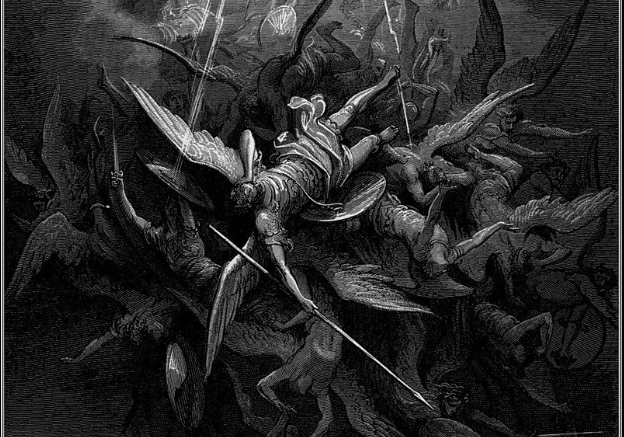
    I love the evocative metaphors Jude uses (angels chained in the nether-gloom! Wild, foaming waves of the sea!). I also love how Jude writes with a pastor’s heart. According to verse 3, he interrupted his plans of writing a more formal theological treatise when he found out his friends were in danger from spiritual abusers. He recognized that the practical needs of his community were the first priority.

    But at the same time, I also find myself frustrated by Jude. He’s long been a bit of a pebble in my shoe, constantly but almost imperceptibly bugging me. 

    You see, in making his argument, Jude relies heavily on extrabiblical, apocryphal material (the lost ending to The Testament of Moses in verse 9; the Jewish mythology of the fallen “Watchers” from 1 Enoch in verses 6 and 14-15). 

    And he doesn’t do this in the same way that, say, Paul quotes pagan philosophers in Acts 17:28 or Titus 1:12. No, Jude uses these apocryphal stories as illustrations of God judging evil in history. He appeals to them as “biblical” lessons right alongside his other Old Testament references. 

    And in doing so, he opens a pretty big can of worms for those of us trying to understand how Scripture works as being divinely inspired or as a closed canon.

    Verses 14-15 really are the kicker for me. Jude quotes 1 Enoch 1:9 as if it were an actual, God-inspired prophecy from the ancient patriarch Enoch. The guy from Genesis 6, who lived all the way back before Noah’s Flood. 

    Suuuure, Jude.

    Scholars are pretty much agreed that 1 Enoch was written no earlier than around the 200s BC. It’s one of the most famous examples we have of Second-Temple Jewish writings where some anonymous writer (or writers) put an apocalyptic prophecy into the mouth of an ancient, long-dead patriarch. 

    And unless you’re Ethiopian Orthodox, it’s not considered canonical Scripture. 

    But to all appearances (and despite how often conservative readers quickly brush past it), Jude treats 1 Enoch 1:9 as a valid prophecy, on par with canonical Old Testament prophecies.

    Does that mean 1 Enoch should be considered Scripture? The majority of the church throughout history has said no. It has largely been recognized as being an apocryphal, non-historical, non-“inspired” work.

    But the story told in 1 Enoch is deeply embedded into the conceptual world that Jude and his audience took for granted. And Jude, at least, seems to have thought it was inspired in some way. That’s definitely the impression his words and argument give off, if we take his text at face value.

    Some have tried to explain this by arguing that maybe this one specific part of 1 Enoch that Jude quotes actually does go all the way back to Enoch himself, passed down orally through hundreds of generations until it was written down. But this idea strains credulity far too hard. It strikes me as special pleading — a desperate attempt to avoid admitting Jude made a mistake when he claimed Enoch prophesied this text. 

    What if we just chalk it up to Jude quoting something he knew was legendary, but that his audience respected and valued? Is he just being cheeky here? Is this the same thing as if I quoted a line from Batman to a group of comic book fans?

    I used to think for a long time that this was the best solution to this puzzle and tried to get on with my life. But the problem is, again, that the actual text on the page of Jude describes the words of 1 Enoch 1:9 as an authoritative prophecy. Not just a cool quote from an interesting book, but a word from the Lord.

    So what do I do with that?

    Well, in many ways it’s still a pebble in my shoe. Perhaps we’ll ruminate on it further in a later post.

    See you down the path.

  • Early Christians Debated How to Interpret Genesis, Too

    Early Christians Debated How to Interpret Genesis, Too

    For many folks with a little exposure to church history, this is actually old news. Discussions of how to interpret the early chapters of Genesis are as old as Christianity.

    But since I’ve been reading through the major theologians of the early church lately, I thought I’d share some of their more interesting quotes on the subject to demonstrate that differences of opinion on how God created are not to be treated as a matter of essential importance for salvation.

    St. Augustine: “Don’t weigh in if you’re ignorant of science!”

    Let’s start with this favorite of mine from St. Augustine of Hippo, written around AD 398:

    “Whenever I hear a brother Christian talking in such a way as to show that he is ignorant of these scientific matters and confuses one thing with another, I listen with patience to his theories and think it no harm to him that he does not know the true facts about material things, provided that he holds no beliefs unworthy of you, O Lord, who are the Creator of them all. The danger lies in thinking that such knowledge is part and parcel of what he must believe to save his soul and in presuming to make obstinate declarations about things of which he knows nothing.” (Confessions, Book 5, Ch. 5).

    In other words, Christians shouldn’t be weighing in on scientific matters about which they really aren’t sufficiently qualified. Much less should they treat their theories as essential to salvation.

    Augustine’s advice feels all the more relevant today. In another chapter of his Confessions, he mentions that the early chapters of Genesis are so dense and rich with ideas that he can’t help but feel like readers shouldn’t limit themselves to just focusing on the one “original meaning” of the text:

    “…since I believe in these commandments, and confess them to be true with all my heart, how can it harm me that it should be possible to interpret these words in several ways, all of which may yet be true? How can it harm me if I understood the writer’s meaning in a different sense from that in which another understands it? All of us who read his words do our best to discover and understand what he had in mind, and since we believe that he wrote the truth, we are not so rash as to suppose that he wrote anything which we know or think to be false” (Conf. 12.18).

    Notice that Augustine is not so flippant as to suggest that we can read whatever we want out of the text; he does acknowledge that there was an intended meaning to it. But at the same time, he has no problem admitting that the “literal” or “original” meaning is not the only layer that matters, and that truth is multifaceted.

    As he goes on to say in the next chapter, “For the great truth, O Lord, is that you made heaven and earth” (Conf. 12.19). That is the essential doctrine; the bottom line we must all agree on.

    Here Augustine lines up well with the creeds of the church, which say we must believe in “God Almighty, Creator of heaven and earth,” but do not hold us to a specific view on how he created, or how long ago.

    Origen of Alexandria: “All of Scripture has a spiritual meaning, but not all of it has a bodily meaning.”

    Prior to Augustine, we find the influential theologian Origen of Alexandria (c. AD 230) vehemently denying that everything in Scripture is to be taken literally:

    “For who possessed of understanding will suppose that the first and the second and the third day, evening and morning, happened without a sun and moon and stars? And that the first day was as it were also without a sky? And who is so foolish as to suppose that God, after the manner of a human farmer, planted a paradise in Eden towards the east, and placed in it a visible and perceptible tree of life, so that one tasting of the fruit by bodily teeth would obtain life, and again that one could partake of good and evil by chewing what was received from the tree there? And if God is said to walk in the paradise in the afternoon, and Adam to hide himself behind the tree, I do not think that anyone doubts that these figuratively indicate, through apparent narratives and through things that did not happen bodily, certain mysteries.” (On First Principles, trans. by John Behr, 4.3.1).

    Origen makes clear that his intention is not to say that the Bible is never talking about actual history (Princ. 4.3.4). Rather, like any good biblical scholar, he says we must carefully search and investigate the Scriptures, as well as history and science, to discover whether a given passage is discussing literal history or is conveying spiritual truths through the use of myth or legend (4.3.5).

    Lest people cry foul, keep in mind that Origen’s principles here were not out of left field for ancient Christianity! He was regarded as the greatest teacher of biblical interpretation and theology by such crucial later theologians as St. Athanasius and St. Gregory of Nazianzus — men largely responsible for mainstream Christianity’s understanding of the doctrine of the Trinity.

    Though Origen was later accused of heresy after his death, it was not because of his biblical hermeneutics, but because certain groups of people grossly misinterpreted some of his other, more sophisticated ideas. His point about being sensitive to the different genres of biblical texts is timelessly important.

    St. Irenaeus of Lyons: “Day” Can Mean a Long Age

    Still earlier than Origen, writing around AD 180, St. Irenaeus of Lyons remarks that in his day, many Christians were of differing opinions as to whether the word “day” in Genesis 1 should be taken as referring to exactly 24 hours or as a symbol for a longer age of time, since verses like Psalm 90:4 and 2 Peter 3:8 affirm that to God “a thousand years are like one day” (Against Heresies, 5.23.2). 

    While Irenaeus himself preferred the more literal interpretation (5.28.3), he in no way implies that this was a matter of importance for one’s salvation, or that those who held to a “day = age” theory were somehow undermining the gospel.

    He is clear that it was a matter of opinion, about which people can disagree and discuss to their hearts’ content, but certainly shouldn’t divide the church over.

  • The Earliest Church Fathers on Election and Predestination (Part Two: Apostolic Fathers)

    The Earliest Church Fathers on Election and Predestination (Part Two: Apostolic Fathers)

    Christians have long wrestled with the subject of how God’s plans and actions in salvation interact with human responsibility and choice. And it is common for proponents of any theological system to appeal to the writings of theologians from the early church to support their views. After all, we should pay attention to how those who learned the gospel within a generation or two from Christ’s apostles talk about salvation, seeing as they are closer to the source.

    In the previous post, we looked at the writings associated with Clement of Rome, one of the earliest sources outside of the New Testament. Today we’ll turn our attention to the rest of those writings traditionally labelled the Apostolic Fathers.

    The Epistles of Ignatius of Antioch (around AD 110)

    Ignatius was bishop of the church in Antioch, and was famously martyred in Rome in the early years of the second century. On his way to martyrdom, he wrote seven letters to churches throughout the empire. These letters are primarily situational and practical, and as such they don’t delve too deeply into theological topics like election. But there are still numerous incidental references to it.

    In several of the letters’ openings, Ignatius refers to his audience as those who are elect of God. He writes that the church at Ephesus was “predestined before the ages for lasting and unchangeable glory forever, united and elect through genuine suffering by the will of the Father and of Jesus Christ our God” (Ephesians, Salutation). [1] Ignatius seems to take a very high view of God’s action in choosing his church, more so than what we saw in the Clementine writings.

    This does not mean, however, that Ignatius thinks God’s actions leave no room for human choice, or that God limits his grace only to a select few. He encourages prayer for all non-believers (“the rest of humankind”), “that they may find God, for there is in them hope for repentance” (Ephesians 10:1). In Ephesians 14:1-2 the bishop speaks of faith and love as necessary conditions for salvation: “faith is the beginning and love is the end. …For the work is a matter not of what one promises now, but of persevering to the end in the power of faith.” Elsewhere he writes that the life of Christ “is not in us unless we voluntarily choose to die into his suffering” (Magnesians 5:2).

    We also find again in Ignatius’s writings (as in Clement’s) several statements that seem to imply that individual believers must ratify their elect status through their lifestyle, and can only reach final salvation if they persevere in faith — and, as Ignatius in particular loves to emphasize, if they remain in union with the church under the authority of their bishop! He says in Ephesians 4:2 that church members must work toward unity and mutual submission “in order that [the Father] may both hear you and, on the basis of what you do well, acknowledge that you are members of his Son. It is, therefore, advantageous for you to be in perfect unity, in order that you may always have a share in God.”

    Nonetheless, Ignatius affirms that it is by God’s preparative grace that believers can, indeed, do the work of God: “because you are stones of a temple, prepared beforehand for the building of God the Father, hoisted up to the heights by the crane of Jesus Christ, which is the cross, using as a rope the Holy Spirit; your faith is what lifts you up, and love is the way that leads up to God” (Ephesians 9:1).

    Polycarp, Bishop of Smyrna, Letter to the Philippians (around AD 110)

    Polycarp was the bishop of the church in Smyrna, a personal friend of Ignatius, and a disciple of the apostle John — quite a strong pedigree for this church father! We have only one surviving document from him — a letter to the church in Philippi, written on the occasion of Ignatius’ death.

    Polycarp is very beholden to Paul’s epistles, especially the pastorals. He builds most of the core of his teaching off of Paul’s instructions about church order and leadership qualifications from 1 Timothy. Along with that, he uses Pauline phraseology to refer to salvation, as when he writes: “knowing that by grace you have been saved, not because of works, but by the will of God through Jesus Christ” (1:3).

    He also maintains the balance of NT soteriology (and aligns closely with all the other Fathers) by stressing that faith must persevere and bear fruit to be genuine and result in final salvation:

    “But the one who raised him from the dead will raise us also, if we do his will and follow his commandments and love the things he loved, while avoiding every kind of unrighteousness…” (2:2).

    “If we please him in this present world, we will receive the world to come as well, inasmuch as he promised that he will raise us from the dead and that if we prove to be citizens worthy of him, we will also reign with him — if, that is, we continue to believe” (5:2).

    For Polycarp, as it was for Paul, faith is not just mental assent but a continuing loyalty or faithfulness. Final salvation is, again, contingent on perseverance in the faith.

    Also I should mention one unique use of election terminology in Polycarp’s epistle. In 1:1, he speaks of Christians suffering persecution (likely with his recently-martyred friend, Ignatius, in mind) as those “confined by chains suitable for saints, which are the diadems of those who are truly chosen by God and our Lord.” In other words, those who are willing to suffer the ultimate test for their faith are seen by Polycarp as having undoubtedly proven their elect status.

    The Epistle of Barnabas (between AD 70 and 132)

    The document traditionally called the “Epistle of Barnabas” is actually an anonymous tract that appears to have been composed to demonstrate how Christians are distinct from mainstream Judaism and, in fact, the true beneficiaries of the Jewish scriptures and covenants. With that focus, the concept of election comes to the fore in a few places.

    A couple of passages in Barnabas connect election to God’s foreknowledge of those who would believe in Christ. The first is in chapter 3:

    “So for this reason, brothers and sisters, the one who is very patient, when he foresaw how the people whom he had prepared in his beloved would believe in all purity, revealed everything to us in advance, in order that we might not shipwreck ourselves as proselytes to their law” (3:6).

    The last phrase is significant, in that it brings up the danger of returning to traditional Judaism as a way in which the elect could potentially “shipwreck” their faith (compare Hebrews 6:1-6; 1 Timothy 1:19). But also note that God’s work of preparing people through Christ (“his beloved”) is involved in their coming to faith. The other passage that mentions God’s foreknowledge is 6:14, which speaks of God fulfilling the prophecy of Ezekiel 11:19 and giving new hearts of flesh to those “whom the Spirit of the Lord foresaw.”

    The phraseology here in Barnabas is quite pregnant, and leaves open to interpretation how much emphasis we should give to God’s work of preparing people vs. his foreknowing of people’s faith. However, other passages in Barnabas make quite clear that human volition is a major deciding factor.

    In keeping with the rest of the Apostolic Fathers, the author of Barnabas once again displays the idea that final salvation can be missed if Christians do not persevere in faith and good works, or if they fall into error. Indeed, Barnabas is even more extreme on this point.

    The author himself is merely “hoping to be saved” (1:3). Believers should “give very careful attention to our salvation, lest the evil one should cause some error to slip into our midst and thereby hurl us away from our life” (2:10). In 19:1 he says that “if any desire to make their way to the designated place, let them be diligent with respect to their works.” And in 21:6, he says we must be “seeking out what the Lord seeks from you and then doing it, in order that you may be found in the day of judgment.”

    To drive the point home, the failures of Israel in the OT are held up as the key example of the danger of apostasy — even for those who are called! — in chapter 4:

    “Let us never fall asleep in our sins, as if being ‘called’ were an excuse to rest, lest the evil ruler gain power over us and thrust us out of the kingdom of the Lord. Moreover consider this as well, my brothers and sisters: when you see that after such extraordinary signs and wonders were done in Israel, even then they were abandoned, let us be on guard lest we should be found to be, as it is written, ‘many called, but few chosen’” (4:13-14).

    Thus Barnabas, perhaps more than any other of the writings of the Apostolic Fathers, seeks to enforce the idea that the believer’s calling is conditional and must be maintained through much effort in order to ensure final inclusion among the elect (compare 2 Peter 1:10).

    The Shepherd of Hermas (between AD 90 and 154)

    The last text we’ll examine today is The Shepherd of Hermas, a complex writing that contains a mix of apocalyptic and allegorical visions intended to promote ethical living in the church. The Shepherd was one of the most popular Christian works in the first few centuries of the church, though we know little about its author other than that he appears to have been a Gentile freedman living in or near Rome and involved with the church there.

    Some of the earliest Church Fathers (including Irenaeus, Clement of Alexandria, and Origen) treated Hermas as authoritative Scripture, and even Athanasius (who was highly influential in shaping the canon as we know it) encouraged new believers to read it as discipleship material. (The analogy I’ve often heard is that The Shepherd of Hermas is a bit like an ancient equivalent to The Pilgrim’s Progress.)

    Seeing as it focuses more on Christian ethics and growth in virtue, Hermas does not discuss the topics of election or predestination in any great detail. But when the topic of salvation is discussed, the emphasis is almost entirely on the side of human volition. Indeed, one of the most striking teachings of the book is that if people “repent with all their heart, they will be enrolled with the saints in the books of life” (Vision 1.3:2). [2] According to Hermas, God gives repentance to those he foresees are “about to serve him with all their heart” (Similitude 8.6:2). Thus, there is no doubt that whoever wrote Hermas believed salvation was contingent on human choice.

    That doesn’t mean God’s grace is absent from the discussion. God is said to have, in his mercy, “instilled righteousness in you in order that you may be justified and sanctified from all evil and all perversity” (Vision 3.9:1; cf 4.3:5). However, and in keeping with every other writing thus far, perseverance in this sanctity is necessary in order to reach final salvation (Vision 1.3:4; 2.3:2; Mandate 7.1; 8.7-12; Similitude 6.1:3; 8.8:2; 8.11:1). Mandate 10.2:5 even warns that continued sin might cause the Holy Spirit to leave a believer! According to Similitude 8.6:3, God’s seal on believers can be broken. Hermas mentions apostasy and blasphemy against the Spirit as being the unforgivable sins (Similitude 6.2:3; 9.26:5; cf. Hebrews 6:1-6; 1 John 5:16).

    In Vision 3 chapter 8, Hermas sees a vision of different Christian virtues personified as women building a tower. The first and foundational virtue is Faith, and “through her God’s elect are saved” (Vision 3.8:3). However, the other virtues are described as also being necessary in order for one to be included in the church and final salvation. Faith must be supplemented with and expressed through a life of virtue (compare 2 Peter 1:3-11; see also Vision 4.2:4; Similitude 9.13:2).

    In a later passage, Hermas is told to go and preach “to all people, in order that they may repent and live to God, for the Lord in his compassion sent me to give repentance to all, though some, because of their deeds, do not deserve to be saved” (Similitude 8.11:1). In other words, the offer of salvation is universal. In that same verse, we’re told that God “wants those who were called through his Son to be saved,” implying in context that even those who are called could miss salvation if they don’t repent in time (much like in Barnabas).


    Thus, we may notice a trend in each of the writings from the century after the New Testament was written: all of these Christian thinkers viewed the believer’s calling and election as something that was contingent on their choices. One’s willingness to live a life of obedience to God in Christ and to persevere in the faith was the deciding factor, and even the most sincere believer could be at risk of failing to attain final salvation by committing apostasy.

    While none of the Apostolic Fathers writes in any kind of detailed, systematic fashion about how election works or whether God’s initial justification of a Christian is unconditional, they unanimously assert the contingency of final salvation. And their understanding of God’s offer of repentance is that it is genuinely universal, extended to all people and effective for those who believe (which is foreknown by God).

    When we turn in a future post to look at the early Christian Apologists from the second century, such as Justin Martyr and Irenaeus, we will see an even more explicit emphasis on this universal offer of salvation and the freedom of humanity to accept or reject it. Indeed, in the face of the prevailing Greek notions of Fate, the Christian Apologists’ constant refrain will be that every person is responsible for his or her own choices, “for there is no coercion with God.”


    [1] All quotations of the Fathers are from Michael W. Holmes, The Apostolic Fathers: Greek Texts and English Translations, 3rd ed. (Baker Academic, 2009).

    [2] The Shepherd of Hermas is divided into three sections — the Visions, the Mandates (or Commandments), and the Similitudes (or Parables). Citations of Hermas typically include references to these divisions, with chapters and verses in each Vision, Mandate, or Similitude (e.g., Vision 1, chapter 3, verse 2).

  • The Earliest Church Fathers’ Views on Election and Predestination (Part One: Clement of Rome)

    The Earliest Church Fathers’ Views on Election and Predestination (Part One: Clement of Rome)

    One topic that’s of perennial interest to Christians is the question of how God’s role in saving people intersects with human choice. How does God’s sovereignty (or, more accurately, his providence) relate to human responsibility?

    The question arises because the Bible speaks of God’s choosing (or election) of certain people to salvation (Eph 1:3-4; Acts 13:48; Mark 13:20; 2 Thes 2:13), while at the same time speaking of people’s need to repent and put their faith in Christ in order to be saved (Mark 1:15; John 3:18; Acts 2:38; 16:30-31), as well as of God’s desire that all should be saved (Ezek 18:23; 1 Tim 2:3-4; 2 Pet 3:9). And Christians have come to all sorts of different conclusions when it comes to putting this data together. That’s why you have Calvinists and Arminians, Thomists and Molinists, Provisionalists, Universalists, and everything in between!

    Well, in my recent read-through of the earliest Christian writings outside the New Testament, I’ve been doing my best to note any place where they discuss this important topic, in an effort to understand how the first few generations of Christians viewed the matter.

    Now, the common question some folks will ask is: Why should we even care what the early Church Fathers thought, since they’re not Scripture?

    Even though I would agree that Scripture should be decisive as the church’s ultimate source of doctrine, it’s still important to see how these ancient believers thought about things, for several reasons:

    1) They lived much closer to the time of the apostles than we do. Some of them even knew the apostles or their immediate successors personally. They had a near-firsthand exposure to the teachings of the apostles themselves, without much time for confusion, debates, and too much cultural baggage to slip into the conversation on this topic.

    2) They revered the Scriptures just as much as devout Christians do today (if not more so), and one gets the sense from their writings that they did their level best to ground their teachings in the Scriptures as they had them. These thinkers built their own arguments upon biblical texts and concepts.

    3) The later theologians you may be more familiar with, like Luther or Calvin, also all read the Church Fathers and frequently appealed to them to support their interpretations! These writings were often crucial in later debates on the topic, so it behooves us to have some familiarity with what they actually teach — especially so that whenever we come across modern teachers attempting to press them into service for a later doctrinal system, we can see if they’re actually doing justice to the Fathers’ own views in their context.

    So, even though it’s easy to think that we should ignore these guys and only look at the Bible, we must all step back and remember that no one approaches Scripture as a blank slate. We all bring our own preconceived notions, as well as the conditioning of centuries of debate, with us when we look at the text of Scripture.

    So it can be extraordinarily helpful to check our interpretations against those who have gone before — and who, in the case of the Church Fathers, were so much closer to the source than us. All the more so whenever we can find a clear consensus among all of them on a particular topic.

    In this post and the next, we’ll look at the Apostolic Fathers — those writings from within the first hundred years of Jesus’ ministry, whose authors were alive early enough to have known the apostles. This will let us get a sense for how those very first few generations of Christian thinkers understood the subject of election.

    1 Clement (between AD 70-97)

    The language of “election” or of “God’s elect” is common throughout 1 Clement, a letter written from Rome to the church in Corinth to quell a recent schism between older church leaders and younger church members. This epistle is especially important theologically since it is one of the earliest writings outside the NT, and its author draws attention to his status as being in the same generation as the apostles Peter and Paul (5:1-5), both of whom were martyred there at Rome. Early tradition and manuscript evidence identify this author as Clement, one of the earliest successors of these apostles and an overseer of the church of Rome. First Clement was also one of the few writings we’ll look at that very nearly made it into the NT.

    In 1:1, Clement describes schism in the church as “alien and strange to those chosen by God.” [1] Here we get our first indicator that the language of God’s elect/chosen is being used by Clement primarily as a reference to the church as a chosen community, not necessarily to individuals.

    Later references in the letter will bear this out — especially in chapters 29-30, where Clement explicitly identifies the Church as being in continuity with the nation of Israel as God’s chosen community. He writes,

    “Let us, therefore, approach him in holiness of soul, lifting up to him pure and undefiled hands, loving our gentle and compassionate Father who made us his own chosen portion. For thus it is written: ‘When the Most High divided the nations, when he dispersed the sons of Adam, he fixed the boundaries of the nations according to the number of the angels of God. His people, Jacob, became the Lord’s portion, and Israel his inherited allotment‘ [Deut 32:8-9 LXX]. And in another place it says: ‘Behold, the Lord takes for himself a nation out of the midst of the nations, as a man takes the first fruits of his threshing floor; and the Holy of Holies will come forth from that nation.’ Seeing then that we are the portion of the Holy One, let us do all the things that pertain to holiness…” (1 Clement 29:3-30:1. emphasis added).

    Toward the end of the letter, in 59:3, Clement says that from among all the nations God has chosen those who love him through Jesus Christ. And in 64:1, he writes that God “chose the Lord Jesus Christ, and us through him, to be his own special people…”

    This is a perfectly concise statement of a corporate understanding of election, where Jesus is God’s elect one, and those who love Jesus and put their faith in him become included in the elect community, the church. Such an understanding of election flows naturally out of the theology of Israel’s election as a chosen nation from the OT, to which concepts Clement has already clearly referred.

    There’s more we can say about election in 1 Clement. In chapter 2, Clement reminds the Corinthian believers of an earlier time when they were doing much better spiritually. He writes in verse 4, “You struggled night and day on behalf of all the family of believers, that through fear and conscientiousness the number of his elect might be saved.” Again, note the parallel between God’s elect and “the family of believers” — that is, the church.

    Clement’s words suggest that while he believes God has a number of elect in mind, individuals may or may not attain to elect status (and to salvation). At a later point, Clement says he’s going to pray and intercede for an end to the Corinthian schism so that the full number of the elect can arrive at salvation intact (59:2). And just before that, in 58:2, he says it is those who persevere in obedience to God who will be “enrolled and included among the number of those who are saved through Jesus Christ.”

    The fact that the “number of God’s elect” might be saved, depending on their perseverance and on the influence of other Christians, suggests that, for Clement, election is never a guaranteed thing. Believers must persevere in their allegiance to Christ to finally be counted among “the elect” as a group. This is further supported by his teaching in 11:1-2, where he cites Lot’s wife as an example of falling away from salvation through double-mindedness and turning back.

    We should also note 7:4-7, in which Clement says that Christ’s sacrifice “won for the whole world the grace of repentance,” and that “from generation to generation the Master [=God] has given an opportunity for repentance to those who desire to turn to him.” God’s offer of repentance and salvation, along with the ability to respond to that offer, are thus envisioned as universal and unlimited, rather than based on a prior, unconditional decree to save some individuals.

    At the same time, and lest we misunderstand Clement as teaching that people can work their way into God’s love, we should notice that his prayer in 59:3 expresses tremendous dependence on God’s grace and enablement for his people to know him. There is also a beautiful summary of the gospel given in 32:4, which echoes the language of the apostle Paul:

    “And so we, having been called through his will in Christ Jesus, are not justified through ourselves or through our own wisdom or understanding or piety, or works that we have done in holiness of heart, but through faith, by which the Almighty God has justified all who have existed from the beginning; to whom be the glory for ever and ever. Amen.”

    Thus, Clement serves as an important witness to the early Christian balance between salvation by grace through faith and the need to persevere in faith and good works — a balance we see constantly stressed throughout the NT, as well.

    In sum, Clement’s understanding of election:

    • is steeped in OT notions of Israel as the chosen people
    • reflects his culture’s focus on community and group dynamics primarily (as opposed to our modern overemphasis on the individual), and
    • displays a dynamic tension between God’s purposes and calling on the one hand, and on the other the actions and choices of people who must avail themselves of his grace and calling to have a part in his salvation — and perhaps even to avoid hindering others from attaining it, as well!

    2 Clement (between 70 and 140 AD)

    The document known traditionally as 2 Clement appears to have originally been a sermon that may have been preached at Corinth sometime after the crisis of 1 Clement was resolved. It has always been preserved alongside 1 Clement, but could have been composed anytime during the late first or early second century.

    The first chapter calls on its hearers not to belittle Christ “who is our salvation” (1:1) to whom we owe “many holy acts” (1:3). The author then describes the benefits Christ gives to believers for which we have to be grateful:

    “For he has given us the light; as a father he has called us children; he saved us when we were perishing. What praise, then, shall we give him, or what repayment in return for what we received? Our minds were blinded, and we worshiped stones and wood and gold and silver and brass, things made by humans; indeed, our whole life was nothing but death. So while we were thus wrapped in darkness and our vision was filled with this thick mist we recovered our sight, by his will laying aside the cloud wrapped around us. For he had mercy upon us and in his compassion he saved us when we had no hope of salvation except that which comes from him, even though he had seen in us much deception and destruction. For he called us when we did not exist, and out of nothing he willed us into being” (1:4-8).

    We should note several things about this important paragraph. First, the audience’s present experience of salvation is described as their having been rescued by God from the ignorance of idolatry. Second, their former life of idolatry is described as a kind of living death, in terms very reminiscent of Ephesians 2:1-10. The emphasis on God’s sheer mercy and apparently unilateral action in calling the church into existence from out of that idolatry also echoes Ephesians.

    Were we to stop here, we could conclude that 2 Clement appears to fit quite comfortably with later systems of theology that have a more monergistic view of predestination and salvation, like Calvinism. However, the rest of 2 Clement makes it quite questionable whether its author thinks in that direction. The turning point is clear in chapter 3:

    “Seeing, then, that he has shown us such mercy — first of all, that we who are living do not sacrifice to dead gods, nor do we worship them, but through him have come to know the Father of truth — what else is knowledge with respect to him if it is not refusing to deny the one through whom we have come to know him? Indeed, he himself says, ‘whoever acknowledges me before men, I will acknowledge before my Father.’ This, then, is our reward, if we acknowledge the one through whom we were saved. But how do we acknowledge him? By doing what he says and not disobeying his commandments…” (3:1-4).

    In other words, God’s decision to rescue the Gentile church from their previous idolatry was an act of sheer, unmerited mercy. However, the only way individual believers will benefit from that initial salvation from ignorance and attain to final salvation from damnation (being acknowledged before the Father) is by their willingness to persevere in obeying Christ.

    For the author of 2 Clement, reaching final salvation is dependent on good works and perseverance. The sermon’s moral exhortations are completely built on this assumption, which is hammered home over and over:

    “What, then, must we do to obtain these things, except to live a holy and righteous life, and to regard these worldly things as alien to us, and not desire them? For when we desire to acquire these things, we fall away from the path of righteousness” (5:6-7).

    “For if we do the will of Christ, we will find rest; but if we do not — if we disobey his commandments — then nothing will save us from eternal punishment (6:7).

    “Now if even such righteous men as these are not able, by means of their own righteous deeds, to save their children, what assurance do we have of entering the kingdom of God if we fail to keep our baptism pure and undefiled?” (6:9).

    “So, my brothers and sisters, let us not be double-minded, but patiently endure in hope, so that we may also receive the reward. For faithful is the one who promised to pay wages in accord with each person’s works. Therefore, if we do what is right in God’s sight, we will enter his kingdom and receive the promises…” (11:5-7).

    “So then, brothers and sisters, if we do the will of God our Father we will belong to the first church, the spiritual one, which was created before the sun and moon. But if we do not do the will of the Lord, we will belong to those of whom the scripture says, My house has become a robbers’ den.’ So let us choose, therefore, to belong to the church of life, in order that we may be saved.” (14:1). [2]

    “For if we renounce these pleasures and conquer our soul by refusing to fulfill its evil desires, we will share in Jesus’ mercy” (16:2).

    Faith is barely mentioned in 2 Clement, and then only as the inner disposition in which we need to do good works. Believing God’s promises is the necessary motivation for obeying God (11:1), but obedience is ultimately the deciding factor. Initial entrance into the church is viewed as a response to God’s gracious offer of the gospel, but it can be lost if not maintained by a virtuous life (7:6; 15:1; 17:2-3). The text even speaks twice of the possibility that believers may violate their sealing by God and be lost (7:6; 8:6; compare Ephesians 1:13 and 4:30).

    Thus, we should be leery of any attempts to press 1 or 2 Clement into service as a support for monergism, unconditional election, or eternal security. At best, it would be anachronistic. At worst, and as I presently tend to think, it would seem to fly in the face of the inner logic of the text’s warnings about perseverance.

    On the other hand, though, it is significant that this fiery homily grounds its moral exhortations in the work of Christ on our behalf in graciously offering liberation from sin and darkness, and it frames our obedience as the reasonable response of gratitude to him. In other words, our good works and perseverance are seen as the way we truly acknowledge Christ as Lord and Savior (placing 2 Clement in good company with such NT texts as James 2 and 2 Peter 1). And perhaps we can forgive its apparently legalistic leanings by seeing it as an important warning against some serious moral laxity in the church to which it was first preached.

    And that’s it for the Clementine material. We’ll look at the rest of the Apostolic Fathers in the next post.


    [1] All quotations from 1 & 2 Clement are from Michael W. Holmes, The Apostolic Fathers: Greek Texts and English Translations, 3rd ed. (Baker Academic, 2009).

    [2] Second Clement 12-14 is a bit of an odd section. Its author seems to be interacting with ideas that were circulating in early Christian communities and in apocryphal Gnostic texts like the Gospel of Thomas. His train of thought seems to be that God created a spiritual reality called “the Church” before the world began, and throughout history has been filling it with those who do his will, thus forming the cosmic Body of Christ. As esoteric as such language may seem to us, it may be that he is describing nothing more than the concept of corporate election just as in 1 Clement, in language that his audience found meaningful and engaging. The significant part is that the author of 2 Clement finds human choice to be decisive in whether or not one is made a part of this true, spiritual Church.

  • The Apocryphal Book of Sirach and its Influence on Early Christianity

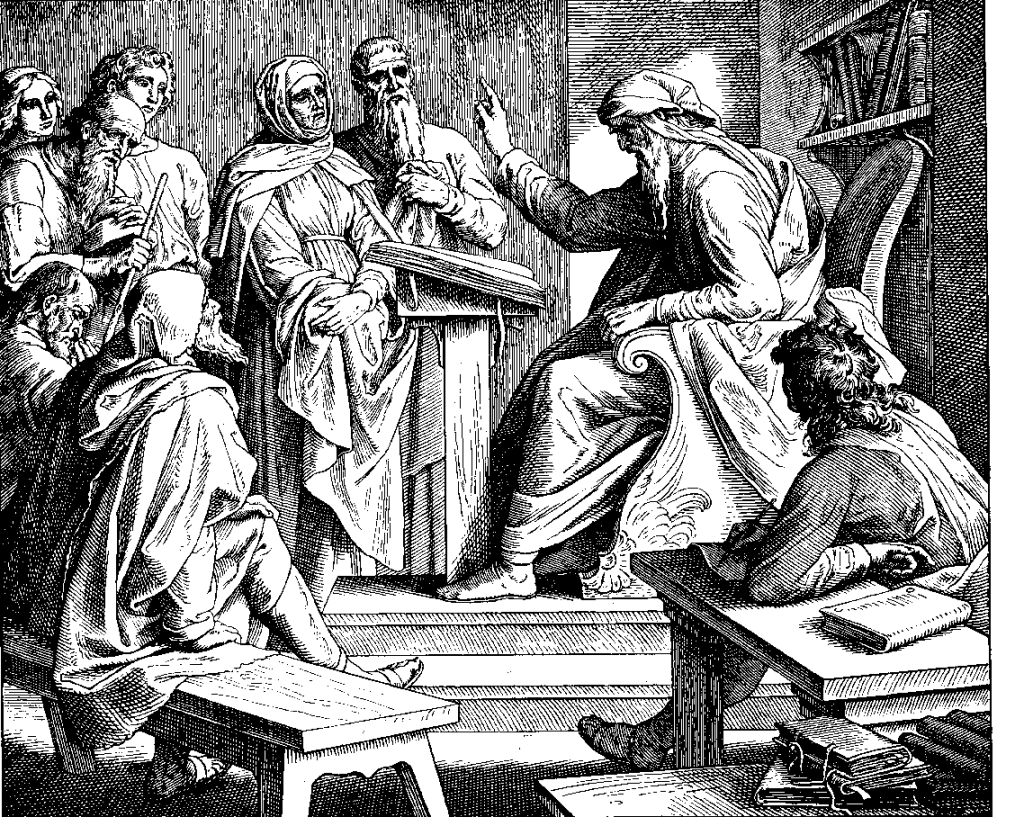
    Jesus Ben Sirach, 1860 woodcut by Julius Schnorr von Karolsfeld, from Wikipedia.

    One of the apocryphal books I think is particularly interesting is the book called “The Wisdom of Jesus Ben Sirach.” It has also gone by a couple of other names, such as simply Sirach, Ben Sira, or Ecclesiasticus. It is a sequel of sorts to the wisdom literature in the Old Testament, such as Proverbs (which Ben Sira obviously drew heavily from and modeled his work after) and Ecclesiastes.

    The Background of Sirach: The author of the book was a Jewish sage named Yeshua ben Sira, and the book itself is a compilation and translation of his work into Greek by his grandson. Ben Sira was probably active around 196-175 BC, meaning that his work reflects the period shortly before the Maccabean crisis in Judea. The translation was probably produced between 132-115 BC. The Book of Sirach may have served as a curriculum of sorts for Jewish students to learn traditional wisdom rooted in Jewish piety during a time when there was pressure to conform to encroaching Greek culture and values.

    Sirach’s Influence on the New Testament: There are some very clear echoes of this book that show up in New Testament teaching, with the books of Matthew and James making plentiful references or allusions to it. For example, Jesus’ teaching in the Sermon on the Mount (Matthew 6-7) has some clear echoes: not babbling in prayer = Sirach 7:14; forgiving others so God will forgive you = Sirach 28:2; and storing up heavenly treasure through almsgiving = Sirach 29:7-13.

    In the first chapter of James, the language of how God will never tempt anyone draws on Sirach 15:11-20. The instruction to be “quick to listen and slow to speak” may come from Sirach 5:11. It’s clear that this book of Jewish wisdom was highly influential for Christ and his apostles. Even if they never explicitly cite it as a source, it reflects the kind of Jewish ethical teaching that was commonly valued in their day.

    Sirach is also important as an example of how the Jewish conception of Wisdom as a personified figure (first introduced in Proverbs 8) continued to develop in the time between the Old and New Testaments, to the point where it was almost divinized (see Sirach 24). Ben Sira mentions God sustaining creation by his word and his wisdom — concepts later taken up in the New Testament and applied to Jesus, similarly to the concept of the Logos developed by Philo (another Jewish philosopher) and then utilized in John’s Gospel.

    Worthwhile Content in Sirach: Ben Sira offers many insightful and pithy reflections on various aspects of life, especially on subjects like friendship, navigating the social ladder, managing one’s household, education and trade, moderation and health, justice and ethics, and of course religious piety.

    Among some of the standout quotes for me were: “Fight to the death for truth, and the Lord God will fight for you” (4:28); “Let those who are friendly with you be many, but let your advisers be one in a thousand” (6:6); “A slip on the pavement is better than a slip of the tongue” (20:18); and “Wine and music gladden the heart, but the love of friends is better than either” (40:20).

    Among his advice that remains surprisingly relevant for modern readers, Ben Sira offers excellent perspective on being willing to receive help from doctors and medicines, knowing that God put those on this earth for our benefit, while also praying for healing (38:1-15). Also great is his advice to give charitably to all those in need “for the commandment’s sake” instead of worrying about being duped (29:7-13). And one proverb that was hilariously sassy: “Do not make fun of one who is ill-bred, or your ancestors may be insulted” (8:4)!

    Items of Critique: Not everything Ben Sira says is to be commended, though. He encourages beating unruly slaves (yikes!), and there are a number of intensely misogynistic passages (25:13-26; 26:10-12; 42:9-14). We could do without such opinions as “The birth of a daughter is a loss” (22:3), and “Better is the wickedness of a man than a woman who does good; it is woman who brings shame and disgrace” (42:14).

    While I’m tempted to chalk this up to Ben Sira being a man of his times, some of these sayings are just obviously harsh. In his excellent introduction to the Apocrypha (p. 196), David deSilva mentions that this negativity toward women played a role in later Jewish and Christian interpreters downplaying the book’s authority as a sacred writing, or at least seeking to find its worth in its other passages.

    We should not be surprised, then, at Sirach’s exclusion from canonical status among several parts of the Christian tradition. A few important church fathers argued for its canonicity, including St. Augustine of Hippo, but many others including St. Athanasius and St. Jerome excluded it from the canon while still encouraging its use for devotional reading.

    In many parts of the early church, Sirach was treated a bit like an ancient version of 12 Rules for Life. It was one philosopher’s advice on pursuing the good life, popular as a devotional read among younger disciples, but not widely held as equal to the canonical books.

    If you have an interest in exploring the kinds of Jewish literature that Jesus, his apostles, and the early church almost certainly read from or were at least familiar with, Sirach is one of the apocryphal books I’d say is most worth a full read.

    For an overview of the Apocrypha as a whole, check out my previous post, The Apocrypha in a Nutshell.

  • The Apocrypha in a Nutshell

    The Apocrypha in a Nutshell

    Recently I’ve been working my way through the Apocrypha. If you aren’t familiar with these, they are a collection of Jewish writings composed during the time between the Old and New Testaments (400 BC to the first century AD).

    The term “apocrypha” means “stored away,” from the Greek word for “hidden.” The early church father Origen, for example, used it to refer to books that were to be kept out of public reading in church liturgies. But which books counted as “apocryphal” was something that changed over time and depended on who you asked.

    And it wasn’t based on conspiracies or anything, as if these books were forbidden. They were still read by Christians. But it was often disputed whether they were to be considered divinely inspired and authoritative. On the one hand, you have such theological giants as Augustine of Hippo arguing strongly for their canonicity. On the other, you have some equally respectable figures like Origen, Cyril of Jerusalem, Athanasius, and especially Jerome excluding them from the canon, particularly on the basis that the Jewish people had also excluded them.

    The tricky part is that no ecumenical council of the early church ever definitively settled on a list of the biblical canon. This meant that what could be read liturgically in church as Scripture varied by regional custom, all the way into the days of the Protestant Reformation in the 1500s, when battle lines became more sharply drawn on the Apocrypha.

    Most Protestant Christians land on a negative answer to the question of the Apocrypha’s inspiration, and so we do not view them as equal to the canonical books of Scripture but might still read them for their historical value. A lot of modern English Bible translations have stopped including the Apocrypha (originally to save money on printing!), but you can find them in some editions of the KJV, the NRSV, the ESV, or in Catholic or Orthodox Bibles.

    Roman Catholics, on the other hand, consider the Apocrypha canonical. The Catholic Council of Trent in 1546 firmly decided to make the Apocrypha canonical for Roman Catholics, specifically in response to the Protestant conclusion. Many Eastern Orthodox Christians also affirm the Apocrypha, although their canon lists vary by region.

    In the Anglican tradition, we hold to the view well-summarized by the church father Jerome: that the Apocrypha ought to be read for our instruction and for example, but we do not establish doctrine from them. In other words, broadly speaking, Anglican Christians seek to maintain a respect for the value of the Apocrypha as historical and devotional literature, and as witnesses to the continued faith of Israel between the Testaments, while also acknowledging the doubts which many church fathers expressed about their inspiration. The Anglican communion is one of the only groups within Protestantism that continues to include selections from the Apocrypha in our lectionaries, liturgy, and hymnody.

    So what are the apocryphal books, and what are they about? Here’s a quick overview of each one, for your convenience!


    Tobit: A short story/folk tale about a pious Jew named Tobit living in exile in Assyria. When Tobit falls ill with blindness, he sends his son Tobias to settle a debt with a distant relative. Tobias is unknowingly accompanied by the archangel Raphael in disguise, who leads him on a quest to save the pious maiden Sarah from the demon Asmodeus. Tobias succeeds and marries Sarah, settles his father’s debt, and returns home, where Raphael reveals himself and Tobit pronounces a blessing on his children before passing away in peace. Likely composed sometime between 300 and 175 BC, Tobit seems to have been written both to entertain readers and to inspire respect for traditional Jewish values in the midst of life in exile: family, marrying within the covenant race, respecting the dead, and especially almsgiving. The book’s emphasis on giving alms as a way of ensuring blessing for oneself is paralleled in Dan 4:27, and later echoed in Sirach, the NT (Luke 12:33-34; Acts 10:4; 1 Tim 6:18-19), and early Christian literature like the Didache, the Shepherd of Hermas, and the Epistle of Barnabas. Tobit also displays developments in Jewish angelology in the intertestamental period.

    Judith: A short story in which the land of Judah is besieged by Nebuchadnezzar’s army and its commander, Holofernes, but is saved when the pious widow Judith manages to insinuate herself into Holofernes’ company and behead him while his guard is down. The story, which was probably composed sometime after the Maccabean revolt (167-160 BC), is filled with dramatic irony and clever remixes of earlier biblical stories (such as Jael’s defeat of Sisera in Judges 4). The presence of these riffs on other stories, as well as the many anachronisms in the book (like calling Nebuchadnezzar the king of Assyria rather than Babylon), suggest that it was meant to be read as a historical fiction or parable, perhaps to promote support for the Hasmonean party (the successors of Judas Maccabeus) in Judah against their Gentile enemies. It also promotes the Jewish faith by lampooning the Gentiles (and their gods), who are overthrown in the story by a lowly widow known only for her faithfulness in prayer and her observance of Torah.

    Additions to Esther: The Greek translation of Esther found in the Septuagint texts contains several additional chapters not found in the Hebrew text tradition. These expansions do not change the core story much, but instead serve to make the book more explicitly religious through mentions of God and of the Torah. There are also several places where ancient “historical documents” are added into the text to bolster its historicity. Most of these additional scenes appear to have been composed later than the Hebrew version, and may have been motivated by efforts to secure the book of Esther’s canonical status. (There’s also a cool dream sequence where the struggle between Mordecai and Haman is represented by two dueling dragons. So that’s fun.)

    Wisdom of Solomon: A theological reflection in the form of a fictional address from King Solomon to the rulers of the Gentile world. “Solomon” exhorts them to submit to God’s wisdom, abandon idolatry, and live righteously, or else they will face punishment at the final judgment. The second half of the book uses the plagues of the exodus as an example of the sovereign God’s ability to punish the wicked with the very things they worship, while delivering the righteous. Scholars generally hold that Wisdom of Solomon was composed in the first century BC in Alexandria, Egypt, which had a substantial Jewish population struggling to live amidst their pagan neighbors. This would explain the book’s denunciation of creature worship and its use of Exodus themes. By presenting itself as the testimony of Solomon from beyond the grave, it also ties itself to Israel’s other wisdom literature, such as the Psalms and Proverbs. Wisdom of Solomon significantly develops the concept of a judgment after death more than the OT did, and its depiction of a personified, heavenly Wisdom would later play a role in the church fathers’ explanations of Christ and the Trinity. Wisdom’s presentation of idolatry and God’s general revelation in nature appears to have had a large influence on Paul’s thought in Romans 1-3.

    Sirach (also called Ecclesiasticus, or the Wisdom of Jesus ben Sira): A sequel of sorts to the wisdom literature in the Old Testament, such as Proverbs (which Ben Sira obviously drew heavily from and modeled his work after) and Ecclesiastes. The author of the book was a Jewish sage named Yeshua ben Sira, and the book itself is a compilation and translation of his work into Greek by his grandson. Ben Sira was probably active around 196-175 BC, meaning that his work reflects the period shortly before the Maccabean crisis in Judea. The translation was probably produced between 132-115 BC. Sirach may have served as a curriculum of sorts for Jewish students to learn traditional wisdom rooted in Jewish piety during a time when there was pressure to conform to encroaching Greek culture and values. Many of the ethical teachings in Sirach are echoed in the NT (especially in Matt 6-7 and James 1). However, while much of the advice in Sirach is still quite helpful even today, it does sport a few intensely misogynistic passages (25:13-26; 26:10-12; 42:9-14), which played a role in later Jewish and Christian interpreters downplaying the book’s authority as a sacred writing, or at least seeking to find its worth in its other passages.

    Baruch (and The Letter of Jeremiah): This document purports to be an epistle from Baruch (Jeremiah’s scribe and assistant) to the Jewish people living in exile in Babylon. It divides into three parts: the first section (1:1-3:8) reflects on the destruction of Jerusalem and the exile and includes a prayer of confession affirming God’s covenant justice as prophesied in Deut 28-30. The second section (3:9-4:4) is a poem encouraging the Jewish people to seek the wisdom found in God’s Torah. In the final section (4:5-5:9), a personified Jerusalem gives a poetic lament over her people’s exile but predicts their eventual gathering and return from the east. A sixth chapter, often printed separately as The Letter of Jeremiah, is a scathing denunciation of Gentile idolatry, much like what is found in Jer 10:2-15. Both documents display how Jews in the Second Temple period reflected on their experience of exile and subjugation under the Gentiles in light of biblical prophecy.

    The Prayer of Azariah & the Song of the Three: The first of three apocryphal Greek additions to the book of Daniel, inserted between Daniel 3:23 and 3:24 (the story of the Hebrew youths being thrown into the fiery furnace). This prayer and the following hymn were probably originally composed as separate liturgical pieces to be used in Jewish temple worship, but were placed into the mouths of the three Hebrew men in the fiery furnace, where they take on added theological significance – affirming God’s justice and glory even in the midst of (literal!) fiery trials. The Song of the Three is still used to this day as a canticle (hymn) in the Anglican daily prayer office.

    Susanna: The second addition to Daniel is a short story in which two wicked Jewish elders attempt to trap the beautiful Susanna to have an affair with her, but when she refuses they accuse her of adultery and attempt to have her executed. However, the wise youth Daniel manages to deduce the elders’ trickery and thwart their wicked plot. Susanna has been called the world’s first detective story. Susanna’s decision to obey God even at the risk of her own life continues that central theme of the book of the Daniel, while Daniel’s cleverness highlights the need for discernment even in court cases that seem black-and-white.

    Bel and the Dragon: The third addition to Daniel, in which Daniel uses his wisdom to prove the falseness of Babylon’s idols. In the first scene, he refutes the claim that the statue of Bel is able to eat its sacrifices. In the second, he proves that the king’s “dragon” (or large snake) is not immortal when he manages to kill it. And in the final scene, Daniel in the lion’s den is miraculously fed by the prophet Habakkuk.

    The Prayer of Manasseh: A psalm of confession and repentance associated with Judah’s king Manasseh (ruled 687-642 BC). While 2 Kings 21 presents Manasseh as the most wicked of all Judah’s kings, whose idolatry eventually sealed the nation’s doom, the version of his story told in 2 Chronicles 33 adds that he eventually repented. The idea of God’s mercy being available to even the most wicked sinner in history is highlighted in this beautiful hymn, which praises the Lord as not only the God of the righteous, but “the God of those who repent.”

    1 Maccabees: An account of the Maccabean revolt and the establishment of the Hasmonean dynasty in Jerusalem. When Greek king Antiochus Epiphanes mandates Greek religion and culture in Judah and defiles the Temple, Judas Maccabeus and his brothers wage a guerrilla war for Judean independence and retake Jerusalem. One by one Judas and his brothers give their lives for the cause until the last one standing, Simon, establishes peace and becomes king and high priest of Judah. 1 Maccabees contains many echoes of the OT historical books, indicating that its author believed Simon’s line was providentially given victory in keeping with God’s covenant. It covers the period from 175 BC to around 104 BC, and so was likely written sometime around 100 BC, likely to encourage support of the Hasmonean priestly line. This was in the days of the Greek empire when Alexander the Great’s successors, the Seleucids in Palestine and the Ptolemies in Egypt, were fighting for power, and Rome was flourishing as a republic in the west. Many of these international intrigues play a role in 1 Maccabees.

    2 Maccabees: While its title might suggest that this is a sequel to 1 Maccabees, this work was in fact likely written earlier and thus functions more as a prequel. It gives more detail and embellishment to the stories of Antiochus Epiphanes’ assault on Jerusalem and Judas Maccabeus’ liberation efforts (175 to 167 BC). 2 Maccabees is an abbreviation of a longer account that is lost to history, and its author chooses to highlight the sacredness of the Jerusalem Temple and the bravery of those who died as martyrs rather than assimilate to Greek religion. The account of Judas’ purification of the Temple is the historical basis behind the holiday of Hanukkah (or the “Feast of Dedication” – see John 10:22).

    The Books of Esdras: What is sometimes referred to as 3 Esdras (but in the NRSV and many other editions is called 1 Esdras) is a retelling of the biblical book of Ezra, but with a few additional scenes (including a famous scene where the Jewish leader Zerubbabel wins a contest of wits in the court of King Darius). The book sometimes called 4 Esdras (but often printed as 2 Esdras) is a composite work, most of which dates to the end of the first century AD (contemporaneous with some of the NT). In it, Ezra receives apocalyptic visions of the end of the world and the arrival of the “Son of Man.” It is essentially a Jewish parallel to the NT book of Revelation, which shares similar themes but identifies the Son of Man as Jesus. Thus 4 Esdras, while written too late to have been a direct influence on the NT, nonetheless serves as an example of the kinds of apocalyptic themes and ideas that were circulating among Jews in the first century AD.


    For further reading: My source for most of the information on each book of the Apocrypha is David A. deSilva’s excellent textbook, Introducing the Apocrypha: Message, Context, and Significance, 2nd ed. (Grand Rapids: Baker Academic, 2018).

  • Revelation 3:10 and the Timing of the Rapture

    Revelation 3:10 and the Timing of the Rapture

    What is Jesus promising when he says he’ll keep the faithful Philadelphian Christians from the “hour of testing” (3:10)? Is this talking about a pre-tribulation rapture?


    This is one of the few places in Revelation where some interpreters see a reference to a rapture of Christians before a seven-year great tribulation. Three main lines of evidence are used to support this:

    1) Jesus’ language about an “hour of testing that is going to come on the whole world to test those who live on the earth” is widely agreed to be a reference to the terrifying judgment of God at the end of history. [1]

    2) The specific Greek wording of being “kept from” that “hour” of testing seems to imply total, physical separation from that time period, and not merely spiritual protection through it. [2]

    3) The letters to the seven churches have implications for all Christians everywhere (as I belabored in my previous post), so something of this promise should be relevant to all those “with ears to hear” in any generation. [3]

    On all of these details, I am actually inclined to agree with pre-trib interpreters. But, there’s one interesting little fact that most supporters of a pre-tribulation rapture often miss that really hurts their position, and it’s that the “hour” is not the whole tribulation!

    When Jesus refers to “the hour of testing,” he’s not referring to a seven-year period of tribulation, but to a very limited time at the tail end of the tribulation!

    The tribulation is consistently referred to throughout Revelation with the time-reference “1,260 days,” or three and a half years (Rev 11:3; 12:6, 14; derived from the “half-week” prophecy of Daniel 9:27). Nowhere is it described as an “hour.” In fact, Allen Kerkeslager points out that instances of an “hour” of time in Revelation always refer to the very final day, at the end of the tribulation, when Christ returns and the evil empire of “Babylon” is finally overthrown (Rev 11:11-13; 14:7, 15; 18:10, 17, 19). [4]

    We also see this kind of time reference in the Gospels, where Jesus consistently refers to the time of his actual Second Coming as “that day or that hour” (Matt 24:44, 50; 25:13; Luke 12:39-40, 46; John 5:25). [5] This will be the time when God’s full wrath is vented on unbelievers on the earth, when he overthrows “Babylon” in “a single hour.”

    Believers will be delivered from that horrible day by the post-tribulation rapture, which will happen concurrently with Christ’s descent from heaven at the Second Coming (see Mark 13:24-27; 1 Thes 4:16-17; 1 Cor 15:52).

    Since Christians living in the first century believed that the events leading up to Christ’s return could begin taking place any day, this promise that they would not experience the day of final wrath on the earth was applicable to them just as it is to us should we happen to be alive at the end. The Philadelphian Christians just happened to experience this protection through their physical deaths, which technically is still a form of physical separation from an earthly trial!

    These Christians  — and us, as well — would still have to be faithful through all other trials (including the possibility of imprisonment or martyrdom for their faith, as well as the attacks of the coming Beast and his empire). But these will pale in comparison to the outpouring of God’s full and final wrath on non-believers on the last day of history. That hour of trial we are exempt from, by the grace of God through our faith in Christ.

    All of this information lines up with the fact that elsewhere in Scripture and in Revelation believers are told to endure to the very end, when Christ will appear to the whole world (Matt 24:13; Mark 13:13; 2 Thes 2:1-10; 1 Pet 4:12-13; Rev 7:14; 13:10).

    To sum up: The “hour of testing” is not referring to the whole time of tribulation, but only to the events connected with the very final day of history and the Second Coming, when Christ descends from heaven and God pours out his final wrath on “Babylon” and those who worship the Beast. When Christ promises believers in Rev 3:10 that he will “keep” them from this hour of trial, it is indeed via the rapture, but I’m convinced this will be a post-tribulation rapture!


    [1] See Grant R. Osborne, Revelation, BECNT (Baker, 2002), 193. He calls this the consensus view, and summarizes the usual two pieces of support: the global scope of the trial and the fact that “those who dwell on the earth” is a stock phrase throughout the book for unbelievers who follow the Beast. Osborne takes a post-tribulational view, though.

    [2] See Buist M. Fanning, Revelation, ZECNT (Zondervan, 2020), 177 for some pretty convincing arguments why we shouldn’t see Rev 3:10 as merely referring to spiritual preservation through the tribulation, and why supposed parallels with John 17:15 won’t work.

    [3] Though see Sam Storms’ blog post, “Kept From the Hour of Trial (Revelation 3:10-11),” for an example of the view that Rev 3:10 is in fact a promise only for the first-century Philadelphian church. This used to be my own approach.

    [4] Allen R. Kerkeslager, “The Day of the Lord, the ‘Hour’ in the Book of Revelation, and Rev 3:10,” unpublished paper delivered at the annual 1991 Annual Meeting of the Society of Biblical Literature; cited in G. K. Beale, Revelation, NIGTC (Eerdmans, 1999), 292.

    [5] John Murray, “The Interadventual Period and the Advent: Matthew 24-25,” reprinted in his Collected Writings, Vol. 2 (Banner of Truth Trust, 1996), 394-95; cited in Jonathan Menn, Biblical Eschatology: Second Edition (Resource Publications, 2018), 142-43.

  • The Book of Revelation is a Musical?!

    The Book of Revelation is a Musical?!

    When you’re reading a book of the Bible, one of the easiest mistakes to make is to breeze past the parts that were originally sung. The book of Revelation is a case-in-point. It’s positively teeming with songs — more so than any other book of the New Testament. But what’s the point of all the music?

    Why is John’s Apocalypse, the last book in the Christian canon, a musical?

    Well, okay. I suppose I should admit that technically the term “musical” only refers to modern media forms. According to most sources, a musical is a play or film that uses song to advance the plot or develop the characters. So, since Revelation is a book, it doesn’t fully count.

    But still! The point I want to make today is that the book of Revelation uses songs to advance its plot, just like modern musicals do. The hymnic portions scattered throughout Revelation aren’t there just for show; they develop and enforce the key themes and ideas of the book.

    I’ll explain how below. But first, how do we know which parts were sung?

    Revelation’s Musical Numbers

    Most modern translations will indicate when the original text was meant to be read as poetry or music by indenting the text a little bit and setting it in poetic lines. The CSB translation, for example, has 28 of these poetic sections in Revelation.

    Of these poetic passages, only two are explicitly referred to as songs: the “new song” in 5:9-10, and the “song of Moses and of the Lamb” in 15:3-4. But several others are very clearly songs, too, even if they aren’t labeled as such.

    Other sections that many scholars agree should be seen as hymnic or musical include:

    • The “Holy, Holy, Holy” hymn of the living creatures (4:8).
    • The song of the elders (4:11).
    • The praises of the angelic hosts and every living creature (5:11-13).
    • The song of the elders, redux (11:17-18).
    • “The Accuser of our brothers has been thrown down” (12:10-12).
    • “Just are you, O Holy One” (15:5-7).
    • The final Hallelujahs of heaven (19:1-8).

    These songs are all interspersed throughout the main narrative portion of Revelation (chapters 4-21), and they show up at key turning points throughout the story that unfolds in John’s visions.

    The Message of the Music

    The first songs in Revelation 4:8-11 are hymns of worship to God from the celestial beings around his throne. They focus on God’s holy character and on why he is worthy of worship. We could see these musical numbers as an intro or overture of sorts, setting the musical (and spiritual) tone for what’s to come. They introduce one of the main themes of the book: Only God truly deserves our worship and devotion.

    And as we read the rest of Revelation, we will discover that the book centers around a conflict between those who are competing for this worship! There are enemies — the dragon in the heavens and his minions, the beasts, on the earth — who are trying to lay claim to this worship and this authority. They will be introducing discord into the melody of the book as they accuse God’s people day and night (12:10).

    No wonder, then, that we’re told the angels worship God with hymns day and night (4:8) — they’re trying to drown out the unholy voices of the enemy! This is a musical battle! The heavenly worship is a weapon in a cosmic struggle.[1]

    Revelation’s second musical number (5:9-14) reflects on the first great plot-twist in the book: No one in heaven is worthy to open the scroll in God’s hand, except for the “Lion of the Tribe of Judah” — but this “lion” appears as a sacrificed lamb! The one who is worthy is the one who was slain, and the song explains this further: the Lamb won his victory over evil by laying down his life for God’s people and God’s purposes.

    And so heaven breaks out in praise and cheer for the Lamb (aka Jesus) and, in the surprising conclusion to the song, their worship is shared between the One on the throne and the Lamb! Jesus is shown to be worthy of the same worship as his Father. This musical number expands our vision of the One who is worthy of our worship, and fills out an even bigger picture of why he deserves praise: because of the love and sacrifice he’s shown to redeem his creatures.

    The next three musical numbers all revolve around the highest point of drama and conflict in Revelation — the struggle of God’s kingdom against the earthly kingdoms under the rule of the Dragon/Satan (11:17-18; 12:10-12; 15:1-7). These songs highlight God’s justice and certain victory over evil, even before that victory has been fully realized. It’s as good as done, because the good and holy God is the one who is acting. He is just in bringing destruction back upon those who have been destroying his creation (11:18), and he is faithful to vindicate those who have stayed loyal to him.

    The grand finale comes as the conflict concludes (19:1-8), and it is grand indeed! A string of “Hallelujahs” rings out from a massive crowd in heaven as God overthrows the armies of the Beast and brings about his kingdom on earth at last. Evil is defeated, heaven and earth meet, and Jesus and his people are now able to enjoy the consummation of all their hopes and longings to finally be together forever. Hence, the final lyrics paint the picture of a great wedding banquet — the greatest party in history.

    This musical has a happy ending.

    The Power of Song

    Whether you love musicals or hate them, one thing that can make a good musical so powerful is the emotional effect music has on its listeners.

    When a story is not just told but sung, it stirs up strong feelings and engages an entirely different part of our brains (and souls). It also becomes more memorable (just ask anyone who’s had a song stuck in their head!).  

    Because of these qualities, music also has great power to shape our affections and values. So when the book of Revelation repeatedly highlights its main themes in song form, it’s driving home the values that God wants to cultivate in the book’s readers/hearers.

    (Keep in mind that the books of the New Testament would originally have been read out loud/performed to a listening congregation — which is why Revelation pronounces a blessing on those who “hear” it in 1:3; 22:17-18.)

    As Craig Koester summarizes it,

    “Worship expresses fundamental loyalties and commitments. As the hymns define the character of God, they shape the identities of those who worship him. The divine actions affirmed in the hymns include creation, redemption through sacrifice, and the exercise of justice and truth. By praising these acts of God and the Lamb, the hymns shape the way worshipers see their place in a world where they live with competing claims upon their loyalties, while fostering their hope in God’s kingdom. As the hymns provide a means of expressing faith, they also shape the faith of readers who identify with the worshipers in the narrative.”[2]

    Now, obviously we no longer have the melodies to which these songs were originally sung, nor do we still speak the Koine Greek in which they were originally written.

    But there have been many, many songs inspired by the lyrics in Revelation down through the years (some of them better than others; this one is my personal favorite, though it’s a bit dated now). The sheer volume of contemporary worship lyrics and classic English hymns that have taken wording from Revelation illustrates the power that this book’s poetry has had upon its readers throughout the centuries.

    But besides listening to music inspired by Revelation, another way we can appreciate the book’s musical nature is by taking more time than usual to ponder its song lyrics.

    Read them more meditatively, recognizing that they are very intentional and important to the overall message of the book. Don’t just breeze by them. Sit with them a while. Try to imagine the wonder of hearing these words as a song.

    And consider that there is more focus on beauty than on terror in this last book of the canon.

    See you down the path.


    [1] Sigve K. Tonstad, Revelation, Paideia Commentaries on the New Testament (Grand Rapids: Baker Academic, 2019), 108-09.

    [2] Craig R. Koester, Revelation: A New Translation with Introduction and Commentary, Anchor Yale Bible Commentary, vol. 38A (Yale University, 2014), 130, emphasis added.

  • Was 1 Peter Written to Jews or Gentiles? Why the Answer Matters More Than You Might Think

    Was 1 Peter Written to Jews or Gentiles? Why the Answer Matters More Than You Might Think

    The opening line of 1 Peter identifies it as a letter from “Peter, an apostle of Jesus Christ: To those chosen, living as exiles dispersed abroad in Pontus, Galatia, Cappadocia, Asia, and Bithynia…” (1:1, CSB).

    At first blush, the wording suggests that Peter is addressing ethnically Jewish followers of Jesus. He calls them the “chosen” — Israel was God’s chosen nation in the Old Testament. He refers to them as “exiles” — the Jewish people had been exiled from their homeland by the Babylonians in 586 B.C.E. And when he says they are “dispersed abroad,” the Greek term he uses is “diasporas,” a term used to refer to the scattering of the Jewish people (from which we get the phrase “Diaspora Jews”). 

    And yet, there are some other verses in 1 Peter that seem to suggest the letter was intended for Gentile (non-Jewish) Christians — leading to much debate among commentators.

    In 1:18 Peter writes of how his readers have been redeemed from “your empty way of life inherited from your fathers.” Would Peter really have referred to the Jewish faith he grew up with as an “empty way of life”? And in 4:3, he implies that his readers used to practice “unrestrained behavior, evil desires, drunkenness, orgies, carousing, and lawless idolatry”– hardly the kind of behavior that should characterize good, Torah-observing Jews.

    Scholars have long been divided over the question of 1 Peter’s intended audience, but it seems the majority of classical interpreters took the phrase “exiles dispersed abroad” at face-value, seeing a Jewish audience to be in view. John Calvin is a good representative when he writes in his commentary on 1 Peter:

    “They who think that all the godly are thus called, because they are strangers in the world, and are advancing towards the celestial country, are much mistaken, and this mistake is evident from the word dispersion which immediately follows; for this can apply only to the Jews.” [1]

    In modern times, though, the consensus has shifted. Today most scholars understand 1 Peter to have been written to Gentile Christians. They do so primarily because of verses like 1:18 and 4:3, but also because the regions Peter addresses were largely Gentile territory.


    Does It Make a Difference?

    Why does it matter whether 1 Peter was written primarily to Jewish or Gentile followers of Christ? What difference does it make for interpretation?

    It turns out that if we take 1 Peter as addressing a Gentile audience, then the epistle becomes one of the strongest supports for the theological idea that the church has replaced Israel as the people of God. This concept is also referred to as “replacement theology” or “supersessionism” (i.e. the church supersedes Israel).

    In 1 Peter 2:9, the readers are said to be “a chosen race, a royal priesthood, a holy nation, a people for his possession” — phrases pulled right out of the Hebrew Scriptures as descriptors of the nation of Israel. If Peter is applying this imagery to Gentiles, then as Scot McKnight claims, “There is no passage in the New Testament that more explicitly associates the Old Testament terms for Israel with the New Testament church than this one.” [2]

    But if the original readers of 1 Peter were themselves ethnically Jewish, then Peter’s language is not surprising at all, and it would undercut the use of 1 Peter as a proof-text in support of supersessionism. That’s not to say you couldn’t potentially arrive at a supersessionist theology from other passages, but 1 Peter 2:4-10 is often one of the most important passages in the debate, so it’s worth considering.

    That said, here are four reasons why I believe, against the current consensus, that 1 Peter was originally written to Jewish followers of Jesus.


    Four Lines of Evidence That Point to a Jewish Audience:

    #1: A straightforward reading of 1:1 supports a Jewish audience. 

    As I mentioned above, this is the simplest and best way to make sense of why Peter refers to his readers as the chosen exiles of the Diaspora. This phrasing was enough to convince most pre-modern interpreters of 1 Peter that it was written to ethnic Jews. It’s also the strongest argument for a Jewish readership.

    The term diasporas is only ever applied to ethnic Jews in biblical texts (John 7:35; James 1:1; in the Apocrypha, 2 Maccabees 1:27; Judith 5:19), so if it were taken to mean Gentiles in 1 Peter 1:1, it would have to be a remarkable exception. It certainly wouldn’t be a natural reading of the verse.

    #2: Peter’s critique of their former way of life actually applies quite well to Hellenistic Jews in the Roman Empire.

    Commentators often stress that it’s hard to see the Jewish apostle Peter referring to his Jewish heritage as “former ignorance” (1:14) and an “empty way of life inherited from [the] fathers” (1:18). Funny enough, however, it apparently wasn’t difficult for the apostle Paul (himself also Jewish) to describe Judaism apart from faith in Christ as a life of ignorance (Romans 10:2-3; 1 Timothy 1:13) and a life dominated by sinful desires (Ephesians 2:3). In Philippians 3:2-9, Paul similarly describes all of his Jewish merits as worthless compared to knowing Christ (Philippians 3:2-9).

    What’s more, as Jim R. Sibley points out in his article on this issue, Peter’s critique of the “traditions of the fathers” makes perfect sense if referring to such traditions as those of the Pharisees, which Jesus himself vehemently criticized (Matthew 15:1-9) and which Paul also distanced himself from (Galatians 1:14). [3]

    We know from archaeology that not only was there a substantial Jewish population living in the regions Peter addresses, but they were very much prone to emulate the pagan lifestyle of their Greco-Roman neighbors when it was socially advantageous for them. [4]

    All of this to say that Peter’s language isn’t all that unexpected if referring to a Jewish audience; indeed, it’s all the more powerful for highlighting the need that even the Jewish people have for the redemption available in the Messiah Jesus.

    #3: Peter’s use of Old Testament prophetic imagery points to a Jewish audience.

    Peter alludes to prophecies from Hosea 1-2 to describe his readers in 2:10, and that Old Testament text clearly refers to the Israelites. Hosea speaks of Israel’s abandonment of God and subsequent restoration. If Peter is addressing Jews, then he is not throwing away the original context of Hosea, but is actually demonstrating its fulfillment in the way Jesus of Nazareth is bringing about the promised restoration of his people.

    In 2:25, Peter says that his readers are returning to the Shepherd and Overseer of their souls. If Gentiles were in view, we might expect him to say they were turning to God for the first time, or were returning to their Creator. But the “God as Shepherd” imagery makes better sense if referring to the covenant relationship of God to the Jewish people, since the Hebrew prophets frequently use that metaphor (Psa 80:1; Ezek 34:13-16; Hos 4:16; Zech 11:7).

    #4: Peter explicitly distinguishes his readers from “the Gentiles” (2:12; 4:3-4).

    At various points in the letter, Peter’s readers are exhorted to live holy lives in the sight of the “Gentiles” they live among. As Sibley writes,

    “Those outside of the circle to whom Peter is writing are referred to as ‘Gentiles’ (ἐθνῶν). The pronouns are most significant: ‘You’ are not a part of ‘them’ and ‘they’ are surprised that ‘you’ do not run with ‘them,’ and therefore, ‘they’ malign ‘you.’ It would hardly be possible to draw a sharper contrast between the Gentiles and Peter’s audience. The clear implication is that his audience is comprised of Jewish believers. Since, however, it has been concluded that the audience, though Gentile, is being addressed as the ‘true Israel,’ then the word ‘Gentiles’ is reinterpreted as ‘unbelievers,’ or non-Christians.” [5]

    I put this argument last, however, because there are instances where the apostle Paul felt free to refer to all non-believers as “Gentiles” (1 Corinthians 5:1; Ephesians 4:17; 1 Thessalonians 4:5), so it’s not beyond possibility that Peter did, too. This is part of the reason why commentators have so long debated whether 1 Peter was written to Jews or Gentiles.

    But based on the other three lines of evidence above, it’s more natural to take Peter’s reference to Gentiles as an ethnic distinction first, and a religious distinction only by extension.


    Reading This Jewish Letter as a Gentile Christian Today

    So what’s the upshot of all this? If 1 Peter was written to ethnically Jewish followers of Jesus living in Asia Minor as part of the Diaspora, then what does it have to say as Scripture for Gentile Christians like me?

    The way I look at it, 1 Peter stands as a reminder that what we now know as “Christianity” began as a sect within Judaism. It didn’t start out as a Gentile religion that was totally separate from God’s dealings with the Jewish people. Rather, it was a movement of Jews who had recognized that their Messiah had come, and that the Messianic Age promised in the Hebrew Scriptures was finally dawning.

    Along with the arrival of the Messianic Age came the inclusion of the Gentiles into God’s people as part of the New Covenant. People from all nations were now being grafted into God’s covenant people (see Romans 11). This doesn’t necessarily mean the same thing as saying that an entirely new entity (the church) replaced Israel; it could just as well mean that the availability of becoming members of Israel had broadened. Jewish priority is maintained (as Paul seems to stress in Romans 1:16; 2:9-10).

    Bottom Line: Since 1 Peter was most likely written to an ethnically Jewish audience, it shouldn’t be pressed into service as a linchpin in arguments to support supersessionism. The conversation is much more complex than that. If one wants to read 1 Peter from a supersessionist perspective, the rationale needs to be stronger than just saying, “He’s applying OT terms for Israel to a Gentile audience.”

    Of course, there are all sorts of other issues and passages to consider when constructing one’s theology of Israel and the church. But whatever theological system we adopt, we need to make sure we’re reading 1 Peter with the grain of its Jewish context rather than against it.

    See you down the path.


    Notes:

    [1] John Calvin, Commentary on the Catholic Epistles, accessed from https://www.ccel.org/ccel/calvin/calcom45.iv.ii.i.html.

    [2] Scot McKnight, 1 Peter, NIVAC (Grand Rapids: Zondervan, 1993), 109-10.

    [3] Jim R. Sibley, “You Talkin’ to Me? 1 Peter 2:4-10 and a Theology of Israel,” Southwestern Journal of Theology 59:1 (Fall 2016), 65. Accessed from https://swbts.edu/sites/default/files/images/content/docs/journal/59_1/SWJT%2059.1_Sibley.pdf.

    [4] See the discussion in Ben Witherington III, Letters and Homilies for Hellenized Christians: A Socio-Rhetorical Commentary on 1–2 Peter, vol. 2 (Downers Grove, IL; IVP Academic, 2007), 25–27.

    [5] Sibley, “You Talkin’ to Me?” 66.

  • No One Can Come to Jesus Unless the Father Draws Them: Two Views on Election in John 6

    No One Can Come to Jesus Unless the Father Draws Them: Two Views on Election in John 6

    (Unless otherwise noted, all Scripture quotations are from the CSB).

    In John 6, Jesus makes a number of startling claims. He’s in the middle of a dialogue with a crowd of Jewish people who were denying the claims he was making about himself. Specifically, they struggled to accept that he truly had “come down from heaven” (6:41-42). In response to their unbelief, Jesus says, among other things:

    “Everyone the Father gives me will come to me, and the one who comes to me I will never cast out” (6:37).

    No one can come to me unless the Father who sent me draws him, and I will raise him up on the last day” (6:44).

    “He said, ‘This is why I told you that no one can come to me unless it is granted to him by the Father’” (6:65).

    Why does Jesus tell these people that only those who are drawn by the Father can come to him? Here I’ll do my best to briefly summarize two possible views on this topic.


    Option 1: Unconditional, Individual Election

    Here’s one way we could interpret Christ’s statements: We could see John 6 as teaching that God already decided (unconditionally) that certain people would believe and be saved — and only those people will come to Jesus. Calvinist interpreters, in particular, look to John 6 as a foundational passage for this doctrine of unconditional election. On this reading, people only choose to believe in Jesus because God the Father, before time began, predestined them to do so. And then, at some point during their earthly life, he draws them irresistibly to Jesus.

    Among the details in the passage that might support such a reading are: 1) the intense emphasis on the inability of many in Jesus’ audience to accept his teaching, 2) the fact that Jesus’ words focus on individuals, and 3) the Greek term for “draw” (helkō), which in many contexts refers to a strong action like drawing in a net of fish (John 21:11) or actually dragging someone (Acts 16:19).

    On the other hand, reading John 6 as a timeless affirmation of unconditional election does involve a few difficulties. One is the fact that elsewhere in John’s Gospel, Jesus teaches that every person’s eternal destiny will be based on whether or not they choose to put their faith in him (John 3:18; 5:24). Another is the question of how the “drawing” in John 6 relates to Jesus’ “drawing” (same Greek word) of all people in John 12:32.

    We’re also told in John 3:16 that God loves the whole world (specifically referring, in John’s writings especially, to the world of unbelieving humanity). Holding to a doctrine of unconditional election raises the difficult question of how exactly God’s love extends to the unbelievers he chooses not to draw.

    There have, of course, been numerous thoughtful answers to these questions by Calvinist scholars. Many of them point out that no one would choose salvation unless God first overpowered their rebellious wills, and that his decision to leave some in their sins is to display his just wrath against sin. This is all so that salvation is completely by God’s grace.


    Option 2: The Drawing of Faithful Jews to Jesus as Their Messiah

    Another way we could interpret John 6 is to see it as describing a unique situation in history — namely, the transfer of faithful Israelites under the Mosaic Covenant to their newly-arrived Messiah, Jesus. On this view, the people whom the Father was drawing to Jesus on that particular occasion were those Jewish people who were already faithfully responding to God’s revelation through the Torah and the Prophets.

    Right after Jesus says that no one can come to him unless the Father draws them (6:44), he immediately gives an explanation of what he means: “It is written in the Prophets: And they will all be taught by God. Everyone who has listened to and learned from the Father comes to me ” (6:45, emphasis added).

    Notice the parallel: the Father’s action of drawing people to Jesus is tied to the people’s action of heeding the words of the prophets. So the way Jesus himself explains it, God had already been preparing his people for their Messiah through the proclamation of his word. Those who were being drawn were those who were heeding what the Spirit of God was saying through the Hebrew Scriptures and the teachings of Jesus.

    The problem is, not everyone in Israel was responsive; the majority were not receptive at all. But there was a faithful remnant — we see this exemplified in the disciples (well, except for Judas!) who remained with Jesus because they understood he had “the words of eternal life” and believed (6:68).

    This minority of faithful Jews were the ones the Father drew to their Messiah. He ensured that no one who was responsive to his word missed out on its fulfillment in Jesus. Thus, when we read John 6, we shouldn’t see Jesus as offering philosophical speculations about eternity past; rather, he was addressing the issue of how only those who were receptive to the Father under the Old Covenant would be receptive to their promised Messiah, Jesus, now that he was finally on the scene.

    John’s Gospel in particular is concerned with the question, “Now that the Messiah has come, why did so many Jewish people reject him?” This is a very important topic for John, as he makes clear in his prologue: “he [Jesus] came to his own, and his own people did not receive him” (John 1:11). On the other hand, “But to all who did receive him, who believed in his name, he gave the right to become children of God” (1:12).

    With the arrival of Messiah, a massive shift in history was taking place. God was drawing the faithful remnant of Jews to their Messiah. Related to the salvation of the believing remnant of Israel was the full inclusion of Gentiles, too,  into God’s community. This is why Jesus later stresses that he has “other sheep that are not of this fold,” and he “must bring them also” (10:16). This refers to God-fearing Gentiles — those who, like the remnant of Israel, were already being taught by the Father and learning from him through the Jewish Scriptures.

    Later on in John’s Gospel, Jesus says that he will draw “all people” to himself when he is “lifted up” (12:32). In other words, through Jesus’ atoning work on the cross, the drawing activity of God through his Word/Messiah would be radically extended to include the entire Gentile world (see also the “mystery” Paul refers to in Ephesians 3:1-13). [1]

    In my opinion, this view does a better job of situating Jesus’ teaching firmly within its first-century Jewish context, and better accounts for how John’s Gospel describes the seismic salvation-historical shift that took place in Jesus’ ministry. That’s not to say it’s unquestionably the right view — one could still debate whether God decreed that the remnant would be receptive to the word, and of course other passages that touch on election/predestination have to be considered. But it does mean that John 6 can be faithfully interpreted in a way that coheres with a conditional view of election, without doing injustice to the text.


    Conclusion

    No matter which of these two views you end up taking, they both affirm that God is the one who has made salvation possible — a salvation found only by his grace through Jesus Christ. Faithful Christians can (and should) continue to test their interpretations against Scripture, and hold those interpretations with a gracious and humble attitude.

    Obviously, discussion about the interpretation of John 6 will continue. But I know that some people in my particular circles (within American evangelicalism) have only ever been exposed to Calvinist readings of John 6, so at the very least I hope this post will present a viable alternative they may not have considered.

    What do you think? Which reading do you prefer, and why? Are there some aspects of the alternative view that you hadn’t considered? Let me know in the comments.

    I close with this nice quote from Gerald Borchert’s commentary on John:

    “Salvation is never achieved apart from the drawing power of God, and it is never consummated apart from the willingness of humans to hear and learn from God. To choose one or the other will ultimately end in unbalanced, unbiblical theology. . . . Rather than resolving the tension, the best resolution is learning to live with the tension and accepting those whose theological commitments differ from ours.” [2]

    For more on the topic of election/predestination, check out my previous posts:
    Calvinism & Arminianism: What I Wish Everyone Knew About the Debate
    – Recommended Resources on Calvinism & Arminianism

    See you down the path.


    [1] This statement in John 12 cautions against seeing the “drawing” activity of God as something that leads irresistibly to salvation, since not everyone among the Gentiles will inevitably be saved.

    [2] Gerald L. Borchert, John 1-11, NAC vol 25A (Nashville: Broadman & Holman, 1996), 268-69.